Computational Resources
This section provides information on the
computational resources required to use PROC TRANSREG.
Let
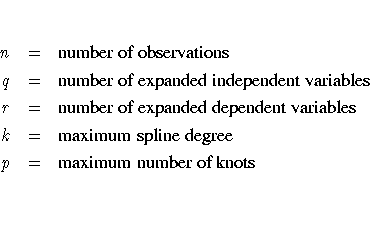
- More than 56(q+r) plus the maximum of the data matrix
size, the optimal scaling work space, and the covariance
matrix size bytes of array space are required.
The data matrix size is 8n(q+r) bytes.
The optimal scaling work space requires
less than 8(6n+(p+k+2)(p+k+11)) bytes.
The covariance matrix size is 4(q+r)(q+r+1) bytes.
- PROC TRANSREG tries to store the original
and transformed data in memory.
If there is not enough memory, a utility data set is used,
potentially resulting in a large increase in execution time.
The amount of memory for the preceding data formulas
is an underestimate of the amount
of memory needed to handle most problems.
These formulas give the absolute
minimum amount of memory required.
If a utility data set is used, and if memory can
be used with perfect efficiency, then roughly the
amount of memory stated previously is needed.
In reality, most problems require at
least two or three times the minimum.
- PROC TRANSREG sorts the data once.
The sort time is roughly proportional to (q+r)n3/2.
- One regression analysis per iteration is required
to compute model parameters (or two canonical
correlation analyses per iteration for METHOD=CANALS).
The time required for accumulating the crossproducts
matrix is roughly proportional to n(q+r)2.
The time required to compute the regression
coefficients is roughly proportional to q3.
- Each optimal scaling is a multiple regression
problem, although some transformations are
handled with faster special-case algorithms.
The number of regressors for the optimal scaling
problems depends on the original values of the
variable and the type of transformation.
For each monotone spline transformation, an unknown
number of multiple regressions is required to find a
set of coefficients that satisfies the constraints.
The B-spline basis is generated twice for each SPLINE
and MSPLINE transformation for each iteration.
The time required to generate the B-spline
basis is roughly proportional to nk2.
Copyright © 1999 by SAS Institute Inc., Cary, NC, USA. All rights reserved.


