
Chapter Contents

Previous

Next
|
Chapter Contents |
Previous |
Next |
| Introduction to Discriminant Procedures |
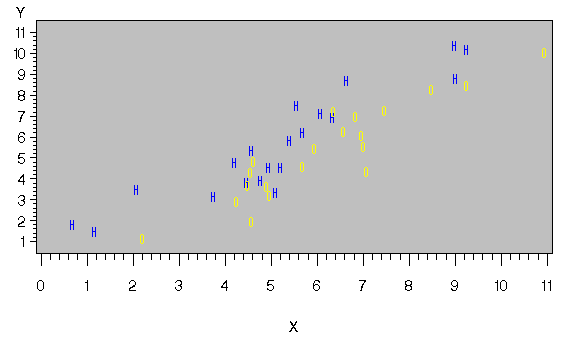
Consider the two classes indicated by `H' and `O' in Figure 7.1. The results are shown in Figure 7.2.
   data random;
      drop n;

      Group = 'H';
      do n = 1 to 20;
         X = 4.5 + 2 * normal(57391);
         Y = X + .5 + normal(57391);
         output;
      end;

      Group = 'O';
      do n = 1 to 20;
         X = 6.25 + 2 * normal(57391);
         Y = X - 1 + normal(57391);
         output;
      end;

   run;

   symbol1 v='H' c=blue;
   symbol2 v='O' c=yellow;
   proc gplot;
      plot Y*X=Group / cframe=ligr nolegend;
   run;

   proc candisc anova;
      class Group;
      var X Y;
   run;
|
|
| |||||||||||||||||||||||||||||||||||||||||||||||||||||||||||||||||||||||||||||||||||||||||
|
| ||||||||||||||||||||||||||||||||||||||||||
|
| |||||||||||||||||||||||||
|
| |||||||||||||||||||||||||||||||||
The univariate R2s are very small, 0.0503 for X and 0.0037 for Y, and neither variable shows a significant difference between the classes at the 0.10 level.
The multivariate test for differences between the classes is significant at the 0.0003 level. Thus, the multivariate analysis has found a highly significant difference, whereas the univariate analyses failed to achieve even the 0.10 level. The Raw Canonical Coefficients for the first canonical variable, Can1, show that the classes differ most widely on the linear combination -1.205756217 X + 1.010412967 Y or approximately Y - 1.2 X. The R2 between Can1 and the class variable is 0.357963 as given by the Squared Canonical Correlation, which is much higher than either univariate R2.
In this example, the variables are highly correlated within classes. If the within-class correlation were smaller, there would be greater agreement between the univariate and multivariate analyses.
|
Chapter Contents |
Previous |
Next |
 Top |
Copyright © 1999 by SAS Institute Inc., Cary, NC, USA. All rights reserved.