Argument Assignment
 Argument Assignment
Linguistics 322
 Lexical Insertion (Lexical
Insertion) does not place the position of each argument in
syntax. We will be able to cover the entire topic here. but lets
start with the simplest construction--an intransitive verb. Let
us start with the following structure:
Lexical Insertion (Lexical
Insertion) does not place the position of each argument in
syntax. We will be able to cover the entire topic here. but lets
start with the simplest construction--an intransitive verb. Let
us start with the following structure:
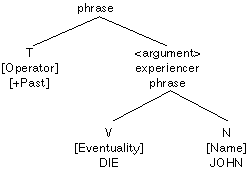
(1)
Recall that arguments are not ordered in proposition structure. Lexical insertion does not assign the order and the exact position of an argument. We may observe that nearly all argument marked for theme are complements of the verb. Let us suppose the following default rule:
(1 ) Theme Assignment
Theme is structurally assigned to complement of the head (predicate) that assigns it.
Rule (1) formally assigns the theme argument to the complement of the verb generating structure (1). Verbs such as die, which are intransitive and assign theme to its argument, are called unaccusative verbs. (see Internal Subject Hypothesis).
There is another kind of intransitive verb--ergative verbs. Ergative verbs assign the theta role agent. Many linguists believe that this argument is assigned to Spec-V or it is adjoined to V--let us call this position the external position. An example of an ergative verb is
(2) John left.
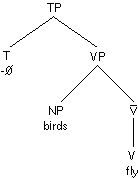
(3) Birds fly.
The difference between unaccusative verbs and ergative verbs in English syntax is subject. In unaccusative verbs the theme argument may follow the verb in some cases:
(4) There blows the noon whistle.
(5) There goes Mary.
(6) There goes the morning train to Paduccah.
(7) There arrived a package at the front door.
(8) *There runs John.
(9) *There dies the bird.
(10) *There walks the neighbor.
One problem arises. The verb go normally assigns agent to its main argument, yet (4) is perfectly fine. Perhaps the verb is focussing on the movement (theme) here as in (5), not on the source of locomotion (agent).
The D-structure for (3) is the following (if other linguists are right):
(11)
 If a verb assigns
an agent and a theme, the theme is assigned to the complement
(direct object) position of the verb--the position that is immediately
to the right of the verb:. The remaining argument (agent) is assigned
to the next position:
If a verb assigns
an agent and a theme, the theme is assigned to the complement
(direct object) position of the verb--the position that is immediately
to the right of the verb:. The remaining argument (agent) is assigned
to the next position:
(12) Bill played cards.
(13)
The first complement is assigned the accusative Case by the verb. The second complement can not be marked for Case by the verb. To satisfy the Case filter and to satisfy the Extended Projection Principle, the agent is adjoined to VP or it is raised to the external argument position (Spec-V) of the verb:
(14)
Bill cannot be assigned Case in this position. T assigns the nominative Case to its left. Therefore, Bill must raise to the subject-of-the-sentence position. Go to Raising.

To return to course outline
Click here.