Raising
 Raising
Linguistics 322
contents: Subject-Predication Principle | Subject as Head | Nominative Case Assignment | Two Arguments
 Let us start this discussion by looking
at the lowered structure proposed in the file on lowering (Lowering). T governs V, and V governs
NP. The features of T are copied to V:
Let us start this discussion by looking
at the lowered structure proposed in the file on lowering (Lowering). T governs V, and V governs
NP. The features of T are copied to V:
(1)
(1) is not an appropriate sentence e of English. Like all sentences of English (with some possible exceptions), a subject is required. Initially, we introduce the following principle (proposed by Chomsky):
(2) The Subject-Predication Principle
All clauses require a subject.
(A verb must be licensed by a subject.)
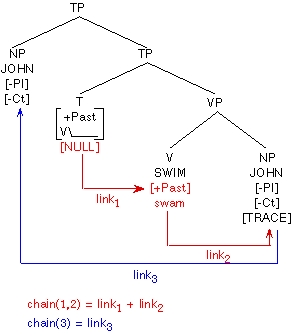
To achieve this goal, the features of the only argument of swim are copied upwards (this process is often called raising) to the subject position. Formerly, in the two level hypotheses, the subject is raised and adjoined to TP (or VP that immediately dominates T):
(3)
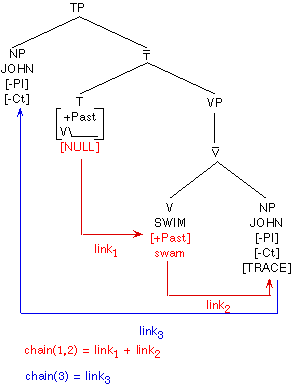
In X-bar theory, VP (TP) dominates V-bar (Ý) which dominates T:
(4)
There appears to be no real or convincing evidence that NP is adjoined to TP to form the subject. This theory works better in the 3-level hypothesis than it does in the 2-level hypothesis. :Let us suppose that the subject is a node generated in the syntactic base; it takes as its argument TP:
(6)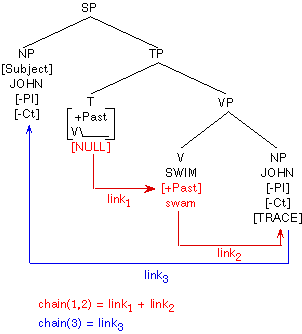
The advantage here is that the position for the subject is generated in the base. No mechanism is required to add an extra position to the structure. The second and more convincing argument is covered in the next section.
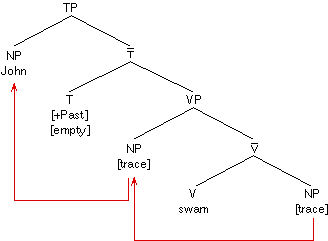
According the Chomsky's theory of tense, tense is divided into two features: [±Tense]. The feature [+Tense], which contains [±Past], assigns the nominative Case (see Case.theory), not to the right, but to the left. Chomsky refers this odd sense of Case-assignment as the exceptional case of Case assignment. Hence in figure (3) or (4), John in situ cannot be assigned Case. In view of this claim, John must raise once again, being adjoined to TP or becoming a sister T-bar:
(7)
In the 3-level X-bar version, the lower TP is T-bar:
(6)
According to Chomsky T assigns the nominative Case to the left to NP in subject position. Now John has Case, the Case filter allows the structures to survive. Note that the feature [+Past] remains in situ as well as in the verb to which and with which it merged. This follows from Chomsky's theory that movement leaves a copy of each node. Under normal conditions, the phonetic information of the original is erased, while it is spelled out in one form or another in its moved-to position. It is the feature [+Past] that assigns the nominative Case to the left.
In the two-level base-subject analysis, which we are adopting here, there is no specifier position. The features of the Caseless NP are copied to the subject position. The first satisfies the Extended Projection Principle.
In the standard theory, Chomsky claims that the nominative class is assigned to the left by [+Tense]. This requires an extension of the theory of government. Furthermore, it is unlike all the other Case assigners which assign Case to the right in right-branching languages (where the complement occurs to the right of the head).
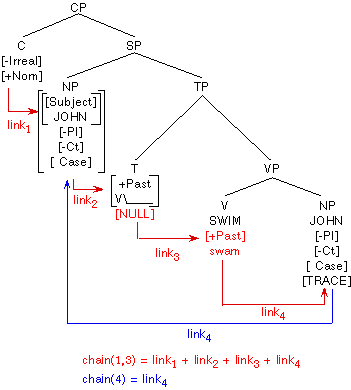
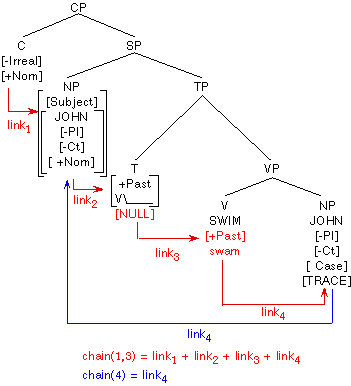
Let us suppose the C (mood, or more specifically, the [-Irreal] mood) assigns the nominative Case to the head of its complement. This idea is not far fetched since there are languages such as Arabic in which C does assign Case to the head of its complement. The complement of C is SP, whose head is the subject. Let us go one step further: suppose that the feature [+Nom] (nominative Case) is generated as part of the indicative mood [-Irreal].
John is not marked for Case by the main verb; only the direct object is governed by the main verb and it thus able to copy Case from the main verb. Let us suppose next that the features of the second argument (John, here) are copied to S:
The case seems to be universal being used to mark subjects of sentences. Note also that the subject governs the abject NP:
(8)
If we adopt the Case feature version Case, the empty Case feature in John (or any subject) is filled with the feature [+Nom]. [-Nom], the unmarked Case is otherwise known as the accusative Case.(see Case.theory). First, all nouns must be marked for Case. This feature is empty in the lexical entry:
(9)
John orthographic form +N, -V Category Number +Count Countable Case
Like number, Case must be filled. If it is not filled, then noun is rendered ungrammatical. The feature [±Pl] is not inherent in nouns. It is an operator whose argument is a noun (see Logical Structure of Noun Agreement). We have proposed above that [+Nom] is a feature of C. Like other instances of agreement, suppose that the Caseless NP agrees with the inherent nominative Case of [-Irreal] by copying the feature of Case:
(10)
John orthographic form +N, -V Category Number +Count Countable +Nom Case
Thus, the following structure is derived:
(11)
If a verb takes two arguments the questions
arises which argument is assigned to the complement of the verb,
and which argument is assigned to the external position (see Argument Assignment). Consider
the following sentence:
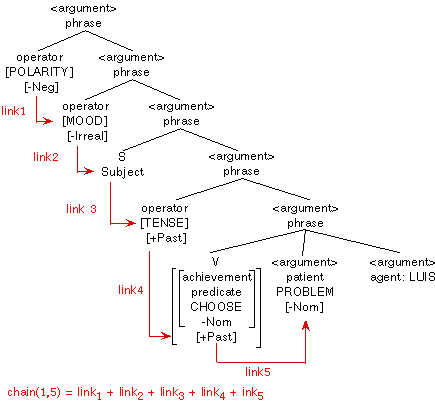
(12) Luis chose a problem.
The logical structure for (8) is the following; the lower verbal operators are omitted for brevity:
(13)
Recall that in argument (logical) structure, there is no linear ordering. The syntax imposes linear ordering. In the next step, the features of [+Past] are copied to the verb, and [-Nom] is copied to the noun. By the theta hierarchy, the theme (the lowest theta-role), is assigned to Comp-V (the first position) and the agent Luis occurs in second position. By a default rule the theme is assigned to Comp-V. Exceptional cases override this default rule:
(10)
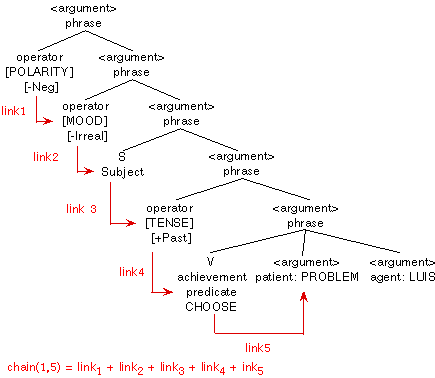
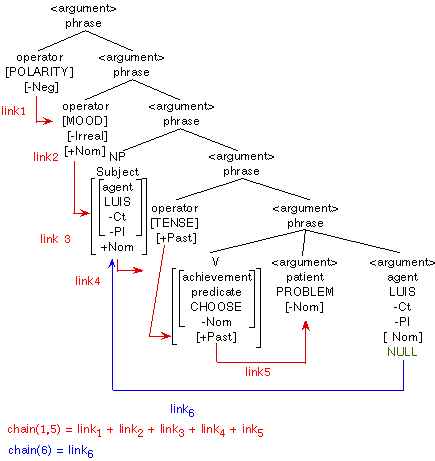
The verb assigns the accusative Case to its complement through copying. However, Luis remains unmarked for Case. To find Case and to satisfy the Extended Projection Principle, the features of LUIS are copied upwards (raised), looking for a suitable position the subject position where the feature [+Nom] is copied to the subject NP:
(11)
The Case filter (*NP, if NP has phonetic form and has no Case) determines that the features of LUIS must be copied upwards to the subject position where the subject NP will be assigned the Nominative Case. But what happens to the TRACE (the tail end of link-6)? Since the Case filter doesn't block phonetically null forms, the TRACE is spelled out as NULL (no phonetic form).
We now have a well-formed sentence representing (8) above.

contents: Subject-Predication Principle | Subject as Head | Nominative Case Assignment | Two Arguments