Mood deals with
speaker's perception of the reality of a proposition. All propositions
must be marked for mood.
Mood deals with
speaker's perception of the reality of a proposition. All propositions
must be marked for mood.Mood
Linguistics 322
Intermediate Syntax
Mood deals with
speaker's perception of the reality of a proposition. All propositions
must be marked for mood.
 The most common mood is the
declarative mood also called the indicative mood. Here, the speaker
quietly asserts the sentence as being true (factual). Whether
or not he is correct is an issue that belongs to real world pragmatics,
not grammatical correctness. The indicative mood in not marked
in matrix clauses. The complementizer is the category that marks
mood. The indicative complementizer is phonetically null in matrix
sentences. In embedded sentences it may be marked with that
or it may be null. In the following sentences that is a
complementizer, not a demonstrative determiner:
The most common mood is the
declarative mood also called the indicative mood. Here, the speaker
quietly asserts the sentence as being true (factual). Whether
or not he is correct is an issue that belongs to real world pragmatics,
not grammatical correctness. The indicative mood in not marked
in matrix clauses. The complementizer is the category that marks
mood. The indicative complementizer is phonetically null in matrix
sentences. In embedded sentences it may be marked with that
or it may be null. In the following sentences that is a
complementizer, not a demonstrative determiner:
(1) John bought a book.
(2) *That John bought a book.
(3) Mary knows John bought a book.
(4) Mary knows that John bought a book.
The null variant is possible only when the embedded clause follows the subcategorizing verbs. In other positions, that is required:
(5) It surprised John that Mary bought a book.
(6) *It surprised John Mary bought a book.
(7) That Mary bought a book surprised John.
(8) *Mary bought a book surprised John.
Mood is assigned the category 'C' (for complementizer). The argument of mood is in old-fashioned syntax S; here we consider it to be a T-proposition ('T' for TENSE). A full proposition contains the semantic content of a sentence which is judged to be true unless otherwise marked. The declarative mood is the default in English (and almost certainly in all natural languages). MOOD is an operator. The declarative mood is unmarked since it is the default. All non-declarative moods are marked by the feature [-Irreal]. The feature [-Irreal] means that the speaker is asserting that the argument of [MOOD [-Irreal]] is true.
The base structure for a sentence of English is now (9) starting with mood:
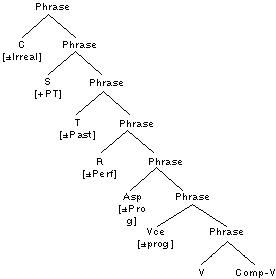
The argument structure for (1) is (10) based on (9):
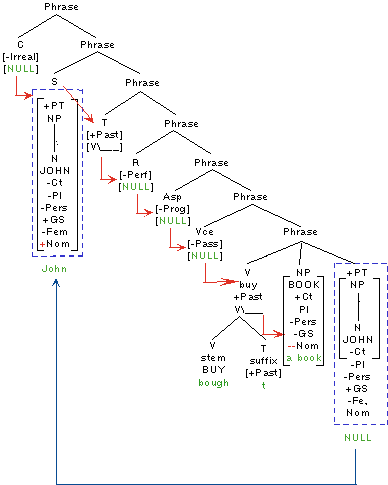
(10) [MOOD [-Irreal]] <SP [S] < [TENSE [+Past]] <[R[-Perf] <Asp[-Prog] <Vce[-Pass]< BUY <theme: A BOOK> <agent: JOHN[+PT] >>
In tree-structure form:
(11)
The feature [+Irreal] means that the speaker is not asserting the argument to be true.
 The first feature
within [+Irreal] that we will analyze is [+Interr]. We consider
interrogative sentences to be one of mood--the interrogative mood.
In questions, the speaker is seeking information whether a proposition
is asserted to be true by the person(s) he asks. Go to questions.
The first feature
within [+Irreal] that we will analyze is [+Interr]. We consider
interrogative sentences to be one of mood--the interrogative mood.
In questions, the speaker is seeking information whether a proposition
is asserted to be true by the person(s) he asks. Go to questions.
 Another common
mood is the conditional mood. It occurs in construction with the
indicative or the imperative mood. Either clause in this construction
is dependent on the conditional clause. The conditional mood is
marked with the complementizer if: The conditional mood
is always an embedded clause. It cannot be a matrix clause:
Another common
mood is the conditional mood. It occurs in construction with the
indicative or the imperative mood. Either clause in this construction
is dependent on the conditional clause. The conditional mood is
marked with the complementizer if: The conditional mood
is always an embedded clause. It cannot be a matrix clause:
The modal marker will indicating futurity amongst other semantic features does not occur in the conditional when futurity is implied, though the consequential indicative clause is marked with will. The indicative clause implies futurity or it has the reading of an epistemic modal must. The epistemic modal must refers to event that is assumed be true, if the condition upon which it is dependent is true as in (5) above. Whether the food is cooking is dependent on whether the stove is on or off.
The conditional mood may be used in the past tense:
Here, the speaker does not know whether it rained yesterday.
An off the shoot
is the negative conditional mood. Here, the complementizer is
unless:
(12) Unless it rains tomorrow, we will go on the picnic.
(12) means
(13) If it doesn't rain tomoarrow, we will go on the picnic.
Uncertain is th acceptability or grammaticality of Unless-contiionals occurring inthe scope of negation:
(14) ?Unless it doesn't rain tomorrow, we won't go on the picnic.
The questionability of the sentence arises from the fact that a simple If-conditional conveys the same message, which is easier for the listener to process:
(15) If it rains tomorrow, we won't go on the picnic.
In all probability, sentential negation (polarity) is distinct from lexical negation, which may have its source elsewhere. We will assume this to be the case without elaboration.
The contrary-to-fact
mood is also marked by if. The marking becomes complicated
because the tense of the verb in the clause is affected. The contrary-to-fact
mood refers to a proposition which is not true as far as the speaker
is concerned:
The us of were with a singular subject marks contrary-to-fact mood amongst those speakers who use it. Other speakers use the normal past tense form:
The use of the present tense form here marks the conditional mood:
In the former sentence, John is not a king. In the latter, it is uncertain whether he is a king, but in the event that is one, the speaker is assuming that he eliminating misery.
If the contrary-to-fact proposition occurs in the logical past tense, the pluperfect construction must b e used:
In this sentence John was never a king.
The imperative mood refers
to a command. In matrix sentence the imperative mood is not marked
by an overt complementizer; it is null. Tense and aspect are absent
in imperative clauses. Sentence intonation is the key marker:
In embedded clauses, the complementizer than marks the imperative mood. Tense and aspect are also absent:
The negative imperative is always formed with the dummy auxiliary verb do:
To formalize the imperative, we need to posit the feature [+Imp] for the imperative mood. Like T (see tense and aspect) Imp requires a host. If lowering is not blocked Imp lowers and adjoins to V. It has no morphological form in English, but it does affect the sentence intonation pattern. [+Imp] originates as C:
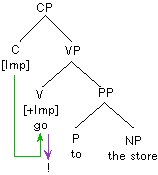
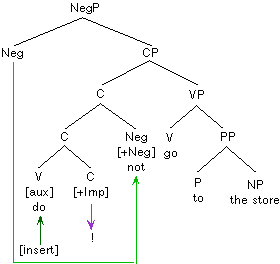
The feature [+Imp] is spelled out as "¡" representing the imperative intonation contour. In the negative imperative, the operator [+Neg] first lowers to [+Imp]. There it blocks the lowering of [+Imp] to V. Being stranded, [+Imp] requires a host. The main verb cannot raise [+Imp]. Hence, the dummy auxiliary verb do is inserted to function as the host by Last Resort:
The hortative
mood refers to a plea; it is not a command. It is often confused
with the imperative mood because both are formed the same in English,
although the hortative is often formed with dummy auxiliary verb
do in the affirmative:
In the negative there is no difference.

To return to course outline
Click here.