Tense,
Relevance, Aspect, and Voice
Linguistics
322
Intermediate
Syntax
 The grammatical
category of tense in English is a bipolar relation based on the
feature [±Past]. [+Past] (the so-called present tense)
refers to any eventuality that occurs before the speech event
(the moment of speaking) and [-Past] to any other eventuality.
The present tense includes eventualities which may happen in the
future. In English, future is not a grammatical category (tense).
Certain modal auxiliaries such as will
and shall point to the future, but they do not
constitute tense.
The grammatical
category of tense in English is a bipolar relation based on the
feature [±Past]. [+Past] (the so-called present tense)
refers to any eventuality that occurs before the speech event
(the moment of speaking) and [-Past] to any other eventuality.
The present tense includes eventualities which may happen in the
future. In English, future is not a grammatical category (tense).
Certain modal auxiliaries such as will
and shall point to the future, but they do not
constitute tense.
 What constitutes
aspect is a matter of definition. Most linguists call the progressive
from in English aspect. The progressive is formed with the auxiliary
verb be and the ending -ing:
What constitutes
aspect is a matter of definition. Most linguists call the progressive
from in English aspect. The progressive is formed with the auxiliary
verb be and the ending -ing:
(!) Henry is reading a book.
In a bipolar
feature system, the progressive is [+Prog], and the non-progressive
is [-Prog]. The non-progressive is unmarked:
(2)
Henry reads a book.
Not all linguists
agree that the perfect is an aspect. The perfect construction
is formed with the auxiliary verb have and a set of endings
which are most frequently -ed
,-t,
-d, or -en:
(3) Henry has read a book.
(4)
Henry has
written an article.
(5)
Henry has
burned his manuscript.
The function
of the perfect is to relate a past action as relevant to the present
or to another eventuality.
Voice is distinct
from tense and aspect. Voice is the most complex construction
conceptually. English has two voices: the active and the passive.
In bipolar terms: [±passive]. Only transitive verbs can
be marked in the passive voice. All verbs with the exception of
a few idioms occur in the active voice. The passive voice is marked
with the auxiliary verb be and the ending -ed
,-t:,
-d, or -en::
(6) The
book was read
by Henry.
(7)
The book was
written by Henry.
(8)
Henry's manuscript was
burned.
Tense, relevance,
aspect, and voice are logical modifiers of the verb. Formally,
they function as operators. Operators have special properties
which may cause features to be copied from a source node to a
target node. (See transformational
processes). There are two types of operators: strong and non-strong
(weak). Strong operators contain the feature [+Strong] which blocks
feature copying downwards (extraction of features). In English
tense operators are non-strong and do not block feature copying
In languages like German, they are strong The question operator
(see sense and reference.htm)
is nearly always strong in English.
Go to question
operator to read about questions in English.
The underlying
from of tense is based on the head T (tense). T may take a VP
as its complement as in sentence (2) repeated here as (9):
- (9) Henry
reads a book.
Up until the late 80's the (surface)
subject occurred a specifier of T. Later we considered it adjoined
to T. We now consider the subject to be the head of the subject
node (S for Subject) (see Subject: Head
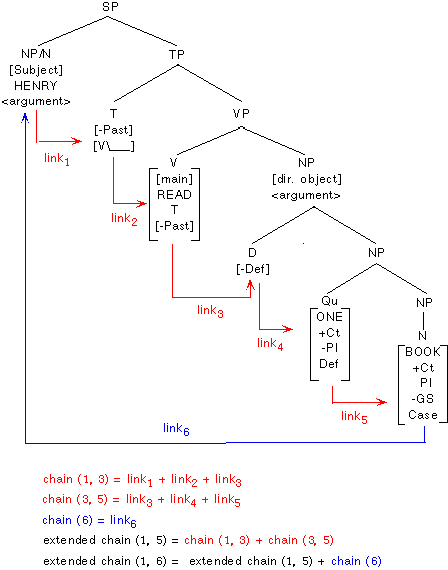
of SP). The features of the subject NP are copied from their
underlying position within VP (see 322.Raising):
Note that there is no phonological
(morphological) form assigned to to T:[-Past] because [-Past]
needs a verbal host. When this happens, the original position
of T is spelled out as NULL. This formed cannot be determined
until T is adjoined to V. It is the host that determines which
class of tense and aspect operators will be adjoined to them.
What follows now is very controversial. We could claim that T
is lowered to the closest acceptable host for tense, which in
this case is V. However, we will claim that the grammatical features
of T are copied to V, which T must govern. V must function as
a host for the grammatical features of tense. Neither NP, N, AP,
A, PP nor P can function as a host for tense in English:
Chomsky rants and raves against
lowering, although he had adopted it in 1989. His solution requires
more machinery that I am prepared to introduced at this point.
At S-structure (surface structure) T is a trace. This is illegal.
A trace cannot c-command its antecedent. It is here where the
problem of lowering occurs. In 1989 Chomsky found a way go get
around this. It involves raising in Logical Form (LF). Raising
in LF is to be covered later. Chomsky, however, has not explicitly
addressed the issue of copying features downward, which we will
do here.
The features of aspect, perfect,
and voice are similarly copied. They too leave illegal traces.
The only problem left is ordering. In English, tense dominates
relevance which dominates progressive which dominates passive:
(10). Tense
> Perfect > Progressive > Passive.
This hierarchy determines the
word order in such a sentence as:
(11). The
students have been being tested for an hour now.
Tense consists
of a binary pair: [±Past]. [+Past] refers to an eventuality
that occurred before the speech event. [-Past] includes the present
and the future as they do not occur before the speech event.
There is one true aspect in English:
the progressive aspect. It consists of a binary pair: [±Prog].
[+Prog] is always spelled out with the suffix '-ing'. [-Prog] has no form. If a sentence
does not contain the auxiliary verb be plus a verb with the suffix
'-ing' it is [-Prog]. [+Prog]
indicates that an eventuality is in progress; it is taking place.
It has not been completed. [-Prog] marks nothing but usually indicates
an eventuality that is not currently taking place.
The perfect is
binary as well: [±Perf]. [+Perf] marks one event as relevant
to another event:
- (12). Have
you finished the paper yet?
- (13). I
haven't finished it yet.
[+Perf] is marked by the non-progressive morpheme and the auxiliary verb
have. [-Perf] is not marked
in English. The lack of the perfect construction signals an eventuality
that is not relevant to any particular point in time (as far as
the speaker is concerned).
Voice is binary
also: [±Pass]. [+Pass] is the feature we use to designate
the passive voice, [-Pass] to designate the active voice. [+Pass]
is marked by the non-progressive morpheme and the auxiliary verb
be. Only transitive verbs
may occur in the passive voice. All verbs occur in the active
voice.
 Relevance
Relevance is grammatical category
of English that marks from the speaker's point of view whether
a targeted clause is relevant to the speech event or to some other
event either prior to or after the speech event. Relavance is
marked by the suffix set {-en, ed, d, t, [NULL]}. Probably more
charfacteristic of this construction the insertion of the dummy
verb HAVE. The binary feature pair of relevance is [±Perf]:
(14) John ate dinner.
(15) John has eaten
dinner.
(14) is [-Perf]. and (15) is
[+Perf]. IOn (15) the speaker is indicating that the eventualtiy
of John eating dinner is relevant to the speech event. If a point
in time marks when John ate dinner, then the speech event cannot
be seen as the target of relevance:
(16) *John has eaten
dinner at 8.
(17) John ate dinner
at 8.
Tense and [+Rel]
All sentences are marked for
tense. We shall claim that all sentences are marked for relevance,
as well. The features of an operator are binary. [-Rel] means
that the referential eventuality is not seen by the speaker as
relevant to the speech event or some other eventuality. In this
case [-Rel] requires no host and is spelled-out as [NULL]. As
we have seen above [+Rel] requires a verbal host. Consider (13)
above again. The tense of the eventuality is [-Past] which requires
a verbal host as does [+Rel].
English contains a parameter
that only one inflectional affix may be added to a stem. Consider
the following diagram:
(19)
Since [+Rel] requires a verbal
host, the feature is copied to the verb. But wh hwat happens to
T which also requires a verbal host? The oarameter block it from
being copied to the verb. In this case, there exist a last
restort strategy. The last resort is to insert a dummy verb,
called an auxiliary verb. As the word implies, a last resort is
used only if other options fail as in this case.
There are three dummy (auxiliary)
verbs in English: do, have, be. One of these is inserted;
here have is selected. Before we cover the selection process
another problems remains. The order of applying the rules that
satisfy the need for a verbal host. If we start from the bottom
(the verb) and go up, the feature [+Rel] is copied first thus
blocking the verb.
However, for reasons that we
will cover later, rules must apply from the first operator and
proceed to each complement of the operator and then to the operator
in the complement if one exists. Assuming this to be the case,
the host feature tense must be satisfied first. Theoretically,
this could go through Relevance and be copied to the verb, thus
blocking the copying of the feture [+Past] to the verb. But this
is what does not happen:
(15). I [-Past]
[+Rel] finish it.
(16). *I had finish
it.
The correct form is:
(17). I have finihsed
it.
(18) The copying
of host features
The features of A are coied
to B iff
a) A requires B
as a host,
b) A c-commands
B, and
c) there is no intervening
node C such that C requires B as a host.
 The
non-progressive morpheme is a set of allomorphs that have a double
function. It is used to from the passive voice or the perfect.
In the former the auxiliary verb be
is used; in the latter the auxiliary verb have
is used:
The
non-progressive morpheme is a set of allomorphs that have a double
function. It is used to from the passive voice or the perfect.
In the former the auxiliary verb be
is used; in the latter the auxiliary verb have
is used:
- (14). John has
bought a new car.
- (15). A new car was
bought by John
- (16). A new car has been bought by
John.
Sentence (16) is marked with
both the perfect and the passive voice. The forms in red are perfect,
the forms in blue are passive.
Chains
If the tail of link A is the
head of link B, then the two links form a chain. Information
(features) is passed through chains. Information does not normally
pass beyond a chain. However, it may become necessary to link
two or more chain together. In such a case we get an extended
chain.

To go to theta roles Click here.
To return to course outline Click
here.
