


STAT 330 Lecture 30
Reading for Today's Lecture: 12.1, 12.2,12.3
Goals of Today's Lecture:
Today's notes
Simple Linear Regression Model:
We assume for each observation a model equation of the form

where
 is the (fixed) value of a covariate.
 is the slope and
  the intercept of a straight line.
 are independent mean 0 errors with constant variance
  .
.
Distribution theory for estimates:
 and
and  minimize

and are given by

and

where

 , of the errors is estimated by


and

and are unbiased:

and


 is an unbiased estimate of
If we also assume that the errors are  then
then
has a normal distribution with mean and variance
 NOTE: in samples where the largest
  is small compared
to
is small compared
to  (most large samples) this normality is approximately true even if
the errors do NOT have a normal distribution.
(most large samples) this normality is approximately true even if
the errors do NOT have a normal distribution. are independent of s.
 has a
has a  distribution on n-2 degrees of freedom.
has a t distribution on n-2 degrees of freedom.
We can use this distribution theory to test hypotheses and give confidence intervals:
Confidence Intervals
The inequality  can be solved as usual to get the
interval
can be solved as usual to get the
interval

This confidence interval, which is exact for normally distributed errors can also be used in large samples for non-normal errors.
Hypothesis Tests
We can test  by computing

and getting P values from t tables. Again this test can be used
in large samples even if the errors are not normal.
The most common value for  is 0. In this case

and

is the F statistic from the ANOVA table.
Residual Plots
After fitting the model you should examine residual plots. The fitted residuals are defined by

You should plot:
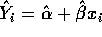 . Look for the
same features as in the previous plot. Note: this plot is more useful in multiple regression.
For simple linear regression this plot is the same as the plot of
. Look for the
same features as in the previous plot. Note: this plot is more useful in multiple regression.
For simple linear regression this plot is the same as the plot of  against x
except for the label on the x axis.
against x
except for the label on the x axis.
An experiment was conducted to relate a variable Y, the production of nitrous oxides to a variable x, the "Burner Area Liberation Rate" (a measure of energy produced per square foot of area of some burner in a power plant). The data are
| x | 100 | 125 | 125 | 150 | 150 | 200 | 200 |
| y | 150 | 140 | 180 | 210 | 190 | 320 | 280 |
| x | 250 | 250 | 300 | 300 | 350 | 400 | 400 |
| y | 400 | 430 | 440 | 390 | 600 | 610 | 670 |
Here is a plot of the data:
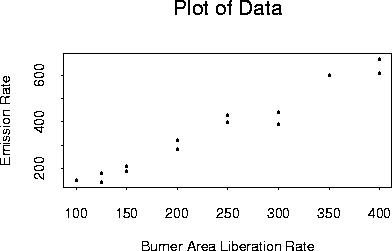
I used SAS to fit the regression model. In particular I used proc glm (glm stands for general linear model). Here is the SAS code:
  options pagesize=60 linesize=80;
  data nox;
  infile 'ch12q9.dat';
  input area emission ;
  proc glm  data=nox;
   model emission = area;
   output out=noxfit p=yhat r=resid ;
  proc univariate data=noxfit plot normal;
   var resid;
  proc plot;
   plot resid*area;
   plot resid*yhat;
  run;
The line labelled model says that I am interested in the effects of area (my shorthand name for ``Burner Area Liberation Rate'') on emissions.
The output from proc glm is
                        The SAS System                                1
                                        10:00 Monday, November 20, 1995

               General Linear Models Procedure

           Number of observations in data set = 14

                        The SAS System                                2
                                        10:00 Monday, November 20, 1995

               General Linear Models Procedure

Dependent Variable: EMISSION
                         Sum of            Mean
Source          DF      Squares          Square     F Value     Pr > F

Model            1   398030.26093    398030.26093    294.74     0.0001

Error           12    16205.45335      1350.45445

Corrected Total 13   414235.71429

      R-Square             C.V.        Root MSE        EMISSION Mean

      0.960879         10.26905       36.748530            357.85714


Source      DF        Type I SS     Mean Square   F Value     Pr > F

AREA         1     398030.26093    398030.26093    294.74     0.0001

Source      DF      Type III SS     Mean Square   F Value     Pr > F

AREA         1     398030.26093    398030.26093    294.74     0.0001


                                  T for H0:    Pr > |T|   Std Error of
Parameter            Estimate    Parameter=0                Estimate

INTERCEPT        -45.55190539          -1.79     0.0989    25.46779420
AREA               1.71143233          17.17     0.0001     0.09968772
The conclusions are that AREA has a very significant and strong effect on emissions, that the intercept of the linear regression might be 0 and that the estimated slope is

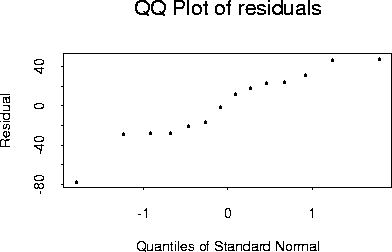
The diagnostic plots show one possible Y outlier at x=300
            Plot of RESID*AREA.  Legend: A = 1 obs, B = 2 obs, etc.
RESID |
      |
   60 +
      |
      |
      |
      |                                    A                       A
      |
   40 +
      |
      |
      |                                                                        A
      |
      |A                       A
   20 +
      |                                    A
      |
      |      A
      |
      |
    0 +            A
      |
      |
      |
      |
      |                        A
  -20 +            A
      |
      |                                                A
      |      A                                                                 A
      |
      |
  -40 +
      |
      |
      |
      |
      |
  -60 +
      |
      |
      |
      |
      |                                                A
  -80 +
      |
      -+-----+-----+-----+-----+-----+-----+-----+-----+-----+-----+-----+-----+
      100   125   150   175   200   225   250   275   300   325   350   375  400
                                         AREA
Here is a Q-Q plot of the residuals
Prediction Intervals
University admissions officers would like to guess a student's GPA at the end of
first year on the basis of her/his high school record. In the simplest case that
high school record might be summarized by x, the high school GPA. The mathematical
version of this problem is that there is a data set of  pairs and a
new individual x for which we desire to guess the corresponding Y. A related,
but different problem is to guess the average first year GPA for a large group
of students whose high school GPA is x.
pairs and a
new individual x for which we desire to guess the corresponding Y. A related,
but different problem is to guess the average first year GPA for a large group
of students whose high school GPA is x.
We will use the following notation.
 is a prediction of the Y value of a new individual.
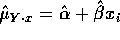
 is the expected value of Y corresponding to a given
x. For simple linear regression
is the expected value of Y corresponding to a given
x. For simple linear regression

If we have fitted a simple linear regression model to our data set, obtaining
estimated slope and intercept then we predict
both the individual and the average of the group using the regression line:

Next lecture we will develop the theory to get an estimate of the
likely size of the prediction error  , a prediction
interval for Y (of the form
, a prediction
interval for Y (of the form  ) and
a standard error and confidence interval for
) and
a standard error and confidence interval for
 .
.