


STAT 350: Lecture 29
Power and Sample Size Calculations
Definition: The power function of a test
procedure in a model
with parameters  is
is 
Definition: The non-central distribution t
with non-centrality
parameter  and degrees of freedom
  is the distribution of

where Z is  , U is
  and Z and U are independent
When
and Z and U are independent
When  we get the usual, or central t distribution.
Fact: If a is a vector of length p and  is some scalar
then
is some scalar
then

has a non-central t distribution with non-centrality parameter

Power of two sided tests from table B 5. Normally
computed before experiment based on assumptions about ,  and
and  .
.
Sample Size determination
Before an experiment is run it is sensible, if the experiment is
costly, to try to work out whether or not it is worth doing. You
will only do an experiment if the probability of Type I and II errors
are both reasonably low.
The simplest case arises when you prespecify a level, say
 and an acceptable probability of Type II error,
 say 0.10, for testing a null hypothesis like
 . Then you need to specify
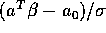 ; this value comes from a physically
motivated understanding of what value of the discrepancy
; this value comes from a physically
motivated understanding of what value of the discrepancy
 would be important
to detect and from some understanding of the roughly what values
might be reasonable for .
would be important
to detect and from some understanding of the roughly what values
might be reasonable for . and then
use each member of that set say m times so that the aggregate sample
size is mk. This gives a non-centrality parameter of the form
and then
use each member of that set say m times so that the aggregate sample
size is mk. This gives a non-centrality parameter of the form

The value n=mk influences both the row in table B.5 which
should be used and the value of . If the solution is large,
however, then all the rows in B.5 at the bottom of the table are very
similar so that effectively only depends on n; we can then
solve for n.
F tests
Simplest example: regression through the origin (no intercept term.)

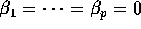

Suppose now that the null hypothesis is false.
 in F.
in F. 
 has the distribution of a
  on n-p degrees of freedom
divided by its degrees of freedom.
on n-p degrees of freedom
divided by its degrees of freedom. 
and rewrite this as

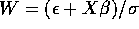 has a multivariate normal
distribution with mean
has a multivariate normal
distribution with mean 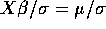 and variance
the identity matrix.
and variance
the identity matrix.
FACT:
If W is a  random vector and Q is
idempotent with rank p then
random vector and Q is
idempotent with rank p then  has a non-central
distribution with non-centrality parameter
has a non-central
distribution with non-centrality parameter

and p degrees of freedom. This is the same distribution as that of

where the  are iid standard normals. An ordinary variable is
called central and has .
are iid standard normals. An ordinary variable is
called central and has .
FACT:
If U and V are independent variables with degrees of freedom
 and
and  , V is central and U is non-central with non-centrality
parameter
, V is central and U is non-central with non-centrality
parameter  then
then

is said to have a non-central F distribution with non-centrality
parameter and degrees of freedom and .
POWER CALCULATIONS
or  .
. is our
  (that is, the square root of what I called the non-centrality parameter
divided by the square root of 1 more than the numerator degrees of freedom.)
(that is, the square root of what I called the non-centrality parameter
divided by the square root of 1 more than the numerator degrees of freedom.)
SAMPLE SIZE CALCULATIONS

To use the table you specify
 (one of 0.2, 0.1, 0.05 or 0.01)
 in notation of table)- must be one of 0.7, 0.8, 0.9 or 0.95
 .
.
Then you look up n.
difficult in practice.
Examples
POWER of t test: SAND and FIBRE example. See Lecture 11
Consider fitting the model

Compute power of t test of  for the alternative
 . (This is roughly the fitted value. In practice,
however, this value needs to be specified before collecting data
so you just have to guess or use experience with previous related
data sets or work out a value which would make a difference
big enough to matter compared to the straight line.)
. (This is roughly the fitted value. In practice,
however, this value needs to be specified before collecting data
so you just have to guess or use experience with previous related
data sets or work out a value which would make a difference
big enough to matter compared to the straight line.)
Need to assume a value for . I take 2.5 - a nice round number
near the fitted value. Again, in practice, you will have to make this
number up in some reasonable way.
Finally 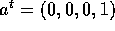 and
and 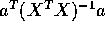 has to be computed.
For the design actually used this is
has to be computed.
For the design actually used this is  . Now
is 2. The power of a two-sided t test at level 0.05
and with 18-4=14 degrees of freedom is 0.46 (from table B 5 page
1346).
. Now
is 2. The power of a two-sided t test at level 0.05
and with 18-4=14 degrees of freedom is 0.46 (from table B 5 page
1346).
Take notice that you need to specify ,  (or
even
(or
even  and ) and the design!
SAMPLE SIZE NEEDED using t test: SAND and FIBRE example.
Now for the same assumed values of the parameters how many replicates
of the basic design (using 9 combinations of sand and fibre contents)
would I need to get a power of 0.95? The matrix for m replicates
of the design actually used is m times the same matrix for 1 replicate. This
means that will be 1/m times the same quantiity for
1 replicate. Thus the value of for m replicates will be
 times the value for our design, which was 2. With m replicates
the degrees of freedom for the t-test will be 18m-6. We now need to
find a value of m so that in the row in Table B 5 across from 18m-6
degrees of freedom and the column corresponding to
times the value for our design, which was 2. With m replicates
the degrees of freedom for the t-test will be 18m-6. We now need to
find a value of m so that in the row in Table B 5 across from 18m-6
degrees of freedom and the column corresponding to

we find 0.95. To simplify we try just assuming that the solution m
is quite large abd use the last line of the table. We get
between 3 and 4 - say about 3.75. Now set  and solve
to find m=3.42 which would have to be rounded to 4 meaning a total
sample size of
and solve
to find m=3.42 which would have to be rounded to 4 meaning a total
sample size of  . For this value of m the non-centrality
parameter is actually 4 (not the target of 3.75 because of rounding)
and the power is 0.98. Notice that for this value of m the degrees of
freedom for error is 66 which is so far down the table that the powers are
not much different from the
. For this value of m the non-centrality
parameter is actually 4 (not the target of 3.75 because of rounding)
and the power is 0.98. Notice that for this value of m the degrees of
freedom for error is 66 which is so far down the table that the powers are
not much different from the  line.
line.
POWER of F test: SAND and FIBRE example.
Now consider the power of the test that all the higher order terms are 0 in the model

that is the power of the F test of  .
.
You will need to specify the non-centrality parameter for this F
test. In general the noncentrality parameter for a F test
based on numerator degrees of freedom is given
by

This quantity needs to be worked out algebraically for each separate case, however, some general points can be made.

and the reduced model as


because we assume that the FULL model is correct.

where  . Replace Y
by its formula
. Replace Y
by its formula  from
the full model equation and take expected value. The answer
is
from
the full model equation and take expected value. The answer
is

where  is the rank of
  . This makes the non-centrality
parameter
. This makes the non-centrality
parameter  .
.