


STAT 350: Lecture 30
Power and Sample Size Calculations: Examples
SAMPLE SIZE NEEDED using t test: SAND and FIBRE example.
Now for the same assumed values of the parameters how many replicates
of the basic design (using 9 combinations of sand and fibre contents)
would I need to get a power of 0.95? The matrix  for m replicates
of the design actually used is m times the same matrix for 1 replicate. This
means that
for m replicates
of the design actually used is m times the same matrix for 1 replicate. This
means that 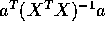 will be 1/m times the same quantity for
1 replicate. Thus the value of
will be 1/m times the same quantity for
1 replicate. Thus the value of  for m replicates will be
 times the value for our design, which was 2. With m replicates
the degrees of freedom for the t-test will be 18m-4. We now need to
find a value of m so that in the row in Table B 5 across from 18m-4
degrees of freedom and the column corresponding to
times the value for our design, which was 2. With m replicates
the degrees of freedom for the t-test will be 18m-4. We now need to
find a value of m so that in the row in Table B 5 across from 18m-4
degrees of freedom and the column corresponding to

we find 0.95. To simplify we try just assuming that the solution m
is quite large and use the last line of the table. We get
between 3 and 4 - say about 3.75. Now set  and solve
to find m=3.42 which would have to be rounded to 4 meaning a total
sample size of
and solve
to find m=3.42 which would have to be rounded to 4 meaning a total
sample size of  . For this value of m the non-centrality
parameter is actually 4 (not the target of 3.75 because of rounding)
and the power is 0.98. Notice that for this value of m the degrees of
freedom for error is 66 which is so far down the table that the powers are
not much different from the
. For this value of m the non-centrality
parameter is actually 4 (not the target of 3.75 because of rounding)
and the power is 0.98. Notice that for this value of m the degrees of
freedom for error is 66 which is so far down the table that the powers are
not much different from the  line.
line.
Technically it would be pretty easy to imagine using 3.5 replicates - each combination of SAND and FIBRE would be tried 7 times giving 63-4=59 degrees of freedom for error. The achieved power would then be quite close to 0.95.
POWER of F test: SAND and FIBRE example.
Now consider the power of the test that all the higher order terms are 0 in the model

that is the power of the F test of  .
.
You will need to specify the non-centrality parameter for this F
test. In general the noncentrality parameter for a F test
based on  numerator degrees of freedom is given
by
numerator degrees of freedom is given
by

This quantity needs to be worked out algebraically for each separate case, however, some general points can be made.

and the reduced model as


because we assume that the FULL model is correct.

where  . Replace Y
by its formula
. Replace Y
by its formula  from
the full model equation and take expected value. The answer
is
from
the full model equation and take expected value. The answer
is

where  is the rank of
  . This makes the non-centrality
parameter
. This makes the non-centrality
parameter  .
.
 is regressed on .
Now consider the sand and fibre example and assume
 ,
,  and
and  .
The following SAS code computes the required numerator.
.
The following SAS code computes the required numerator.
  data plaster;
  infile 'plaster.dat';
  input sand fibre hardness strength;
  newx = -0.004*fibre*fibre -0.005*sand*sand
    +0.001*sand*fibre;
  proc reg  data=plaster;
   model newx = sand fibre ;
  run;
The output shows that the error sum of squares regressing newx on
sand, fibre and an intercept is 31.1875. Taking  to be 7
we get a noncentrality parameter of roughly 4.55. Now compute
the quantity
to be 7
we get a noncentrality parameter of roughly 4.55. Now compute
the quantity  needed for
table B 11. For 3 numerator and 18-6=12 denominator degrees of freedom
we get a power between 0.27 and 0.56 but close to 0.27.
needed for
table B 11. For 3 numerator and 18-6=12 denominator degrees of freedom
we get a power between 0.27 and 0.56 but close to 0.27.
SAMPLE SIZE for F test: SAND and FIBRE example.
Now for the same basic problem and parameter values how many times would we
need to replicate the design to get a power of 0.95? Again the
non-centrality parameter for m replicates is m times that for 1
replicate; in terms of the parameter  used in the tables the
value is proportional to . With m replicates we now have
18m-6 denominator degrees of freedom. Again if 18m-6 is reasonably
large then we can use the line and see that
used in the tables the
value is proportional to . With m replicates we now have
18m-6 denominator degrees of freedom. Again if 18m-6 is reasonably
large then we can use the line and see that  must be
around 2.2 making m roughly 4 (
must be
around 2.2 making m roughly 4 (  ).
).
Table B 12 can be used directly. Table 12 gives values
of n/r where n is the total sample size, the degrees of
freedom in the numerator of the F-test are r-1, the degrees of
freedom for error are n-r and the non-centrality parameter  is given by

If your basic design has  data points and p parameters and your
F test is based on degrees of freedom then when you replicate the
design m times you get
data points and p parameters and your
F test is based on degrees of freedom then when you replicate the
design m times you get  total data points,
  degrees of freedom
for error and degrees of freedom for the numerator of the F test.
degrees of freedom
for error and degrees of freedom for the numerator of the F test.
To use the table take  . Then work out
  by taking
the value of the noncentrality parameter
by taking
the value of the noncentrality parameter  for one replicate of
the basic design and computing
for one replicate of
the basic design and computing

.
Look up n/r in the table and take that to be m. You will be making a small
mistake unless  (which is the case for the overall F test in
the basic ANOVA table). The problem is that you will be pretending you have
(which is the case for the overall F test in
the basic ANOVA table). The problem is that you will be pretending you have
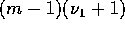 degrees of freeedom for error instead of . As long as
these are both large all is well.
degrees of freeedom for error instead of . As long as
these are both large all is well.
In our example for a power of 0.95 and m replicates of the 18 point design we
have  as above. We have r=3+1=4.
We get
as above. We have r=3+1=4.
We get  . For a level 0.05 test
we then look on page 1362 and get m=5 for a total sample size of 90. The degrees
of freedom for error will really be 84 but the table pretends that the degrees of
freedom for error will be
. For a level 0.05 test
we then look on page 1362 and get m=5 for a total sample size of 90. The degrees
of freedom for error will really be 84 but the table pretends that the degrees of
freedom for error will be 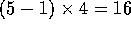 . The latter is pretty small. The
table supposes a small number of error df which would decrease the power of a test.
This means that m=5 is probably an overestimate of the required sample size.
. The latter is pretty small. The
table supposes a small number of error df which would decrease the power of a test.
This means that m=5 is probably an overestimate of the required sample size.
A better answer can be had by looking at replicates of the 9 point design. For
9 data points the nonecntrality parameter would have been  .
This would give
.
This would give  and m of 9 or 10. For m=10 we would have
the same design as before. For m=9 we would have only 72 data points. At this point
you go back to Table B 11 to work out the power properly for 72 or 80 data points and
see if 72 is enough.
and m of 9 or 10. For m=10 we would have
the same design as before. For m=9 we would have only 72 data points. At this point
you go back to Table B 11 to work out the power properly for 72 or 80 data points and
see if 72 is enough.
Heteroscedastic Errors
If plots and/or tests show that the error variances 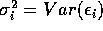 depend on i there are several standard
approaches to fixing the problem, depending on the nature
of the dependence.
depend on i there are several standard
approaches to fixing the problem, depending on the nature
of the dependence.
 and use a technique
called weighted least squares. (See Chapter 10 in the text.)
and use a technique
called weighted least squares. (See Chapter 10 in the text.)
This usually arises realistically in the following situations:
 is an average of
  measurements where you know .
Then
measurements where you know .
Then  .
. might be proportional to some
power of some covariate:
might be proportional to some
power of some covariate:  . Then
 .
.
then
two standard approaches are available:
 for some function g like the logarithm or square root. Then we regress
 on the covariates. This approach sometimes works for skewed
response variables like income; after transformation we occasionally
find the errors are more nearly normal, more homoscedastic and that the
model is simpler. See page 130ff and check under transformations and
Box-Cox in the index.
on the covariates. This approach sometimes works for skewed
response variables like income; after transformation we occasionally
find the errors are more nearly normal, more homoscedastic and that the
model is simpler. See page 130ff and check under transformations and
Box-Cox in the index. 
while generalized linear models use

Generally the latter approach offers more flexibility since it is then possible to model the variance as a general function of the mean while for transformation followed by ordinary least squares the transformed data must follow a homoscedastic linear model.
Weighted Least Squares
If

and

and the errors are independent with normal distributions then the likelihood is

To choose  to maximize this likelihood we minimize the
quantity
to maximize this likelihood we minimize the
quantity

The process is called weighted least squares.
Algebraically it is easy to see how to do the minimization. Rewrite the quantity to be minimized as

This is just an ordinary least squares problem with the response variable being

and the covariates being

The calculation can be written in matrix form. If  is a diagonal
matrix with
is a diagonal
matrix with  in the ith diagonal position then
put
in the ith diagonal position then
put  and
and  . Then

becomes

If  had mean 0, independent entries and
 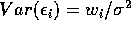 then
then  has mean 0, independent
entries
has mean 0, independent
entries  and
and 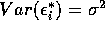 so that ordinary multiple regression theory applies.
The estimate of is
so that ordinary multiple regression theory applies.
The estimate of is

where now  is a diagonal matrix with
  on the
diagonal.
This estimate is unbiased and has variance covariance matrix
on the
diagonal.
This estimate is unbiased and has variance covariance matrix

Example
It is possible to do weighted least squares in SAS fairly easily. As an example we consider using the SENIC data set taking the variance of RISK to be proportional to 1/CENSUS. (Motivation: RISK is an estimated proportion; variance of a Binomial proportion is inversely proportional to the sample size. This makes the weight just CENSUS.
proc reg  data=scenic;
  model Risk = Culture Stay Nratio Chest Facil;
  weight Census;
run ;
EDITED OUTPUT (Complete output)
Dependent Variable: RISK
                        Analysis of Variance
                        Sum of         Mean
  Source       DF      Squares       Square      F Value       Prob>F
  Model         5  12876.94280   2575.38856       17.819       0.0001
  Error       107  15464.46721    144.52773
  C Total     112  28341.41001
      Root MSE      12.02197     R-square       0.4544
      Dep Mean       4.76215     Adj R-sq       0.4289
      C.V.         252.44833
                              Parameter Estimates
                    Parameter      Standard    T for H0:
   Variable  DF      Estimate         Error   Parameter=0    Prob > |T|
   INTERCEP   1      0.468108    0.62393433         0.750        0.4547
   CULTURE    1      0.030005    0.00891714         3.365        0.0011
   STAY       1      0.237420    0.04444810         5.342        0.0001
   NRATIO     1      0.623850    0.34803271         1.793        0.0759
   CHEST      1      0.003547    0.00444160         0.799        0.4263
   FACIL      1      0.008854    0.00603368         1.467        0.1452
EDITED OUTPUT FOR UNWEIGHTED CASE (Complete
output)
Dependent Variable: RISK
                           Analysis of Variance
                              Sum of         Mean
  Source       DF      Squares       Square      F Value       Prob>F
  Model         5    108.32717     21.66543       24.913       0.0001
  Error       107     93.05266      0.86965
  C Total     112    201.37982
      Root MSE       0.93255     R-square       0.5379
      Dep Mean       4.35487     Adj R-sq       0.5163
      C.V.          21.41399
                        Parameter Estimates
                 Parameter      Standard    T for H0:
  Variable  DF      Estimate         Error   Parameter=0    Prob > |T|
  INTERCEP   1     -0.768043    0.61022741        -1.259        0.2109
  CULTURE    1      0.043189    0.00984976         4.385        0.0001
  STAY       1      0.233926    0.05741114         4.075        0.0001
  NRATIO     1      0.672403    0.29931440         2.246        0.0267
  CHEST      1      0.009179    0.00540681         1.698        0.0925
  FACIL      1      0.018439    0.00629673         2.928        0.0042