


If plots and/or tests show that the error variances
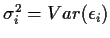 depend on i there are several standard
approaches to fixing the problem, depending on the nature
of the dependence.
depend on i there are several standard
approaches to fixing the problem, depending on the nature
of the dependence.
 and use a technique
called weighted least squares. (See Chapter 10 in the text.)
and use a technique
called weighted least squares. (See Chapter 10 in the text.)
This usually arises realistically in the following situations:
 might be proportional to some
power of some covariate:
might be proportional to some
power of some covariate:
 .
Then
.
Then
 .
.

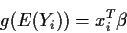
If


![\begin{displaymath}\prod_{i=1}^n \frac{\sqrt{w_i}}{\sqrt{2\pi}\sigma}\exp\left[
-\frac{w_i}{2\sigma^2}(Y_i-x_i^T\beta)^2\right]
\end{displaymath}](img12.gif)
 to maximize this likelihood we minimize the
quantity
to maximize this likelihood we minimize the
quantity
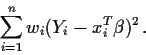
Algebraically it is easy to see how to do the minimization. Rewrite
the quantity to be minimized as
![\begin{displaymath}\sum_{i=1}^n \left[ w_i^{1/2} Y_i - ( w_i^{1/2}x_i)^T\beta\right]^2 \, .
\end{displaymath}](img15.gif)


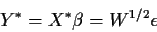
 had mean 0, independent entries and
 then
then
 has mean 0, independent
entries
has mean 0, independent
entries
 and
and
 so that ordinary multiple regression theory applies.
The estimate of
is
so that ordinary multiple regression theory applies.
The estimate of
is
![\begin{displaymath}\hat\beta_w = \left[(X^*)^TX^*\right]^{-1} (X^*)^TY^*
= (X^TWX)^{-1}X^TWY
\end{displaymath}](img24.gif)
![\begin{displaymath}\sigma^2\left[(X^*)^TX^*\right]^{-1} = \sigma^2(X^TWX)^{-1}\, .\end{displaymath}](img25.gif)
It is possible to do weighted least squares in SAS fairly easily. As an example we consider using the SENIC data set taking the variance of RISK to be proportional to 1/CENSUS. (Motivation: RISK is an estimated proportion; variance of a Binomial proportion is inversely proportional to the sample size. This makes the weight just CENSUS.
proc reg  data=scenic;
  model Risk = Culture Stay Nratio Chest Facil;
  weight Census;
run ;
EDITED OUTPUT (Complete output)
Dependent Variable: RISK
                        Analysis of Variance
                        Sum of         Mean
  Source       DF      Squares       Square      F Value       Prob>F
  Model         5  12876.94280   2575.38856       17.819       0.0001
  Error       107  15464.46721    144.52773
  C Total     112  28341.41001
      Root MSE      12.02197     R-square       0.4544
      Dep Mean       4.76215     Adj R-sq       0.4289
      C.V.         252.44833
                              Parameter Estimates
                    Parameter      Standard    T for H0:
   Variable  DF      Estimate         Error   Parameter=0    Prob > |T|
   INTERCEP   1      0.468108    0.62393433         0.750        0.4547
   CULTURE    1      0.030005    0.00891714         3.365        0.0011
   STAY       1      0.237420    0.04444810         5.342        0.0001
   NRATIO     1      0.623850    0.34803271         1.793        0.0759
   CHEST      1      0.003547    0.00444160         0.799        0.4263
   FACIL      1      0.008854    0.00603368         1.467        0.1452
EDITED OUTPUT FOR UNWEIGHTED CASE (Complete
output)
Dependent Variable: RISK
                           Analysis of Variance
                              Sum of         Mean
  Source       DF      Squares       Square      F Value       Prob>F
  Model         5    108.32717     21.66543       24.913       0.0001
  Error       107     93.05266      0.86965
  C Total     112    201.37982
      Root MSE       0.93255     R-square       0.5379
      Dep Mean       4.35487     Adj R-sq       0.5163
      C.V.          21.41399
                        Parameter Estimates
                 Parameter      Standard    T for H0:
  Variable  DF      Estimate         Error   Parameter=0    Prob > |T|
  INTERCEP   1     -0.768043    0.61022741        -1.259        0.2109
  CULTURE    1      0.043189    0.00984976         4.385        0.0001
  STAY       1      0.233926    0.05741114         4.075        0.0001
  NRATIO     1      0.672403    0.29931440         2.246        0.0267
  CHEST      1      0.009179    0.00540681         1.698        0.0925
  FACIL      1      0.018439    0.00629673         2.928        0.0042
Sometimes the response variable will have a distribution which makes it likely that the errors will be not very normal and that the errors will not be homoscedastic. Typical examples:
Example: For each of the doses
 a number of animals
 are treated with the corresponding dose of some drug. The
number, Y, dying at dose d is Binomial with parameter h(d).
are treated with the corresponding dose of some drug. The
number, Y, dying at dose d is Binomial with parameter h(d).
The traditional analysis method is to try transformation:

 .
This is appropriate
whenever we think
is proportional to
.
This is appropriate
whenever we think
is proportional to
 .
.
 .
This is useful
if
.
This is useful
if  is proportional to
  .
.
BIGGEST PROBLEM If the model was linear before transformation then it will not be linear after transformation.