

Reading for Today's Lecture: Chapter 1 and Sections 1, 2 and 3 of Chapter 2 of Mood, Graybill and Boes.
Goals of Today's Lecture:
Today's notes
Course outline:
Standard view of scientific inference has a set of theories which make predictions about the outcomes of an experiment:
| Theory | Prediction |
| A | 1 |
| B | 2 |
| C | 3 |
If we conduct the experiment and see outcome 2 we infer that Theory B is correct (or at least that A and C are wrong).
Add Randomness
| Theory | Prediction |
| A | Usually 1 sometimes 2 never 3 |
| B | Usually 2 sometimes 1 never 3 |
| C | Usually 3 sometimes 1 never 2 |
Now if we actually see outcome 2 we infer that Theory B is probably correct, that Theory A is probably not correct and that Theory C is wrong.
Probability Theory is concerned with constructing the table just given: computing the likely outcomes of experiments.
Statistics is concerned with the inverse process of using the table to draw inferences from the outcome of the experiment. How should we do it and how wrong are our inferences likely to be?
In this course we will be working on Probability for quite a while before we do Statistics.
I am going to begin the course with some very formal mathematical definitions. These definitions need not be memorized and I won't expect you to use them in the homework. I want you to see that the mathematics does not really define the idea of random; instead we just give computational rules which match, we think, our intuitive notion of what probability ought to mean.
Definition: A Probability Space
is an ordered
triple
 .
The idea is that
.
The idea is that  (called the Sample Space) is the set of possible
outcomes of a random experiment,
(called the Sample Space) is the set of possible
outcomes of a random experiment,  is the set of those events, or subsets
of
whose probability is defined and P is the rule for computing probabilities.
[The book uses the jargon Event Space for
but this is not standard and
I won't be using the term.]
Formally:
is the set of those events, or subsets
of
whose probability is defined and P is the rule for computing probabilities.
[The book uses the jargon Event Space for
but this is not standard and
I won't be using the term.]
Formally:
is a set.
is a family of subsets of
with the property that
is a
 -field (or Borel field or -algebra):
 and
are members of .
and
are members of .
is closed under complementation. That is, if A is in (meaning P(A) is defined) then
 is in
(because we want to be able to say
P(Ac)=1-P(A)).
is in
(because we want to be able to say
P(Ac)=1-P(A)).
 are all in
then so is
are all in
then so is
 .
(A is the event that at least one of the Ai happens and we want to be sure that
if each of the Ai has a probability then so does this event A.)
.
(A is the event that at least one of the Ai happens and we want to be sure that
if each of the Ai has a probability then so does this event A.)
and whose range is a subset of
[0,1] which satisfies the axioms for a probability:
 and
and
 .
.
are pairwise disjoint (or mutually exclusive)
( meaning for any 
 )
then
)
then

These axioms guarantee that as we compute probabilities by the usual rules, including
approximation of an event by a sequence of others we don't get caught in any logical
contradictions. The symbol
in the definition of a -field means we allow
countably infinite unions and intersections. The book discusses the situation with only
finite unions and intersections; those examples where we have finite additivity but not
countable additivity are mathematical pathologies, in my view. I won't be discussing such
things.
NOTE: This definition is included principally to make clear that the mathematics of probability theory is not mystical in any way. You may well feel that the definition completely fails to capture the spirit of ``randomness''. The definitions merely provide the rules for manipulating probabilities; they don't provide any intuition. There will be no problems in this course using the definitions just given.
Definition: A real random variable is a function X whose
domain is
and whose range is in the real line R1with the property that

 (that is,
 is in ).
Notation: we will write
 for
for

Idea: defined events in terms of numerical quantities determined by the outcome of a random experiment.
Definition: A Rp- valued random variable X is just
 where
each Xi is a real valued random variable.
where
each Xi is a real valued random variable.
Definition: The Cumulative Distribution Function (or CDF) of a real random variable X
is given by

Definition: The Cumulative Distribution Function (or CDF) of an Rp valued
random variable X
is the function FX on Rpdefined by

Properties of FX (or just F when there's only one CDF under consideration) in the case p=1:
 .
.
 (F is monotone non-decreasing).


 (F is right continuous).
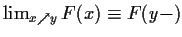 exists (the jargon is that F has
left limits).
exists (the jargon is that F has
left limits).
 for any (Borel) set A.
As an illustration of the role of the axioms of probability I will prove the second and fourth of these assertions.
Proof of 2: Let
 and
and
 .
Let
.
Let
 .
Then an individual
.
Then an individual
 in B must be in either A or C and an
in
either A or C will be in B so
in B must be in either A or C and an
in
either A or C will be in B so  .
If
belongs
to C then it does not belong to A and vice-versa; that is,
.
If
belongs
to C then it does not belong to A and vice-versa; that is,
 .
The second axiom of probability tells us that
.
The second axiom of probability tells us that


 we get
 which ends the proof.
Proof of 4: Here we are assuming that X has values in R;
that is we are assuming that
 .
Let
.
Let
 for
for
 and define


 as I did above.
The third line uses the second axiom in the definition of probability.
The fourth line uses the fact that the definition of an infinite sum
is that it is the limit of partial sums. The fifth line uses
the second axiom for probabilities again but with a finite union.
The sixth line recognizes that if
as I did above.
The third line uses the second axiom in the definition of probability.
The fourth line uses the fact that the definition of an infinite sum
is that it is the limit of partial sums. The fifth line uses
the second axiom for probabilities again but with a finite union.
The sixth line recognizes that if
 then either
 or
or  is between some pair of integers
n-1 and n with
is between some pair of integers
n-1 and n with
 .
The last line is just the definition
of F(m).
.
The last line is just the definition
of F(m).
Definition: The distribution of a random variable X is discrete
(we also call the random variable discrete) if there
is a countable set
 such that

The distribution of a random variable X is absolutely continuous
if there is a function f such that


Notation: Some students will not be used to the notation
 for
a multiple integral. For instance if p=2 and the set A is the disk of radius 1
centered at the origin then
for
a multiple integral. For instance if p=2 and the set A is the disk of radius 1
centered at the origin then

Notation: X is exponential.


Notation: The function

