


Goals of Today's Lecture:
Review of end of last time
I defined independent events and then independent random variables:
Def'n: Ai,
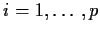 independent:
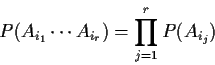
 .
.
Def'n: Rvs
 independent:

 .
.
Theorem:

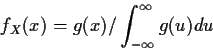
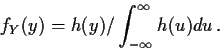
Proof:
 and
and  ;
hence
;
hence

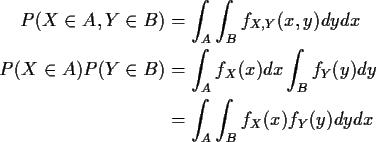

![\begin{displaymath}\int_A\int_B [ f_{X,Y}(x,y) - f_X(x)f_Y(y) ]dydx = 0
\end{displaymath}](img16.gif)
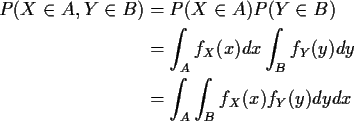


 .
This is proved via a
monotone class argument. The collection of sets Cfor which identity holds has closure properties which guarantee that
this collection includes the Borel sets.
.
This is proved via a
monotone class argument. The collection of sets Cfor which identity holds has closure properties which guarantee that
this collection includes the Borel sets.
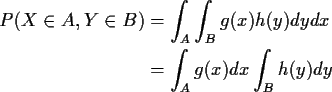
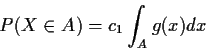
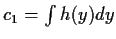 .
So c1 g is the density of X.
Since
.
So c1 g is the density of X.
Since
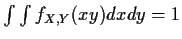 we see that
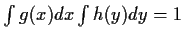 so that
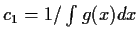 .
Similar argument for Y.
.
Similar argument for Y.
Theorem: If
are independent and
Yi =gi(Xi) then
 are independent.
Moreover,
are independent.
Moreover,
 and
and
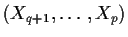 are
independent.
are
independent.
Def'n:
P(A|B) = P(AB)/P(B) if
 .
.
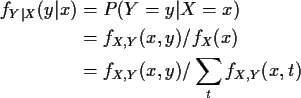
Def'n: For discrete X and Y the conditional
probability mass function of Y given X is
For absolutely continuous X
P(X=x) = 0 for all
x. What is P(A| X=x) or
fY|X(y|x)?
Solution: use limit

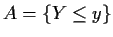 we have
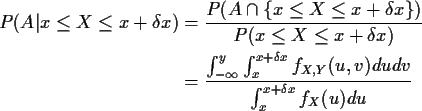
 ;
let
;
let
 .
Denom converges to fX(x); numerator converges to
.
Denom converges to fX(x); numerator converges to



Def'n:
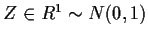 iff
iff
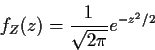
Def'n:
 iff
iff
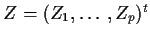 (a column vector for later use) with the
Zi independent and each
(a column vector for later use) with the
Zi independent and each
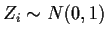 .
.
In this case according to our theorem
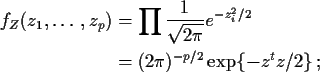
superscript t denotes matrix transpose.
Def'n:  has a multivariate normal distribution if it
has the same distribution as
has a multivariate normal distribution if it
has the same distribution as  for some
 ,
some
,
some
 matrix of constants A and
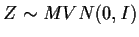 .
.
If the matrix A is singular then X will not have a density. If A is
invertible then we can derive the multivariate normal density
by the change of variables formula:

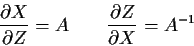

 and notice that



 density. Note density is
the same for all A such that
density. Note density is
the same for all A such that
 .
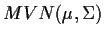
This justifies the notation
.
.
This justifies the notation
.
For which vectors  and matrices
  is this a density?
Any
but if
is this a density?
Any
but if  then
then
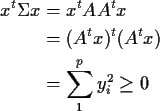
where y=At x. Inequality strict except for y=0 which
is equivalent to x=0. Thus
is a positive definite symmetric
matrix. Conversely, if
is a positive definite symmetric matrix
then there is a square invertible matrix A such that
so that
there is a
distribution. (A can be found
via the Cholesky decomposition, e.g.)
More generally X has multivariate normal distribution
if it has the same distribution as
(no
restriction that A be non-singular). When A is singular X will not
have a density:  such that
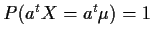 ;
X is confined to a hyperplane. Still
true that the distribution of X depends only on the matrix
:
if
AAt = BBt then
and
;
X is confined to a hyperplane. Still
true that the distribution of X depends only on the matrix
:
if
AAt = BBt then
and
 have the same distribution.
Properties of the MVN distribution
1: All margins are multivariate normal: if
![\begin{displaymath}X = \left[\begin{array}{c} X_1\\ X_2\end{array} \right]
\end{displaymath}](img67.gif)
![\begin{displaymath}\mu = \left[\begin{array}{c} \mu_1\\ \mu_2\end{array} \right]
\end{displaymath}](img68.gif)
![\begin{displaymath}\Sigma = \left[\begin{array}{cc} \Sigma_{11} & \Sigma_{12}
\\
\Sigma_{21} & \Sigma_{22} \end{array} \right]
\end{displaymath}](img69.gif)
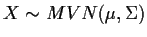 implies
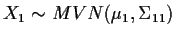 .
.
2: All conditionals are normal: the conditional distribution of X1given X2=x2 is

3:
 :
affine
transformation of MVN is normal.
:
affine
transformation of MVN is normal.
Theorem:
Suppose
 are independent
 random
variables.
Then
random
variables.
Then
 (sample mean)and s2 (sample variance) independent.

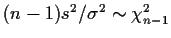
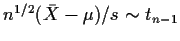
Proof: Let
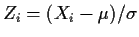 .
Then
.
Then
 are
independent N(0,1) so
is multivariate
standard normal. Note that
are
independent N(0,1) so
is multivariate
standard normal. Note that
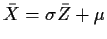 and
and
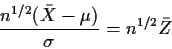
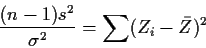
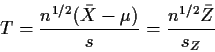
 Thus
Thus
 .
.
So: reduced to  and
and  .
.
Step 1: Define

![\begin{displaymath}Y =\left[\begin{array}{cccc}
\frac{1}{\sqrt{n}} &
\frac{1}{\s...
...in{array}{c}
Z_1 \\
Z_2 \\
\vdots
\\
Z_n
\end{array}\right]
\end{displaymath}](img91.gif)

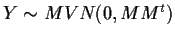 so we need
to compute
MMt:
so we need
to compute
MMt:
![\begin{align*}MM^t & = \left[\begin{array}{c\vert cccc}
1 & 0 & 0 & \cdots & 0 \...
...egin{array}{c\vert c}
1 & 0
\\
\hline
\\
0 & Q
\end{array}\right]
\end{align*}](img94.gif)
Solve for Z from Y:
Zi = n-1/2Y1+Yi+1for
 .
Use the identity
.
Use the identity
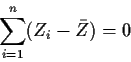
 .
So M
invertible:
.
So M
invertible:
![\begin{displaymath}\Sigma^{-1} \equiv (MM^t)^{-1} =
\left[\begin{array}{c\vert c}
1 & 0
\\
\hline
\\
0 & Q^{-1}
\end{array}\right]
\end{displaymath}](img98.gif)
Now we use the change of variables formula to compute the density
of Y. Let  denote vector whose
entries are
denote vector whose
entries are
 .
Note that
.
Note that

![\begin{align*}f_Y(y) =& (2\pi)^{-n/2} \exp[-y^t\Sigma^{-1}y/2]/\vert\det M\vert
...
...^{-(n-1)/2}\exp[-{\bf y}_2^t Q^{-1} {\bf y_2}/2]}{\vert\det M\vert}
\end{align*}](img102.gif)
Note: ftn of y1 times a
ftn of
.
Thus
 is independent of
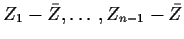 .
Since sZ2 is a function of
we see that
and
sZ2 are independent.
.
Since sZ2 is a function of
we see that
and
sZ2 are independent.
Also, density of Y1 is a multiple of the function of y1 in
the factorization above. But factor is standard normal
density so
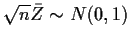 .
.
First 2 parts done. Third part is
a homework exercise. Derivation of the  density:
Suppose
 are independent N(0,1). Define
 distribution to be that of
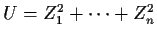 .
Define angles
.
Define angles
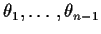 by
by
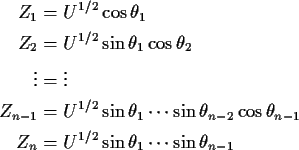
(Spherical co-ordinates in n dimensions. The  values run
from 0 to
values run
from 0 to  except last
from 0 to
except last
from 0 to  .)
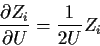
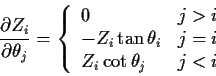
Derivative formulas:
.)
Derivative formulas:
![\begin{displaymath}\left[\begin{array}{ccc}
\frac{\cos\theta_1}{2\sqrt{U}}
&
-U^...
...theta_2
&
U^{1/2} \sin\theta_1\cos\theta_2
\end{array}\right]
\end{displaymath}](img117.gif)
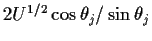 times col 1 to col
j+1 (no change in determinant). Resulting
matrix lower triangular; diagonal entries
times col 1 to col
j+1 (no change in determinant). Resulting
matrix lower triangular; diagonal entries
 ,
,
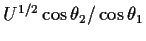 and
and
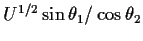 .
We multiply these together to get
.
We multiply these together to get

 ).
For general n we see that every term in the first column contains a factor
U-1/2/2 while
every other entry has a factor U1/2. Multiplying a column in a matrix by c multiplies
the determinant by c so the Jacobian of the transformation is
u(n-1)/2u-1/2/2 times
some function, say h, which depends only on the angles.
Thus the joint density
of
).
For general n we see that every term in the first column contains a factor
U-1/2/2 while
every other entry has a factor U1/2. Multiplying a column in a matrix by c multiplies
the determinant by c so the Jacobian of the transformation is
u(n-1)/2u-1/2/2 times
some function, say h, which depends only on the angles.
Thus the joint density
of
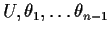 is
is

 .
We see that the answer has
the form
.
We see that the answer has
the form
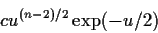

 density is

Fourth part is consequence of
first 3 parts and def'n of  distribution, namely,
 if it has same distribution
as
if it has same distribution
as

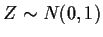 ,
,
 and Z and U are independent.
Derive density of T in this definition:
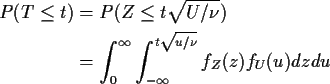
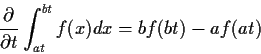
Differentiate wrt t by
differentiating inner integral:
![\begin{displaymath}\frac{d}{dt} P(T \le t) =
\int_0^\infty f_U(u) \sqrt{u/\nu}\frac{\exp[-t^2u/(2\nu)]}{\sqrt{2\pi}} du
\end{displaymath}](img138.gif)

![\begin{displaymath}f_T(t) = \int_0^\infty \frac{(u/2)^{(\nu-1)/2}}{2\sqrt{\pi\nu}\Gamma(\nu/2)}
\exp[-u(1+t^2/\nu)/2]du
\end{displaymath}](img140.gif)
 ,
,
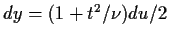 ,
and
,
and
![$(u/2)^{(\nu-1)/2}= [y/(1+t^2/\nu)]^{(\nu-1)/2}$](img143.gif) :
:

