Reading: Ch. 1, 2 and 4 of Casella and Berger.
Goals of Today's Lecture:
Today's notes
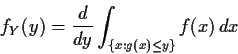
So far: defined probability space, real and vector valued random variables cdfs in R1 and Rp, discrete densities and densities for random variables with absolutely continuous distributions.
Started distribution theory: for Y=g(X) with X and Y
each real valued
![\begin{eqnarray*}P(Y \le y) & = & P(g(X) \le y)
\\
& = & P(X \in g^{-1}(-\infty,y])
\\
& = & P(X \in \{x: g(x) \le y\} )
\end{eqnarray*}](img2.gif)
Method 2: Change of variables.
Assume g is one to one.
I do: g is increasing and differentiable.
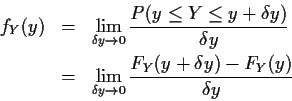
Interpretation of density (based on density =  ):
):


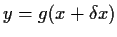 .
The interval is narrow so fY is
nearly constant and
.
The interval is narrow so fY is
nearly constant and



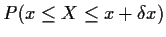 gives
gives


 in the limit
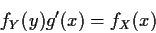


Remark: For g decreasing
 but Then
the interval
but Then
the interval
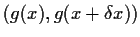 is really
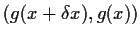 so
that
so
that
 .
In both cases this amounts to the formula
.
In both cases this amounts to the formula

Example:
 or
or

Let  or
or
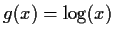 .
Solve
.
Solve  :
:
 or
g-1(y) = ey. Then
or
g-1(y) = ey. Then
 and
and
 Hence
Hence


 and
and
 ;
then,
;
then,

 and scale parameter
  .
(Note: several distributions are called
Extreme Value.)
.
(Note: several distributions are called
Extreme Value.)
Simplest multivariate problem:
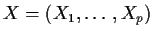 ,
Y=X1 (or in general any Xj).
,
Y=X1 (or in general any Xj).
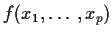 then
then
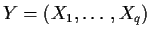 (with q < p) has density

 is the marginal density of
 and fXthe joint density of X but
they are both just densities.
``Marginal'' just to
distinguish from the joint density of X.
and fXthe joint density of X but
they are both just densities.
``Marginal'' just to
distinguish from the joint density of X.
Example The function

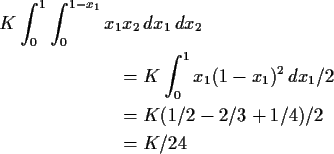
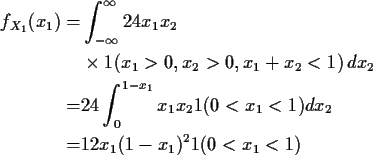
 density.
General problem has
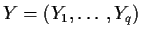 with
with
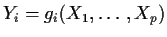 .
.
Case 1: q>p. Y won't have density for ``smooth'' g. Y will have a singular or discrete distribution. Problem rarely of real interest. (But, e.g., residuals have singular distribution.)
Case 2: q=p. We use a change of variables formula which generalizes the one derived above for the case p=q=1. (See below.)
Case 3: q < p.
Pad out Y-add on p-q more variables (carefully chosen)
say
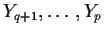 .
Find functions
.
Find functions
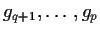 .
Define for
.
Define for  ,
and
,
and
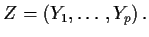 Choose gi so that we can use change of variables on
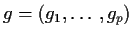 to compute fZ. Find fYby integration:

Suppose
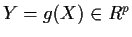 with
with  having density fX.
Assume g is a one to one (``injective") map, that is,
g(x1) = g(x2) if and only if x1 = x2.
Find fY as follows:
having density fX.
Assume g is a one to one (``injective") map, that is,
g(x1) = g(x2) if and only if x1 = x2.
Find fY as follows:
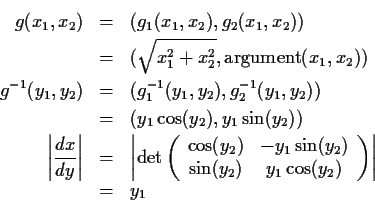
Step 1: Solve for x in terms of y: x=g-1(y).
Step 2: Use basic equation:
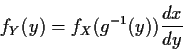
 when p>1:
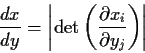
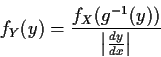
![\begin{displaymath}\left\vert\frac{dy}{dx}\right\vert =
\left\vert \mbox{det} \...
...rac{\partial y_p}{\partial x_p}
\end{array} \right]\right\vert
\end{displaymath}](img63.gif)
Example: The density

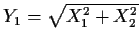 and
and
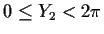 is angle
from the positive x axis to the ray from the origin to the point (X1,X2).
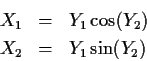
I.e., Y is X in polar co-ordinates.
is angle
from the positive x axis to the ray from the origin to the point (X1,X2).
I.e., Y is X in polar co-ordinates.
Solve for x in terms of y:
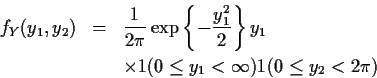
Next: marginal densities of Y1, Y2?
Factor fY as
fY(y1,y2) = h1(y1)h2(y2) where


Then
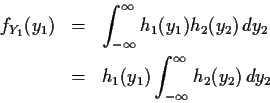
 but in this case



 density.
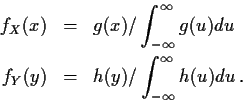
Exercise: W=Y12/2 has standard exponential
distribution. Recall: by definition U=Y12 has a
density.
Exercise: W=Y12/2 has standard exponential
distribution. Recall: by definition U=Y12 has a
 distribution on 2 degrees of freedom. Exercise: find
 density.
Note: We show below factorization of density is equivalent to independence.
So far density of X specified explicitly. Often modelling leads to a specification in terms of marginal and conditional distributions.
Def'n: Events A and B are independent if

 .)
.)
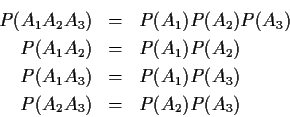
Def'n: Ai,
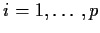 are independent if
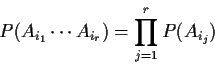
 .
.
Example: p=3
Def'n: X and Y are
independent if

Def'n:
 are
independent if
are
independent if

 .
.
Theorem

 functions
g and h such that
f(x,y) = g(x) h(y)for all (technically almost all) (x,y) then
X and Y are independent; each has density
given by
functions
g and h such that
f(x,y) = g(x) h(y)for all (technically almost all) (x,y) then
X and Y are independent; each has density
given by