


Def'n: The moment generating function of a real valued  is
is
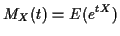
 for which the expected value is finite.
Def'n: The moment generating function of  is
is
![$\displaystyle M_X(u) = E[e^{u^tX}]
$](img5.gif)
 for which the expected value is finite.
Formal connection to moments:
 |
![$\displaystyle = \sum_{k=0}^\infty E[(tX)^k]/k!$](img8.gif) |
|
 |
 and read off the moments of from the coefficients of
 .
.
Theorem: If  is finite for all
![$ t \in [-\epsilon,\epsilon]$](img13.gif) for some
for some
 then
then
is finite.
is  (in fact is analytic).
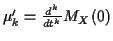 .
.
Note: means has continuous derivatives of all orders. Analytic
means has convergent power series expansion in neighbourhood of each
 .
.
The proof, and many other facts about mgfs, rely on techniques of complex variables.
If
 are independent and
 then
the moment generating function of
then
the moment generating function of  is the product of those
of the individual
is the product of those
of the individual  :
:
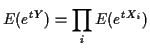
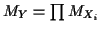 .
.
Note: also true for multivariate .
Problem: power series expansion of  not
nice function of expansions of individual
not
nice function of expansions of individual  .
.
Related fact: first 3 moments
(meaning  ,
,  and
and  ) of are sums of those
of the :
) of are sums of those
of the :
 |
 |
|
 |
 |
|
![$\displaystyle E[(Y-E(Y))^3] =$](img33.gif) |
![$\displaystyle \sum E[(X_i-E(X_i))^3]$](img34.gif) |
![$\displaystyle E[(Y-E(Y))^4] =
\sum \{E[(X_i-E(X_i))^4] -3E^2[(X_i-E(X_i))^2]\}
+ 3 \left\{\sum E[(X_i-E(X_i))^2]\right\}^2\, .
$](img35.gif)
It is possible, however, to replace the moments by other objects called
cumulants which do add up properly. The way to define them relies
on the observation that the log of the mgf of is the sum of the logs
of the mgfs of the . We define the cumulant generating function of a
variable by
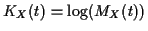
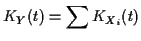
 :
:
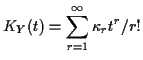
 the cumulants of and observe
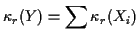
To see the relation between cumulants and moments proceed as follows: the cumulant generating function is
 |
 |
|
![$\displaystyle = \log( 1 + [\mu_1 t +\mu_2^\prime t^2/2 + \mu_3^\prime t^3/3! + \cdots])$](img44.gif) |
![$ [\ldots]$](img45.gif) as
as  and expand

 and collect together like terms.
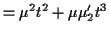
For instance,
and collect together like terms.
For instance,
 |
 |
|
![$\displaystyle \qquad + [2\mu_3^\prime \mu/3! +(\mu_2^\prime)^2/4]t^4 + \cdots$](img51.gif) |
||
 |
 |
|
 |
 |
 occurs only in with
coefficient . The power
occurs only in with
coefficient . The power  occurs in and in
  and so on.
Putting these together gives
and so on.
Putting these together gives
![\begin{multline*}
K(t) =
\\
\mu t + [\mu_2^\prime -\mu^2]t^2/2 \\
+ [\mu_3^\p...
...(\mu_2^\prime)^2 + 12
\mu_2^\prime \mu^2 -6\mu^4]t^4/4! + \cdots
\end{multline*}](img59.gif)
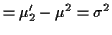
 we see that
 |
 |
|
 |
 |
|
 |
![$\displaystyle = \mu_3^\prime -3\mu\mu_2^\prime +2\mu^3=E[(X-\mu)^3]$](img66.gif) |
|
 |
 |
|
![$\displaystyle = E[(X-\mu)^4]-3\sigma^4$](img69.gif) |
Check the book by Kendall and Stuart (or the new version
called Kendall's Theory of Advanced Statistics by Stuart and Ord)
for formulas for larger orders  .
.
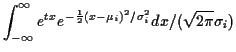
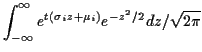
Example: If
are independent and has a
 distribution
then
distribution
then
 |
 |
|
 |
 |
|
|
 |
|
|
 |
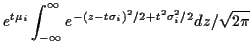
This makes the cumulant generating function

 ,
,
 and every other
cumulant is 0. The cumulant generating function for
is
and every other
cumulant is 0. The cumulant generating function for
is

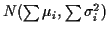 .
.
Example: I am having you derive the moment and cumulant generating function
and all the moments of a Gamma rv. Suppose that
 are independent
 rvs. Then we have defined
 to have a
  distribution. It is easy to check
  has density
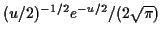
 is
is

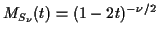
 rv. This shows that the
 distribution has
the Gamma density which is
distribution has
the Gamma density which is

Example: The Cauchy density is

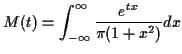
 except for
  where we get 1.
This mgf is exactly the mgf of every distribution
so it is not much use for distinguishing such distributions.
The problem is that these distributions do not have infinitely
many finite moments.
where we get 1.
This mgf is exactly the mgf of every distribution
so it is not much use for distinguishing such distributions.
The problem is that these distributions do not have infinitely
many finite moments.
This observation has led to the development of a substitute for the mgf which is defined for every distribution, namely, the characteristic function.
Definition: The characteristic function of a real rv is
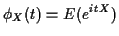
 is the imaginary unit.
Aside on complex arithmetic.
Complex numbers: add
to the
real numbers.
Require all the usual rules of algebra to work.
So:
if  and any real numbers
  and
and  are to be complex numbers then so
must
be
are to be complex numbers then so
must
be  .
.
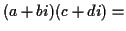
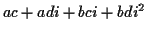
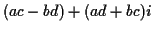
Multiplication:
If we multiply a complex number with and real by
another such number, say  then the usual rules of arithmetic
(associative,
commutative and distributive laws) require
then the usual rules of arithmetic
(associative,
commutative and distributive laws) require
 |
 |
|
|
 |
|
|
 |
Addition: follow usual rules to get

Additive inverses:
 .
.
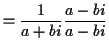
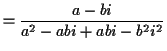
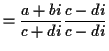
Multiplicative inverses:
 |
 |
|
 |
||
 |
 |
 |
|
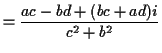 |
 and
and  are real.
Now look at transcendental functions. For real we know
 so
our insistence on the usual rules working means
so
our insistence on the usual rules working means

 . Remember in what follows that
 so
so  ,
, 
 and so on. Then
 |
 |
|
|
 |
|
|
 |
|
 |
||
|
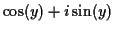 |

Identify  with the
corresponding point
with the
corresponding point  in the plane. Picture the complex numbers
as forming a plane.
in the plane. Picture the complex numbers
as forming a plane.
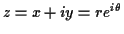
Now every point in the plane can be written in polar co-ordinates as
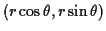 and comparing this with our formula for the
exponential we see we can write
and comparing this with our formula for the
exponential we see we can write
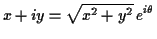
 .
.
Multiplication revisited:
 ,
,
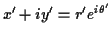 .
.

We will need from time to time a couple of other definitions:
Definition: The modulus of  is
is
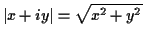
Definition: The complex conjugate of is
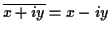 .
.
Some identities:
 and
and
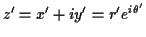 .
.
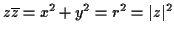
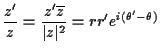
Notes on calculus with complex variables. Essentially the usual rules apply so, for example,

FACT: (not use explicitly in course). If
 is
differentiable then
is
differentiable then  is analytic (has power series expansion).
Definition: The characteristic function of a real rv is
is the imaginary unit.
Since

 and this is precisely the reason for using
characteristic rather than moment generating functions in probability
theory courses.
and this is precisely the reason for using
characteristic rather than moment generating functions in probability
theory courses.
and the following are
equivalent:
and have the same distribution, that is, for any (Borel)
set  we have

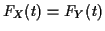 for all .
 for all real .
 such
that for all
such
that for all


and the following are
equivalent:
and have the same distribution, that is, for any (Borel)
set we have
for all .
for all real .
such
that for all
Previous theorem is non-constructive characterization.
Can get from  to
to  or
or  by inversion.
See homework for basic inversion formula:
by inversion.
See homework for basic inversion formula:
If is a random variable taking only integer values then
for each integer 
 |
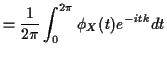 |
|
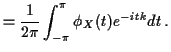 |
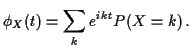
Now suppose that has a continuous bounded density . Define
![$\displaystyle X_n = [nX]/n
$](img170.gif)
![$ [a]$](img171.gif) denotes the integer part (rounding down to the next smallest
integer). We have
denotes the integer part (rounding down to the next smallest
integer). We have
 |
![$\displaystyle P([nX]=k)$](img173.gif) |
|
|
![$\displaystyle \frac{1}{2\pi} \int_{-\pi}^{\pi} \phi_{[nX]}(t)$](img174.gif) |
|
 |
 , and get
![$\displaystyle n P(k/n \le X < (k+1)/n) =\frac{1}{2\pi}
\int_{-n\pi}^{n\pi} \phi_{[nX]}(u/n)e^{iuk/n} du \, .
$](img177.gif)
 we have
![$\displaystyle \phi_{[nX]}(u/n) = E(e^{iu[nX]/n}) \to E(e^{iuX})
$](img179.gif)
 we see that the left hand side converges to
the density
we see that the left hand side converges to
the density  while the right hand side converges to
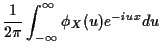
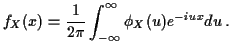
 and so on.
All such formulas are sometimes referred to as Fourier inversion formulas;
the characteristic function itself is sometimes called the Fourier
transform of the distribution or cdf or density of .
MGF and characteristic function related formally:
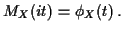 exists this relationship is not merely formal; the
methods of complex variables mean there is a ``nice'' (analytic)
function which is
exists this relationship is not merely formal; the
methods of complex variables mean there is a ``nice'' (analytic)
function which is  for any complex
 for which
  is finite.
SO: there is an inversion formula for using a
complex contour integral:
If  and
and  are two
points in the complex plane and
are two
points in the complex plane and  a path between these two points we
can define the path integral
a path between these two points we
can define the path integral

Do algebra with such integrals via usual theorems of calculus. The Fourier inversion formula was
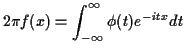
 by we get
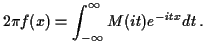
 then we find
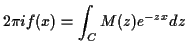 is the imaginary axis.
Methods of complex integration permit us to replace
by any other path which starts and ends at the same place. Sometimes
can choose path to make it easy to do the integral
approximately; this is what saddlepoint approximations are.
Inversion formula is called the inverse Laplace transform; the mgf is
also called the Laplace transform of the distribution or cdf or
density.
is the imaginary axis.
Methods of complex integration permit us to replace
by any other path which starts and ends at the same place. Sometimes
can choose path to make it easy to do the integral
approximately; this is what saddlepoint approximations are.
Inversion formula is called the inverse Laplace transform; the mgf is
also called the Laplace transform of the distribution or cdf or
density.
1): Numerical calculations
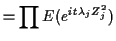
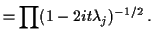
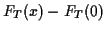
Example: Many statistics have a distribution which is approximately that of

 are iid . In this case
 |
 |
|
 |
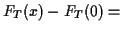 |
 |
|
|
 |
|
 |
![$\displaystyle \phi(t) = \left[\frac{1}{\prod(1-2it\lambda_j)}\right]^{1/2}
$](img208.gif)
![$\displaystyle \phi(t) =
\left[\frac{\prod(1+2it\lambda_j)}{\prod(1+4t^2\lambda_j^2)}\right]^{1/2}
\, .
$](img209.gif)
 is
is
 where
where
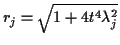 and
and
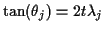 .
This allows us to rewrite
.
This allows us to rewrite
![$\displaystyle \phi(t) = \left[\frac{\prod r_j e^{i\sum\theta_j}}{\prod
r_j^2}\right]^{1/2}
$](img214.gif)
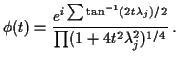

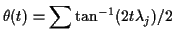
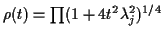 .
But
.
But
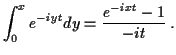
2): The central limit theorem (in some versions) can be deduced from
the Fourier inversion formula:
if
 are iid with mean 0 and variance 1 and
 then with denoting the characteristic function of
a single we have
then with denoting the characteristic function of
a single we have
|
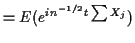 |
|
![$\displaystyle = \left[\phi(n^{-1/2}t)\right]^n$](img223.gif) |
||
![$\displaystyle \approx \left[\phi(0) +\frac{t\phi^\prime(0)}{\sqrt{n}} + \frac{t^2\phi^{\prime\prime}(0)}{2n}+ o(n^{-1})\right]^n \, .$](img224.gif) |
 and
and
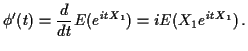
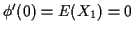 .
Similarly
.
Similarly
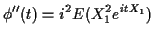
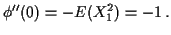
|
![$\displaystyle \approx [1-t^2/(2n) + o(1/n)]^n$](img230.gif) |
|
 |
 |
![$\displaystyle = \frac{1}{2\pi } \int_{-\infty}^\infty e^{-itx} [\phi(tn^{-1/2})]^n dt$](img233.gif) |
|
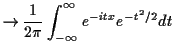 |
||
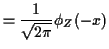 |
 is the characteristic function of a standard normal variable
 . Doing the integral we find
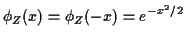
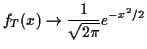
This proof of the central limit theorem is not terribly general
since it requires  to have a bounded continuous density. The central
limit theorem itself is a statement about cdfs not densities and is
to have a bounded continuous density. The central
limit theorem itself is a statement about cdfs not densities and is

3) Saddlepoint approximation from MGF inversion formula
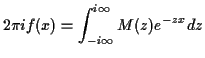
 . (
. ( denotes the real part
of
denotes the real part
of  , that is, when with and real.) Must choose
 so that
 .
Rewrite inversion formula using cumulant generating function
.
Rewrite inversion formula using cumulant generating function
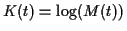 :
:
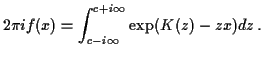
 so we can think of the
integral as being
so we can think of the
integral as being
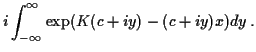
 so that the first derivative
 is a saddlepoint. We get the formula

 . The saddlepoint approximation is
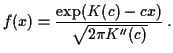
Essentially the same idea lies at the heart of the proof of Sterling's approximation to the factorial function:
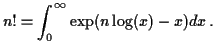
 . For
. For  large
we approximate
large
we approximate
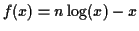 by
by

 to make
 . Then
![$\displaystyle n! \approx \int_0^\infty \exp[n\log(n) - n -
(x-n)^2/(2n)] dx \, .
$](img264.gif)
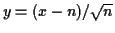 to get the approximation
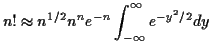
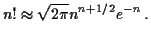
This tactic is called Laplace's method. Note that I am being very sloppy about the
limits of integration; to do the thing properly you have to prove that
the integral over not near is negligible.