Reading for Today's Lecture: Chapter 1 of Casella and Berger.
Goals of Today's Lecture:
Today's notes
Course outline:
Standard view of scientific inference has a set of theories which make predictions about the outcomes of an experiment:
| Theory | Prediction |
| A | 1 |
| B | 2 |
| C | 3 |
If we conduct the experiment and see outcome 2 we infer that Theory B is correct (or at least that A and C are wrong).
Add Randomness
| Theory | Prediction |
| A | Usually 1 sometimes 2 never 3 |
| B | Usually 2 sometimes 1 never 3 |
| C | Usually 3 sometimes 1 never 2 |
Now if we actually see outcome 2 we infer that Theory B is probably correct, that Theory A is probably not correct and that Theory C is wrong.
Probability Theory is concerned with constructing the table just given: computing the likely outcomes of experiments.
Statistics is concerned with the inverse process of using the table to draw inferences from the outcome of the experiment. How should we do it and how wrong are our inferences likely to be?
A Probability Space (sometimes called a Sample Space) is an ordered
triple
 .
The idea is that
.
The idea is that  is the set of possible
outcomes of a random experiment,
is the set of possible
outcomes of a random experiment,  is the set of those events, or subsets
of
whose probability is defined and P is the rule for computing probabilities.
Formally:
is the set of those events, or subsets
of
whose probability is defined and P is the rule for computing probabilities.
Formally:
is a set.
is a family of subsets of
with the property that
is a
 -field (or Borel field or -algebra):
 and
are members of .
and
are members of .
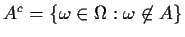
is closed under complementation. That is, if A is in
(meaning P(A) is defined) then
 is in
(because we want to be able to say
P(Ac)=1-P(A))>
is in
(because we want to be able to say
P(Ac)=1-P(A))>
 are all in
then so is
are all in
then so is
 .
(A is the event that at least one of the Ai happens and we want to be sure that
if each of the Ai has a probability then so does this event A.)
.
(A is the event that at least one of the Ai happens and we want to be sure that
if each of the Ai has a probability then so does this event A.)
and whose range is a subset of
[0,1] which satisfies the axioms for a probability:
 and
and
 .
.
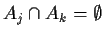
are pairwise disjoint (or mutually exclusive)
( meaning for any 
 )
then
)
then
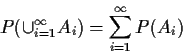
These axioms guarantee that as we compute probabilities by the usual rules, including approximation of an event by a sequence of others we don't get caught in any logical contradictions.
A vector valued random variable is a function X whose domain is
and
whose range is in some p dimensional Euclidean space, Rp with the property that
the events whose probabilities we would like to calculate from their
definition in terms of X are in .
We will write
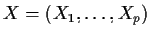 .
We
will want to make sense of
.
We
will want to make sense of

 .
In our formal framework the notation
.
In our formal framework the notation
 ,
defined as
,
defined as
 so that X1 is also a function on .
In almost all of probability and statistics the dependence of a random variable on
a point in the probability space is hidden! You almost always see X not
so that X1 is also a function on .
In almost all of probability and statistics the dependence of a random variable on
a point in the probability space is hidden! You almost always see X not  .
.
Now for formal definitions:
The Borel -field in Rp is the smallest -field in Rp
containing every open ball.
Every common set is a Borel set, that is, in the Borel -field
An Rp valued random variable is a map
 such that
when A is Borel then
such that
when A is Borel then
 .
.
Fact: this is equivalent to

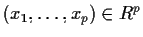 .
.
Jargon and notation: we write  for
for
 and define the distribution of X to be the map
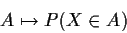 -field rather than
the original
and .
-field rather than
the original
and .
The Cumulative Distribution Function (or CDF) of X is the function FX on Rp
defined by

Properties of FX (or just F when there's only one cdf under consideration):
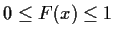 .
.
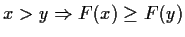 (F is monotone non-decreasing).
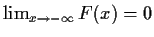
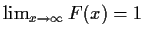
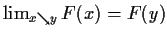 (F is right continuous).
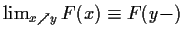 exists.
 for any (Borel) set A.
The distribution of a random variable X is discrete
(we also call the random variable discrete) if there
is a countable set
 such that

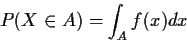
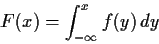
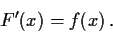
The distribution of a random variable X is absolutely continuous
if there is a function f such that
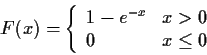
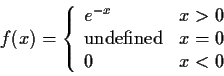
Example: X is exponential.
General Problem: Start with assumptions about the density or cdf of a random
vector
.
Define
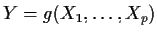 to be some function
of X (usually some statistic of interest). How can we compute the distribution
or cdf or density of Y?
to be some function
of X (usually some statistic of interest). How can we compute the distribution
or cdf or density of Y?
Univariate Techniques
Method 1: compute the cdf by integration and differentiate to find fY.
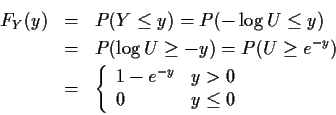
Example:
![$U \sim \mbox{Uniform}[0,1]$](img45.gif) and
and 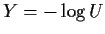 .
Then
.
Then
Example:
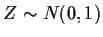 ,
i.e.
,
i.e.
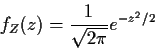


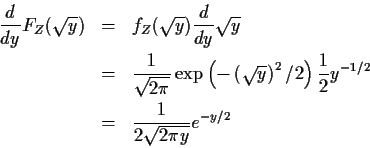
![\begin{displaymath}f_Y(y) = \left\{ \begin{array}{ll}
0 & y < 0
\\
\frac{d}{dy...
...\right] & y > 0
\\
\mbox{undefined} & y=0
\end{array}\right.
\end{displaymath}](img52.gif)
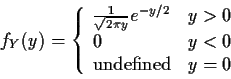
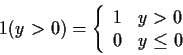
We will find indicator notation useful:
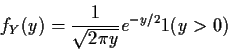
Notice: I never evaluated FY before differentiating it. In fact
FY and FZ are integrals I can't do but I can differentiate then anyway.
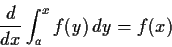
You should remember the fundamental theorem of calculus: