


Reading for Today's Lecture:
Goals of Today's Lecture:
Review of end of last time
 are independent
 random
variables.
(That is each satisfies my definition above in 1 dimension.) Then
random
variables.
(That is each satisfies my definition above in 1 dimension.) Then
 and the sample variance s2 are
independent.
and the sample variance s2 are
independent.


Proof: Reduces to  and
and  .
.
Step 1: Define

![\begin{align*}f_Y(y) =& (2\pi)^{-n/2} \exp[-y^t\Sigma^{-1}y/2]/\vert\det M\vert
...
...^{-(n-1)/2}\exp[-{\bf y}_2^t Q^{-1} {\bf y}_2/2]}{\vert\det M\vert}
\end{align*}](img11.gif)
 .
.
Notice that this is a factorization into a function of y1 times a
function of
 .
Thus
.
Thus
 is independent of
 .
Since sZ2 is a function of
we see that
and
sZ2 are independent (remember that
.
Since sZ2 is a function of
we see that
and
sZ2 are independent (remember that
 ).
).
Furthermore the density of Y1 is a multiple of the function of y1 in
the factorization above. But the factor in question is the standard normal
density so
 .
.
We have now done the first 2 parts of the theorem. The third part is
a homework exercise but I will outline the derivation of the  density.
Suppose that
 are independent N(0,1). We define the
 distribution to be that of
 .
Define angles
.
Define angles
 by
by
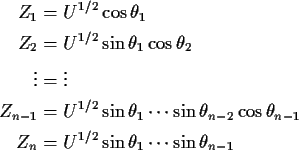
(These are spherical co-ordinates in n dimensions. The  values run
from 0 to
values run
from 0 to  except for the last
whose values run from 0 to
except for the last
whose values run from 0 to  .)
Then note the following derivative formulas
.)
Then note the following derivative formulas


![\begin{displaymath}\left[\begin{array}{ccc}
U^{-1/2} \cos\theta_1 /2
&
-U^{1/2} ...
...theta_2
&
U^{1/2} \sin\theta_1\cos\theta_2
\end{array}\right]
\end{displaymath}](img29.gif)
 times column 1 to column
j+1 (which doesn't change the determinant). The resulting
matrix is lower triangular with diagonal entries (after a small amount of algebra)
times column 1 to column
j+1 (which doesn't change the determinant). The resulting
matrix is lower triangular with diagonal entries (after a small amount of algebra)
 ,
,
 and
and
 .
We multiply these together to get
.
We multiply these together to get

 .
For general n we see that every term in the first column contains a factor
U-1/2/2 while
every other entry has a factor U1/2. Multiplying a column in a matrix by c multiplies
the determinant by c so the Jacobian of the transformation is
u(n-1)/2/2 times
some function, say h, which depends only on the angles.
Thus the joint density
of
.
For general n we see that every term in the first column contains a factor
U-1/2/2 while
every other entry has a factor U1/2. Multiplying a column in a matrix by c multiplies
the determinant by c so the Jacobian of the transformation is
u(n-1)/2/2 times
some function, say h, which depends only on the angles.
Thus the joint density
of
 is
is

 .
We see that the answer has
the form
.
We see that the answer has
the form


 density is
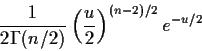
Finally the fourth part of the theorem is a consequence of the
first 3 parts of the theorem and the definition of the  distribution, namely, that
 if it has the same distribution
as
if it has the same distribution
as

 ,
,
 and Z and U are independent.
However, I now derive the density of T in this definition:

I can differentiate this with respect to t by
simply differentiating the inner integral:
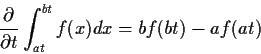
![\begin{displaymath}\frac{d}{dt} P(T \le t) =
\int_0^\infty f_U(u) \sqrt{u/\nu}\frac{\exp[-t^2u/(2\nu)]}{\sqrt{2\pi}} du
\, .
\end{displaymath}](img50.gif)

![\begin{displaymath}f_T(t) = \int_0^\infty \frac{1}{2\sqrt{\pi\nu}\Gamma(\nu/2)}
(u/2)^{(\nu-1)/2} \exp[-u(1+t^2/\nu)/2] \, du \, .
\end{displaymath}](img52.gif)
 ,
,

![$(u/2)^{(\nu-1)/2}= [y/(1+t^2/\nu)]^{(\nu-1)/2}$](img55.gif) to get
to get


In elementary courses we give two definitions of expected values:
Def'n If X has density f then
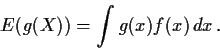
Def'n: If X has discrete density f then

Now if Y=g(X) for smooth g then

In general, there are random variables which are neither absolutely continuous nor discrete. Here's how probabilists define E in general.
Def'n: A random variable X is simple if we can write

 and events Ai.
Def'n: For a simple rv X we define

For positive random variables which are not simple we extend our definition by approximation:
Def'n: If  then
then

Def'n: We call X integrable if


Facts: E is a linear, monotone, positive operator:
 implies
 .
.
 and X, Y integrable implies
 .
.
Major technical theorems:
Monotone Convergence: If
 and
and
 (which has to exist) then

Dominated Convergence: If
 and there
is a random variable X such that
and there
is a random variable X such that  (technical
details of this convergence later in the course) and
a random variable Y such that
(technical
details of this convergence later in the course) and
a random variable Y such that  with
with
 then
then

Fatou's Lemma: If  then
then

Theorem: With this definition of E if X has density
f(x) (even in Rp say) and Y=g(X) then

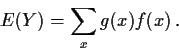
This works for instance even if X has a density but Y doesn't.
Def'n: The
 moment (about the origin) of a real
random variable X is
moment (about the origin) of a real
random variable X is
 (provided it exists).
We generally use
(provided it exists).
We generally use
 for E(X). The
central moment is
for E(X). The
central moment is
![\begin{displaymath}\mu_r = E[(X-\mu)^r]
\end{displaymath}](img87.gif)
 the variance.
Def'n: For an Rp valued random vector X we define
 to be the vector whose
 entry is E(Xi)
(provided all entries exist).
entry is E(Xi)
(provided all entries exist).
Def'n: The (
 )
variance covariance matrix of X is
)
variance covariance matrix of X is
![\begin{displaymath}Var(X) = E\left[ (X-\mu)(X-\mu)^t \right]
\end{displaymath}](img92.gif)
Moments and probabilities of rare events are closely connected as will
be seen in a number of important probability theorems. Here is one
version of Markov's inequality (one case is Chebyshev's inequality):
![\begin{align*}P(\vert X-\mu\vert \ge t ) &= E[1(\vert X-\mu\vert \ge t)]
\\
&\...
...-\mu\vert \ge t)\right]
\\
& \le \frac{E[\vert X-\mu\vert^r]}{t^r}
\end{align*}](img93.gif)
The intuition is that if moments are small then large deviations from
average are unlikely.
Example moments: If Z is standard normal then

and (integrating by parts)

so that

 .
Remembering that
.
Remembering that  and
and


If now
 ,
that is,
,
that is,
 ,
then
,
then
 and
and
![\begin{displaymath}\mu_r(X) = E[(X-\mu)^r] = \sigma^r E(Z^r)
\end{displaymath}](img104.gif) for
the distribution of
for
the distribution of
 is justified;
  is indeed
the variance.
is indeed
the variance.
Theorem: If
 are independent and each Xi is
integrable then
are independent and each Xi is
integrable then
 is integrable and

Proof: Suppose each Xi is simple:
 where the xij are the possible values of Xi. Then
![\begin{align*}E(X_1\cdots X_p) & = \sum_{j_1\ldots j_p} x_{1j_1}\cdots x_{pj_p} ...
...ft[\sum_{j_p} x_{pj_p} P(X_p = x_{pj_p})\right]
\\
&= \prod E(X_i)
\end{align*}](img111.gif)
For general Xi>0 we create a sequence of simple approximations
by rounding Xi down to the nearest multiple of 2-n (to
a maximum of n) and applying the case just done and the monotone
convergence theorem. The general case uses the fact that
we can write each Xi as the difference of its positive and negative
parts:

Def'n: The moment generating function of a real valued X is
Def'n: The moment generating function of  is
is
![\begin{displaymath}M_X(u) = E[\exp{u^tX}]
\end{displaymath}](img114.gif)
The mgf has the following formal connection to moments:
![\begin{align*}M_X(t) & = \sum_{k=0}^\infty E[(tX)^k]/k!
\\
= \sum_{k=0}^\infty \mu_k^\prime t^k/k!
\end{align*}](img115.gif)
It is thus sometimes possible to find the power series expansion of
MX and read off the moments of X from the coefficients of the
powers tk/k!.
Theorem: If M is finite for all
![$t \in [-\epsilon,\epsilon]$](img116.gif) for some
for some
 then
then
 (in fact M is analytic).
 .
.
The proof, and many other facts about mgfs, rely on techniques of complex variables.