


Reading for Today's Lecture:
Goals of Today's Lecture:
Review of end of last time
I defined independent events and then independent random variables:
Definition: Events Ai,
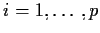 are
independent if
are
independent if
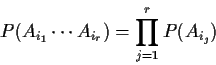
 between 1 and p.
Definition: Random variables
 are
independent if
are
independent if

 .
.

New material
Proof:
 and
and  ;
hence
;
hence

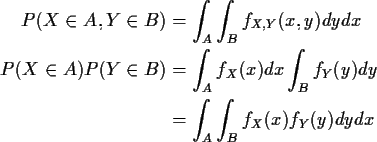
 we see that for any set
A and B
we see that for any set
A and B
![\begin{displaymath}\int_A\int_B [ f_{X,Y}(x,y) - f_X(x)f_Y(y) ]dydx = 0
\end{displaymath}](img16.gif)
![\begin{align*}P(X \in A, Y \in B) & = P(X\in A)P(Y \in B)
\\
&= \int_Af_X(x)dx \int_B f_Y(y) dy
\\
&= \int_A\int_B f_X(x)f_Y(y) ]dydx
\end{align*}](img17.gif)


 .
This is proved via a
monotone class argument. You prove that the collection of sets C
for which the identity holds has closure properties which guarantee that
this collection includes the Borel sets.
.
This is proved via a
monotone class argument. You prove that the collection of sets C
for which the identity holds has closure properties which guarantee that
this collection includes the Borel sets.
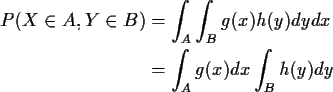

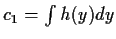 .
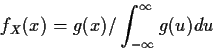
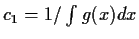
From the definition of density
we see that c1 g is the density of X.
Since
.
From the definition of density
we see that c1 g is the density of X.
Since
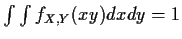 we see that
 so that
 .
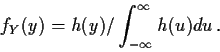
A similar argument works for Y.
.
A similar argument works for Y.
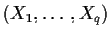
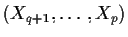
are independent and
Yi =gi(Xi) then
 are independent.
Moreover,
are independent.
Moreover,
 and
and
 are
independent.
are
independent.
Def'n:
P(A|B) = P(AB)/P(B) provided
 .
.
Def'n: For discrete random variables X and Y the conditional
probability mass function of Y given X is
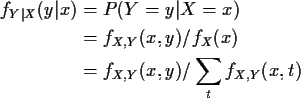
For absolutely continuous X the problem is that
P(X=x) = 0 for all
x so how can we define P(A| X=x) or
fY|X(y|x)?
The solution is to take a limit

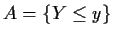 we have

 and let
tend to 0.
The denominator converges to fX(x) while the numerator converges to
and let
tend to 0.
The denominator converges to fX(x) while the numerator converges to
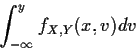

Def'n:
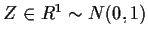 iff
iff

Def'n:
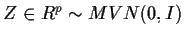 iff
iff
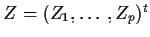 (a column vector for later use) with the
Zi independent and each
(a column vector for later use) with the
Zi independent and each
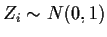 .
.
In this case according to our theorem
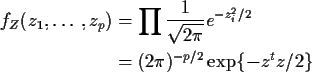
where the superscript t denotes matrix transpose.
Def'n:  has a multivariate normal distribution if it
has the same distribution as
has a multivariate normal distribution if it
has the same distribution as  for some
 ,
some
,
some
 matrix of constants A and
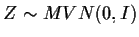 .
.
If the matrix A is singular then X will not have a density. If A is
invertible then we can derive the multivariate normal density
by the change of variables formula:

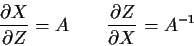

 and notice that



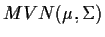 density. Notice that the density is
the same for all A such that
density. Notice that the density is
the same for all A such that
 .
This justifies the notation
.
.
This justifies the notation
.
For which vectors  and matrices
  is this a density?
Any
will work but if
is this a density?
Any
will work but if  then
then

where y=At x. The inequality is strict except for y=0 which
is equivalent to x=0. Thus
is a positive definite symmetric
matrix. Conversely, if
is a positive definite symmetric matrix
then there is a square invertible matrix A such that
so that
there is a
distribution. (The matrix A can be found
via the Cholesky decomposition, for example.)
More generally we say that X has a multivariate normal distribution
if it has the same distribution as
where now we remove the
restriction that A be non-singular. When A is singular X will not
have a density because there will exist an a such that
 ,
that is, so that X is confined to a hyperplane. It is still
true, however, that the distribution of X depends only on the matrix
in the sense that if
AAt = BBt then
and
,
that is, so that X is confined to a hyperplane. It is still
true, however, that the distribution of X depends only on the matrix
in the sense that if
AAt = BBt then
and
 have the same distribution.
Properties of the MVN distribution
1: All margins are multivariate normal: if
![\begin{displaymath}X = \left[\begin{array}{c} X_1\\ X_2\end{array} \right]
\end{displaymath}](img64.gif)
![\begin{displaymath}\mu = \left[\begin{array}{c} \mu_1\\ \mu_2\end{array} \right]
\end{displaymath}](img65.gif)
![\begin{displaymath}\Sigma = \left[\begin{array}{cc} \Sigma_{11} & \Sigma_{12}
\\
\Sigma_{21} & \Sigma_{22} \end{array} \right]
\end{displaymath}](img66.gif)
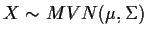 implies that
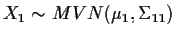 .
.
2: All conditionals are normal: the conditional distribution of X1
given X2=x2 is

3:
 .
That is, an affine
transformation of a Multivariate Normal is normal.
.
That is, an affine
transformation of a Multivariate Normal is normal.
 are independent
 random
variables.
(That is each satisfies my definition above in 1 dimension.) Then
random
variables.
(That is each satisfies my definition above in 1 dimension.) Then
 and the sample variance s2 are
independent.
and the sample variance s2 are
independent.

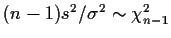
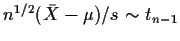
Proof: Let
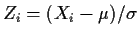 .
Then
.
Then
 are
independent N(0,1) so
is multivariate
standard normal. Note that
are
independent N(0,1) so
is multivariate
standard normal. Note that
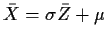 and
and
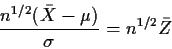
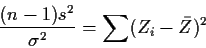
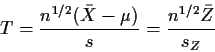
 Thus
Thus
 .
.
Thus we need only give a proof in the special case  and
and  .
.
Step 1: Define

![\begin{displaymath}Y =\left[\begin{array}{cccc}
\frac{1}{\sqrt{n}} &
\frac{1}{\s...
...in{array}{c}
Z_1 \\
Z_2 \\
\vdots
\\
Z_n
\end{array}\right]
\end{displaymath}](img88.gif)
 so we need
to compute
MMt:
so we need
to compute
MMt:
![\begin{align*}MM^t & = \left[\begin{array}{c\vert cccc}
1 & 0 & 0 & \cdots & 0 \...
...egin{array}{c\vert c}
1 & 0
\\
\hline
\\
0 & Q
\end{array}\right]
\end{align*}](img90.gif)
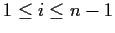
Now it is easy to solve for Z from Y because
Zi = n-1/2Y1+Yi+1
for
 .
To get Zn we use the identity
.
To get Zn we use the identity
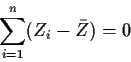
 .
This proves that M is
invertible and we find
.
This proves that M is
invertible and we find
![\begin{displaymath}\Sigma^{-1} \equiv (MM^t)^{-1} =
\left[\begin{array}{c\vert c}
1 & 0
\\
\hline
\\
0 & Q^{-1}
\end{array}\right]
\end{displaymath}](img94.gif)
Now we use the change of variables formula to compute the density
of Y. It is helpful to let  denote the n-1 vector whose
entries are
denote the n-1 vector whose
entries are
 .
Note that
.
Note that

![\begin{align*}f_Y(y) =& (2\pi)^{-n/2} \exp[-y^t\Sigma^{-1}y/2]/\vert\det M\vert
...
...^{-(n-1)/2}\exp[-{\bf y}_2^t Q^{-1} {\bf y_2}/2]}{\vert\det M\vert}
\end{align*}](img98.gif)
Notice that this is a factorization into a function of y1 times a
function of
.
Thus
 is independent of
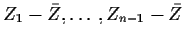 .
Since sZ2 is a function of
we see that
and
sZ2 are independent.
.
Since sZ2 is a function of
we see that
and
sZ2 are independent.
Furthermore the density of Y1 is a multiple of the function of y1 in
the factorization above. But the factor in question is the standard normal
density so
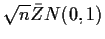 .
.
We have now done the first 2 parts of the theorem. The third part is
a homework exercise but I will outline the derivation of the  density.
Suppose that
 are independent N(0,1). We define the
 distribution to be that of
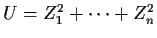 .
Define angles
.
Define angles
 by
by

(These are spherical co-ordinates in n dimensions. The  values run
from 0 to
values run
from 0 to  except for the last
whose values run from 0 to
except for the last
whose values run from 0 to  .)
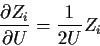
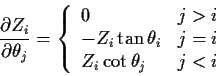
Then note the following derivative formulas
.)
Then note the following derivative formulas
![\begin{displaymath}\left[\begin{array}{ccc}
U^{-1/2} \cos\theta_1 /2
&
-U^{1/2} ...
...theta_2
&
U^{1/2} \sin\theta_1\cos\theta_2
\end{array}\right]
\end{displaymath}](img113.gif)
 times column 1 to column
j+1 (which doesn't change the determinant). The resulting
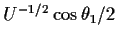
matrix is lower triangular with diagonal entries (after a small amount of algebra)
times column 1 to column
j+1 (which doesn't change the determinant). The resulting
matrix is lower triangular with diagonal entries (after a small amount of algebra)
 ,
,
 and
and
 .
We multiply these together to get
.
We multiply these together to get

 .
For general n we see that every term in the first column contains a factor
U-1/2/2 while
every other entry has a factor U1/2. Multiplying a column in a matrix by c multiplies
the determinant by c so the Jacobian of the transformation is
u(n-1)/2u-1/2/2 times
some function, say h, which depends only on the angles.
Thus the joint density
of
.
For general n we see that every term in the first column contains a factor
U-1/2/2 while
every other entry has a factor U1/2. Multiplying a column in a matrix by c multiplies
the determinant by c so the Jacobian of the transformation is
u(n-1)/2u-1/2/2 times
some function, say h, which depends only on the angles.
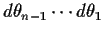
Thus the joint density
of
 is
is

 .
We see that the answer has
the form
.
We see that the answer has
the form


 density is

Finally the fourth part of the theorem is a consequence of the
first 3 parts of the theorem and the definition of the  distribution, namely, that
 if it has the same distribution
as
if it has the same distribution
as

 ,
,
 and Z and U are independent.
However, I now derive the density of T in this definition:

I can differentiate this with respect to t by
simply differentiating the inner integral:

![\begin{displaymath}\frac{d}{dt} P(T \le t) =
\int_0^\infty f_U(u) \sqrt{u/\nu}\frac{\exp[-t^2u/(2\nu)]}{\sqrt{2\pi}} du
\, .
\end{displaymath}](img134.gif)

![\begin{displaymath}f_T(t) = \int_0^\infty \frac{1}{2\sqrt{\pi\nu}\Gamma(\nu/2)}
(u/2)^{(\nu-1)/2} \exp[-u(1+t^2/\nu)/2] \, du \, .
\end{displaymath}](img136.gif)
 ,
,

![$(u/2)^{(\nu-1)/2}= [y/(1+t^2/\nu)]^{(\nu-1)/2}$](img139.gif) to get
to get

