


By model identification for a time series  we mean the process of selecting
values of
we mean the process of selecting
values of  so that the
 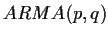 process gives a reasonable
fit to our data. The most important model identification tool is
a plot of (an estimate of) the autocorrelation function of ; we
use the abbreviation ACF for this function.
Before we discuss doing this with real data we explore what plots
of the ACF of various plots should look like (in the
absence of estimation error).
process gives a reasonable
fit to our data. The most important model identification tool is
a plot of (an estimate of) the autocorrelation function of ; we
use the abbreviation ACF for this function.
Before we discuss doing this with real data we explore what plots
of the ACF of various plots should look like (in the
absence of estimation error).
For an  process we found that
 .
.
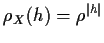
For an  process
 the autocorrelation function is
To derive the autocovariance for a general  we mimic
the technique for
we mimic
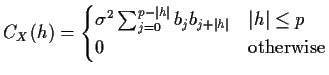
the technique for  . If
. If
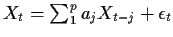 then
then
 |
 Cov Cov |
|
 Cov Cov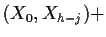 Cov Cov |
||
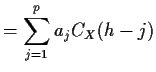 |
 . Take these equations and divide through by
  and remember that
 and
and
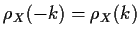 you see that the above recursions for
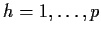 are
are  linear
equations in the unknowns
linear
equations in the unknowns
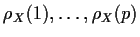 . They are
called the Yule Walker equations. For instance, when
. They are
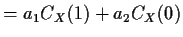
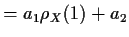
called the Yule Walker equations. For instance, when  we get
 |
 |
|
 |
 |
 |
 |
|
 |
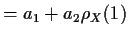 |
 but here we simply observe that we have two equations in
two unknowns to solve. The second equation shows that
but here we simply observe that we have two equations in
two unknowns to solve. The second equation shows that
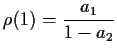
 (unless
  ) and not a correlation for some other
  pairs. The first equation then gives
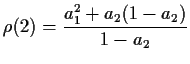 to be calculated
recursively from
to be calculated
recursively from  and
and  for
for  .
.
Now look at  , the characteristic polynomial, when we have

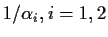 are the two roots. Multiplying out we find
that
are the two roots. Multiplying out we find
that
 so that either one of the two has modulus
more than 1 (and the root
so that either one of the two has modulus
more than 1 (and the root
 has modulus less than 1) or
both have modulus 1. The two roots may be seen to be real so they would
have to be
has modulus less than 1) or
both have modulus 1. The two roots may be seen to be real so they would
have to be  . Since
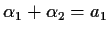 (again from multiplying
it out and examining the coefficient of
(again from multiplying
it out and examining the coefficient of  ) we would then know .
In either case there is no stationary solution.
) we would then know .
In either case there is no stationary solution.
Qualitative features: It is possible to prove that the
solutions of these Yule-Walker equations decay to 0 at a geometric rate
meaning that they satisfy
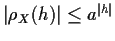 for some
 .
However, for general they are not too simple.
.
However, for general they are not too simple.
If  are iid
 then we saw

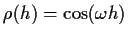 .
Thus the autocorrelation would be perfectly periodic.
.
Thus the autocorrelation would be perfectly periodic.
If and  are jointly stationary then
 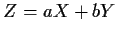 is
stationary and
is
stationary and

In fact you can make AR processes which behave very much like periodic processes. Consider the process

Here are graphs of trajectories and autocorrelations for
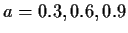 and
and  .
.
 You should observe the slow decay
of the waves in the autocovariances, particularly for
You should observe the slow decay
of the waves in the autocovariances, particularly for  near 1.
When
near 1.
When  the characteristic polynomial is
  which has roots

 so there is no stationary
trajectory with . The point is that some
so there is no stationary
trajectory with . The point is that some  processes have
nearly periodic components.
processes have
nearly periodic components.
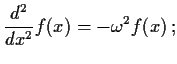
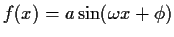
To get more insight consider the differential equation describing a sine wave:
 .
If we replace the derivative by differences we get the
approximation
.
If we replace the derivative by differences we get the
approximation


 in the approximation and reorganize
to get
in the approximation and reorganize
to get

 and replace the letter
 by we get

This is formalism only; there is no stationary solution of this
equation. However, we see that  processes are at least
analogous to the solutions of second order differential equations
with added noise.
processes are at least
analogous to the solutions of second order differential equations
with added noise.
 and
and 
In order to identify suitable  models using data we
need estimates of and . If we knew that
models using data we
need estimates of and . If we knew that  we would see that
 Cov
Cov Cov
Cov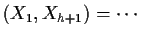
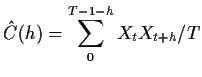
 time units
apart.
When
time units
apart.
When  is unknown we will often simply use
 and then
take
and then
take
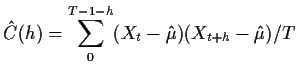
 terms in the sum
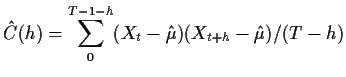
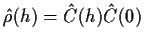 is used in the divisor it is technically
possible to get a
is used in the divisor it is technically
possible to get a  value which exceeds 1.)