


Definition:
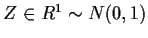 iff
iff

Definition:
 iff
iff
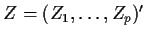 (a column vector for later use) with the
 independent and each
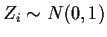 .
.
In this case,
 |
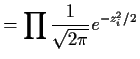 |
|
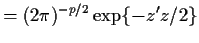 |
 denotes matrix transpose.
Definition:  has a multivariate normal distribution if it
has the same distribution as
has a multivariate normal distribution if it
has the same distribution as  for some
 , some
 matrix of constants
  and
and
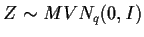 .
.
Lemma: The matrix can be taken to be square with
no loss of generality.
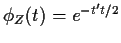
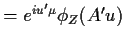
Proof: The simplest proof involves multivariate characteristic functions:
 E
E
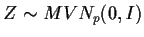 we have
 |
 E E |
|
 |
||
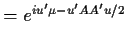 |
 and
and
 the distribution
is the same for any two giving the same
the distribution
is the same for any two giving the same  . In particular given an
which is
we need only use ideas of Cholesky decomposition
to find a square
. In particular given an
which is
we need only use ideas of Cholesky decomposition
to find a square  with
with
 .
I omit a proof.
.
I omit a proof.
If the matrix is singular then  will not have a density. If is
invertible then we can derive the multivariate normal density
by the change of variables formula:
will not have a density. If is
invertible then we can derive the multivariate normal density
by the change of variables formula:

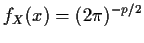 det
det .
.
Properties of the  distribution
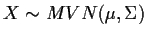 then
then
 follows easily from our
definition. (You work with the real definition not densities,
etc.)
follows easily from our
definition. (You work with the real definition not densities,
etc.)
![$\displaystyle X = \left[\begin{array}{c} X_1\\ X_2\end{array} \right]
$](img38.gif)
![$\displaystyle \mu = \left[\begin{array}{c} \mu_1\\ \mu_2\end{array} \right]
$](img39.gif)
![$\displaystyle \Sigma = \left[\begin{array}{cc} \Sigma_{11} & \Sigma_{12}
\\
\Sigma_{21} & \Sigma_{22} \end{array} \right]
$](img40.gif) implies that
implies that
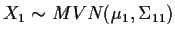 .
This is really a special case of the previous property.
.
This is really a special case of the previous property.
 given
given  is
is
 To prove this you have to do algebra with the definition of the conditional
density. It is possible to give a sensible formula even if
To prove this you have to do algebra with the definition of the conditional
density. It is possible to give a sensible formula even if
 is
singular.
is
singular.
If is an  process then
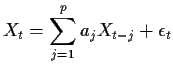
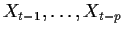 fixed then
 is
is
 plus a fixed constant. Since
is independent of
plus a fixed constant. Since
is independent of  for all
  we see that given
the variables
and
we see that given
the variables
and  for
for  are independent.
This would imply
are independent.
This would imply

 . When the process is Gaussian our results
above on conditional distributions guarantee that we can
calculate this partial autocovariance from the variance
covariance matrix of the vector
. When the process is Gaussian our results
above on conditional distributions guarantee that we can
calculate this partial autocovariance from the variance
covariance matrix of the vector
 . If we partition this
vector into a first piece with
. If we partition this
vector into a first piece with  entries and a second piece
with
entries and a second piece
with  entries we find that the conditional variance covariance
matrix of
entries we find that the conditional variance covariance
matrix of
 given the others is
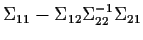
 is the 2 by 2 unconditional covariance
matrix of
, namely,
is the 2 by 2 unconditional covariance
matrix of
, namely,
![$\displaystyle \left[\begin{array}{cc}C(0) & C(q) \\ C(q) & C(0) \end{array}\right]
$](img63.gif) is the
is the
 Toeplitz matrix with
 down the diagonal,
  down the first sub and super diagonal,
and so on. The matrix
down the first sub and super diagonal,
and so on. The matrix
 is the
 matrix
![$\displaystyle \left[\begin{array}{ccc}
C(1) & \cdots & C(p)
\\
C(q-1)& \cdots & C(q-p)
\end{array}\right]
$](img69.gif)
 matrix
you pick out the off diagonal element; this is the partial
autocovariance. Even when the data are not Gaussian we will be
doing this piece of arithmetic with the autocovariance to define
the partial autocovariance.
matrix
you pick out the off diagonal element; this is the partial
autocovariance. Even when the data are not Gaussian we will be
doing this piece of arithmetic with the autocovariance to define
the partial autocovariance.
To use this idea we define the partial autocorrelation function to be
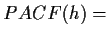 Corr
Corr
 then there are no s between and
  so
there is nothing to condition on. This makes
so
there is nothing to condition on. This makes
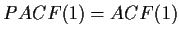 .
.
Qualitative idea: A plot of the sample partial
autocorrelation function (derived by replacing  by
by  in the definition of
  ) is examined. For an process
this sample plot ought to drop suddenly to 0 for
) is examined. For an process
this sample plot ought to drop suddenly to 0 for  .
.
 example
Now I calculate  for a mean 0 process. We have
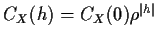 . Let
. Let
![$\displaystyle \left[\begin{array}{c}Y \\ Z\end{array}\right]
=
\left[\begin{array}{c} X_t \\ X_{t-2} \\ X_{t-1}\end{array}\right]
$](img83.gif)
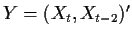 and
and
 . Then
 has
a
has
a
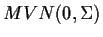 distribution with
![$\displaystyle \Sigma = C_X(0)\left[\begin{array}{ccc}
1 & \rho^2 & \rho
\\
\rho^2 & 1 & \rho
\\
\rho & \rho & 1
\end{array}\right]
$](img88.gif)
 and
and  we find
![$\displaystyle \Sigma_{11} = \Sigma = C_X(0)\left[\begin{array}{cc}
1 & \rho^2 \\ \rho^2 & 1\end{array}\right]
$](img91.gif)
![$\displaystyle \Sigma_{12} = C_X(0)\left[\begin{array}{c}\rho\\ \rho \end{array} \right]
$](img92.gif)
![$\displaystyle \Sigma_{22} = C_X(0) \left[ 1\right]
$](img93.gif)
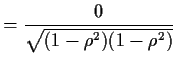
Cov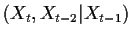 |
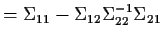 |
|
![$\displaystyle = C_X(0)\left[\begin{array}{cc} 1 & \rho^2 \\ \rho^2 & 1\end{arra...
...)\left[\begin{array}{cc} \rho^2 & \rho^2 \\ \rho^2 & \rho^2 \end{array} \right]$](img96.gif) |
||
![$\displaystyle = C_X(0) \left[\begin{array}{cc} 1-\rho^2 & 0 \\ 0 & 1-\rho^2 \end{array} \right]$](img97.gif) |
 |
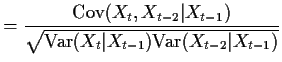 |
|
 |
||
 |
Consider the problem of prediction knowing
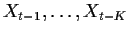 .
In this course we choose a predictor
.
In this course we choose a predictor
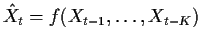 to minimize the mean squared prediction error:
![$\displaystyle [(X_t-\hat{X}_t)^2]
$](img104.gif)
 E
E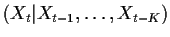
![$\displaystyle (X_t\vert X_{t-1},\ldots,X_{t-K}) = \mu+A\left[\begin{array}{c}
X_{t-1} - \mu \\ \vdots \\ X_{t-k}-\mu \end{array}\right]
$](img107.gif) is
is
 in the notation
of the earlier notes. This can be written in the form
in the notation
of the earlier notes. This can be written in the form
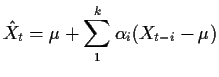
 . Let
. Let
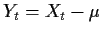 . The
. The  minimize
E![$\displaystyle [(Y_t-\sum\alpha_i Y_{t-i})^2]$](img113.gif) |
E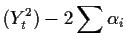 E E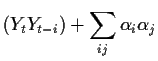 E E |
|
 |
 and set the resulting
 quantities equal to 0 giving

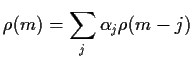 is
is
 but not
 (the last ) is
  .
.
Remark: This makes it look as if you would compute the
first 40 values of the PACF by solving 40 different problems and picking out the
last in each one but in fact there is an explicit recursive
algorithm to compute these things.
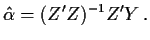
To estimate the PACF you can either estimate the ACF and do the arithmetic above with estimates instead of theoretical values or minimize a sample version of the mean squared prediction error:
The Mean Squared Prediction Error is
![$\displaystyle \left\{[ (X_t - \mu - \sum_{j-1}^k \alpha_k (X_{t-k} - \mu)]^2\right\}
$](img126.gif) in this formula with
in this formula with  and then replace the expected value
with an average over the data so that we minimize
and then replace the expected value
with an average over the data so that we minimize
![$\displaystyle \sum_{t=k}^{T-1}\left \{[ (X_t -\bar{X}-\sum_{j-1}^k \alpha_k (X_{t-k} - \mu)]^2\right\}/T
$](img128.gif)
![$\displaystyle Y = \left[\begin{array}{c} X_k-\bar{X} \\ \vdots \\ X_{T-1} - \bar{X}
\end{array}\right]
$](img129.gif)
![$\displaystyle Z = \left[\begin{array}{ccc}
X_{t-1} - \bar{X} & \cdots & X_0 - \...
...vdots
\\
X_{T-2} - \bar{X} & \cdots & X_{T-k-1} - \bar{X}
\end{array}\right]
$](img130.gif) is the th entry in
is the th entry in
What follows are plots of 5 series, their fitted ACFs and their fitted PACFs. The series are:
 series:

 series

 series:

Here is the SPlus code I used to make the following plots. You should note the use of the function acf which calculates and plots ACF and PACF.
#
# Comments begin with #
#
# Begin by generating the series.  The AR series generated are NOT
# stationary.  But I generate 10000 values from the recurrence relation
# and use the last 500. Asymptotic stationarity should guarantee that
# these last 500 are pretty stationary.
#
n<- 10000
ep <- rnorm(n)
ma2 <- ep[3:502]+0.8*ep[2:501]-0.9*ep[1:500]
ar2 <- rep(0,n)
ar2[1:2] <- ep[1:2]
for(i in 3:n) {ar2[i] <- ep[i]
              + ar2[i-1] -0.99*ar2[i-2]}
ar2 <- ar2[(n-499):n]
ar2 <- ts(ar2)
ar3 <- rep(0,n)
ar3[1:3] <- ep[1:3]
for(i in 4:n) {ar3[i] <- ep[i] + 0.8*ar3[i-1]
           -ar3[i-2]/3 +(0.8/1.712)*ar3[i-3]}
ar3 <- ar3[(n-499):n]
ar3 <- ts(ar3)
#
# The next line turns on a graphics device -- in this case the
# graph will be made in postscript in a file called ma2.ps. It
# will come out in portrait, not landscape, format.
#
postscript(file="ma2.ps",horizontal=F)
#
# The next line says to put 3 pictures
# in a single column on the plot
#
par(mfcol=c(3,1))
tsplot(ma2,main="MA(2) series")
acf(ma2)
acf(ma2,type="partial")
#
# When you finish a picture you turn
# off the graphics device
# with the next line.
#
dev.off()
#
#
#
postscript(file="ar2.ps",horizontal=F)
par(mfcol=c(3,1))
tsplot(ar2,main="AR(2) series")
acf(ar2)
acf(ar2,type="partial")
dev.off()
#
#
postscript(file="ar3.ps",horizontal=F)
par(mfcol=c(3,1))
tsplot(ar3,main="AR(3) series")
acf(ar3)
acf(ar3,type="partial")
dev.off()
#
#
postscript(file="sunspots.ps",horizontal=F)
par(mfcol=c(3,1))
tsplot(sunspots,main="Sunspots series")
acf(sunspots,lag.max=480)
acf(sunspots,lag.max=480,type="partial")
dev.off()
#
#
postscript(file="rain.nyc1.ps",horizontal=F)
par(mfcol=c(3,1))
tsplot(rain.nyc1,main="New York Rain Series")
acf(rain.nyc1)
acf(rain.nyc1,type="partial")
dev.off()


You should notice:
series have complicated ACF's but the PACFs vanish
at lags more than .
 axis
corresponds to about 24 months. An model with around 24
would then be a possibility.
axis
corresponds to about 24 months. An model with around 24
would then be a possibility.