


For the model
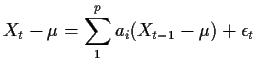
 denote the
vector
denote the
vector
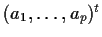 . Now we condition
on the first
. Now we condition
on the first  values of
  and use
![$\displaystyle \ell_c(\phi,\mu,\sigma) = -\frac{1}{2\sigma^2}
\sum_p^{T-1} \left[ X_t-\mu - \sum_1^p a_i(X_{t-i} - \mu)\right]^2
-(T-p)\log(\sigma)
$](img6.gif)
 using
using  we find that we are trying
to maximize
we find that we are trying
to maximize
![$\displaystyle -\frac{1}{2\sigma^2}
\sum_p^{T-1} \left[ X_t-\bar{X} - \sum_1^p a_i(X_{t-i} - \bar{X})\right]^2
-(T-p)\log(\sigma)
$](img9.gif)
 then we merely minimize the sum of squares
![$\displaystyle \sum_p^{T-1} \hat\epsilon_t^2 = \sum_p^{T-1} \left[ X_t-\bar{X} - \sum_1^p
a_i(X_{t-i} - \bar{X})\right]^2
$](img11.gif)
![$\displaystyle \left[\begin{array}{c} X_p -\bar{X} \\ \vdots \\ X_{T-1} -\bar{X} \end{array} \right]
$](img12.gif)
![$\displaystyle \left[\begin{array}{ccc}
X_{p-1} -\bar{X}& \cdots & X_0 -\bar{X}
...
...
\vdots
\\
X_{T-2} -\bar{X}& \cdots & X_{T-p-1} -\bar{X}
\end{array}\right]
$](img13.gif)
An alternative to estimating by is to define
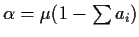 and then recognize that
![$\displaystyle \ell(\alpha,\phi,\sigma) = -\frac{1}{2\sigma^2}
\sum_p^{T-1} \left[ X_t-\alpha - \sum_1^p a_iX_{t-i}\right]^2
-(T-p)\log(\sigma)
$](img15.gif)
![$\displaystyle \left[\begin{array}{c} X_p \\ \vdots \\ X_{T-1} \end{array} \right]
$](img16.gif)
![$\displaystyle \left[\begin{array}{ccc}
X_{p-1} & \cdots & X_0
\\
\vdots &
\vdots & \vdots
\\
X_{T-2} & \cdots & X_{T-p-1}
\end{array}\right]
$](img17.gif)
 and
and  we would get an estimate for
by
we would get an estimate for
by

Notice that if we put
![$\displaystyle Z=\left[\begin{array}{ccc}
X_{p-1} -\bar{X}& \cdots & X_0 -\bar{X...
...&
\vdots
\\
X_{T-2} -\bar{X}& \cdots & X_{T-p-1} -\bar{X}
\end{array}\right]
$](img21.gif)
![$\displaystyle Z^tZ \approx T \left[\begin{array}{cccc}
\hat{C}(0) & \hat{C}(1) ...
...ots & \cdots
\\
\cdots & \cdots & \hat{C}(1) & \hat{C}(0)
\end{array}\right]
$](img22.gif)
![$\displaystyle Y=\left[\begin{array}{c} X_p -\bar{X} \\ \vdots \\ X_{T-1} -\bar{X}
\end{array} \right]
$](img23.gif)
![$\displaystyle Z^tY \approx T \left[\begin{array}{c} \hat{C}(1) \\ \vdots \\ \hat{C}(p)
\end{array}\right]
$](img24.gif)
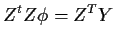
To compute a full mle of
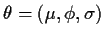 you generally begin by finding preliminary estimates
 say by one of the conditional likelihood
methods above and then iterate via Newton-Raphson or
some other scheme for numerical maximization of the
log-likelihood.
say by one of the conditional likelihood
methods above and then iterate via Newton-Raphson or
some other scheme for numerical maximization of the
log-likelihood.
 models
Here we consider the model with known mean (generally this
will mean we estimate
 and subtract the mean
from all the observations):
and subtract the mean
from all the observations):

In general has a
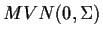 distribution and, letting
 denote the vector of
  s we find
![$\displaystyle \ell(\psi,\sigma) = -\frac{1}{2}\left[\log(\det(\Sigma))
- X^T \Sigma^{-1} X\right]
$](img34.gif) denotes the column vector of all the data.
As an example consider
denotes the column vector of all the data.
As an example consider  so that
![$\displaystyle \Sigma = \left[\begin{array}{ccccc}
\sigma^2(1+b_1^2) & -b_1\sigm...
...
\\
0 & \cdots & \cdots & -b_1\sigma^2& \sigma^2(1+b_1^2)
\end{array}\right]
$](img36.gif)
 .
.
Notice that
 |
 |
|
 |
 |
|
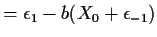 |
||
 |
 |
|
 |
||
 |
||
 |
 |
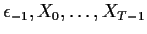
 would give
 |
 |
|
 |
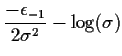
 s the terms in this likelihood are squares
as usual (plus logarithms of
s the terms in this likelihood are squares
as usual (plus logarithms of  ) leading to
 |
 |
|
![$\displaystyle - \sum_0^{T-1} \left[\frac{1}{2} (X_t - \psi X_{t-1} - \psi^2 X_{t-2} - \cdots -\psi^{t+1} \epsilon_{-1})^2+\log(\sigma)\right]$](img58.gif) |
somehow.
Method A: Put
 since 0 is
the most probable value and maximize
since 0 is
the most probable value and maximize
![$\displaystyle -T\log(\sigma) - \frac{1}{2\sigma^2} \sum_0^{T-1} \left[X_t - \psi X_{t-1}
- \psi^2 X_{t-2} - \cdots -\psi^{t}X_0\right]^2
$](img60.gif)
 the coefficients of
are close to 0 for most
the coefficients of
are close to 0 for most  and the remaining few terms are
negligible relatively to the total.
and the remaining few terms are
negligible relatively to the total.
Method B: Backcasting is the process of
guessing
on the basis of the data; we replace
in the log likelihood by
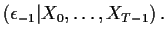
 and .
and .
We will use the EM algorithm to solve this problem.
The algorithm can be applied when we have (real or imaginary)
missing data. Suppose the data we have is ; some other data
we didn't get is  and
and  . It often happens that we can
think of a we didn't observe in such a way that the likelihood
for the whole data set
. It often happens that we can
think of a we didn't observe in such a way that the likelihood
for the whole data set  would be simple. In that case we can
try to maximize the likelihood for by following a two step
algorithm first discussed in detail by Dempster, Laid and Rubin.
This algorithm has two steps:
would be simple. In that case we can
try to maximize the likelihood for by following a two step
algorithm first discussed in detail by Dempster, Laid and Rubin.
This algorithm has two steps:
by computing
E . Technically,
we are supposed to estimate the likelihood function based on .
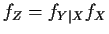
Factor the density of as
. Technically,
we are supposed to estimate the likelihood function based on .
Factor the density of as

 ) by computing
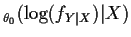
 on E. This indicates
that you have to know the parameter to compute the conditional
expectation. Notice too that there is another in the
conditional expectation - the log conditional density has
a parameter in it.
on E. This indicates
that you have to know the parameter to compute the conditional
expectation. Notice too that there is another in the
conditional expectation - the log conditional density has
a parameter in it.
 to get
a new value
to get
a new value  for . Go back to step 1 with this
replacing and iterate.
for . Go back to step 1 with this
replacing and iterate.
To get started we need a preliminary estimate. Now look at our
problem. In our case the quantity is
.
Rather than work with the log-likelihood directly we work with
. Our preliminary estimate of is 0. We use this value
to estimate as above getting an estimate .
Then we compute
E and
replace
in the log-likelihood above by this
conditional expectation. Then iterate. This process of guessing
is called backcasting.
and
replace
in the log-likelihood above by this
conditional expectation. Then iterate. This process of guessing
is called backcasting.
Summary
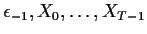 is
is

in this formula and estimate
by minimizing


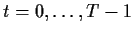 .
.
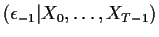 Box, Jenkins and Reinsel presents an algorithm to do so based
on the fact that there are actually two MA representations of
corresponding to a given covariance function (the invertible
one and a non-invertible one). The non-invertible representation
is
Box, Jenkins and Reinsel presents an algorithm to do so based
on the fact that there are actually two MA representations of
corresponding to a given covariance function (the invertible
one and a non-invertible one). The non-invertible representation
is
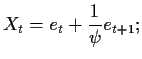
and recomputing the
backcast value of
if needed.