


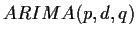
 models to data
Fitting the  part is easy we simply difference
  times. The
same observation applies to seasonal multiplicative model. Thus
to fit an ARIMA
times. The
same observation applies to seasonal multiplicative model. Thus
to fit an ARIMA model to
  you compute
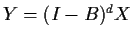 (shortening your data set by observations)
and then you fit an
(shortening your data set by observations)
and then you fit an 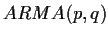 model to
  . So we assume that
 .
.
Simplest case: fitting the AR(1) model

 and
and
 Var
Var .
.
Our basic strategy will be:
Generally the full likelihood is rather complicated; we will use conditional likelihoods and ad hoc estimates of some parameters to simplify the situation.
If the errors  are normal then so is the series . In general
the vector
are normal then so is the series . In general
the vector
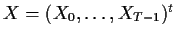 has a
has a
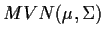 where
where
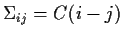 and
and  is a vector all of whose entries are
 . The joint density of is

![$\displaystyle \ell(\mu,a_1,\ldots,a_p,b_1,\ldots,b_q,\sigma) =
-\frac{1}{2}\left[
(x-{\bf\mu})^t \Sigma^{-1} (x-{\bf\mu}) + \log(\det(\Sigma))\right]
$](img21.gif) )
the parameters on which the quantity depends.
)
the parameters on which the quantity depends.
It is possible to carry out full maximum likelihood by maximizing the quantity in question numerically. In general this is hard, however.
Here I indicate some standard tactics. In your homework I will be asking you to carry through this analysis for one particular model.
 model
model
Consider the model
 in
a simpler way:
in
a simpler way:

![$\displaystyle f_{X_{k+1}\vert X_k,\ldots,X_0} (x_k\vert x_{k-1},\ldots,x_{0}) =
g\left[x_k-\mu-\rho(x_{k-1}-\mu)\right]
$](img25.gif)
 is the density of an individual . For iid
 errors this gives
a log likelihood which is
errors this gives
a log likelihood which is
![$\displaystyle \ell(\mu,\rho,\sigma) = - \frac{1}{2\sigma^2}\sum_1^{T-1} \left[x_k-\mu-\rho(x_{k-1}-\mu)\right]^2
-(T-1)\log(\sigma) + \log(f_{X_0})
$](img28.gif)
 so that

 |
![$\displaystyle = - \frac{1}{2\sigma^2} \left\{ \sum_1^{T-1}\left[x_k-\mu-\rho(x_{k-1}-\mu)\right]^2 +(1-\rho^2)(x_0-\mu)^2\right\}$](img32.gif) |
|
 |
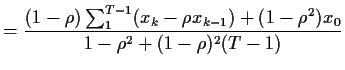
and  explicitly. First

+ (1-\rho^2)(x_0-\mu)\right\}
$](img35.gif)
 |
 |
|
 |
and that if  is large we may drop the 1
in the denominator and the term inolving
is large we may drop the 1
in the denominator and the term inolving  in the denominator and get
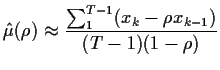


Now compute
![$\displaystyle \frac{\partial}{\partial\sigma} \ell = \frac{1}{\sigma^3}\left\{
...
...mu-\rho(x_{k-1}-\mu)\right]^2 +(1-\rho^2)(x_0-\mu)^2\right\}
-\frac{T}{\sigma}
$](img44.gif)
![$\displaystyle \hat\sigma^2(\rho) = \frac{\left\{
\sum_1^{T-1}\left[x_k-\mu(\rho)-\rho(x_{k-1}-\mu(\rho))\right]^2
+(1-\rho^2)(x_0-\mu(\rho))^2\right\}}{T}
$](img45.gif)
 is known it is easy to check that
 maximizes
 .
.
To find  you now plug
 and
and
 into
into  (getting the so called profile likelihood
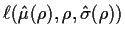 )
and maximize over . Having thus found the mles of and
)
and maximize over . Having thus found the mles of and
 are simply
 and
and
 .
.
It is worth observing that fitted residuals can then be calculated:

 of them since you cannot easily estimate
 .) Note, too, that the formula for
 simplifies to

In general, we simplify the maximum likelihood problem several ways:
 .
.
 in the likelihood is different
in structure and causes considerable trouble. We drop it.
The result is called a conditional likelihood. In general
in a statistical inference problem
if the data can be written in the form
in the likelihood is different
in structure and causes considerable trouble. We drop it.
The result is called a conditional likelihood. In general
in a statistical inference problem
if the data can be written in the form  then
we can factor the density in the form
then
we can factor the density in the form

 is
called a conditional likelihood (when you think
of it as a function of the unknown parameters); the
second term,
is
called a conditional likelihood (when you think
of it as a function of the unknown parameters); the
second term,  is called a marginal likelihood.
Sometimes one or the other of the two terms is conveniently
simpler than the full likelihood; in these cases people often
suggest using the simple piece. You get less efficient
estimates in general but sometimes the loss is not very
important.
is called a marginal likelihood.
Sometimes one or the other of the two terms is conveniently
simpler than the full likelihood; in these cases people often
suggest using the simple piece. You get less efficient
estimates in general but sometimes the loss is not very
important.
In the case is just
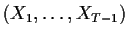 while
while
 is
is  . We take our conditional log-likelihood to be
|
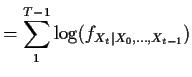 |
|
![$\displaystyle = \frac{-1}{2\sigma^2} \sum_1^{T-1} \left[X_t-\mu - \rho(X_{t-1}-\mu)\right]^2 -(T-1)\log(\sigma)$](img72.gif) |
![$\displaystyle \ell(\bar{X},\rho,\sigma) = \frac{-1}{2\sigma^2} \sum_1^{T-1}
\left[X_t-\bar{X} - \rho(X_{t-1}-\bar{X})\right]^2 -(T-1)\log(\sigma)
$](img73.gif)
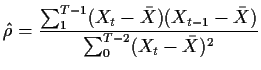
![$\displaystyle \hat\sigma^2 = \frac{ \sum_1^{T-1}
\left[X_t-\bar{X} - \hat\rho(X_{t-1}-\bar{X})\right]^2}{T-1}
$](img75.gif)
to include all possible terms gives
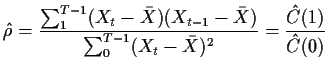
Notice that we have made a great many suggestions for simplifications and adjustments. This is typical of statistical research - many ideas, only slightly different from each other, are suggested and compared. In practice it seems likely that there is very little difference between all the methods. I am asking you in a homework problem to investigate the differences between several of these methods on a single data set.
For the model
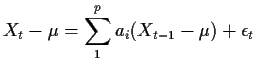
 denote the
vector
denote the
vector
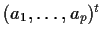 . Now we condition
on the first
. Now we condition
on the first  values of and use
![$\displaystyle \ell_c(\phi,\mu,\sigma) = -\frac{1}{2\sigma^2}
\sum_p^{T-1} \left[ X_t-\mu - \sum_1^p a_i(X_{t-i} - \mu)\right]^2
-(T-p)\log(\sigma)
$](img81.gif) using
using  we find that we are trying
to maximize
we find that we are trying
to maximize
![$\displaystyle -\frac{1}{2\sigma^2}
\sum_p^{T-1} \left[ X_t-\bar{X} - \sum_1^p a_i(X_{t-i} - \bar{X})\right]^2
-(T-p)\log(\sigma)
$](img83.gif)
 then we merely minimize the sum of squares
![$\displaystyle \sum_p^{T-1} \hat\epsilon_t^2 = \sum_p^{T-1} \left[ X_t-\bar{X} - \sum_1^p
a_i(X_{t-i} - \bar{X})\right]^2
$](img85.gif)
![$\displaystyle \left[\begin{array}{c} X_p -\bar{X} \\ \vdots \\ X_{T-1} -\bar{X} \end{array} \right]
$](img86.gif)
![$\displaystyle \left[\begin{array}{ccc}
X_{p-1} -\bar{X}& \cdots & X_0 -\bar{X}
...
...
\vdots
\\
X_{T-2} -\bar{X}& \cdots & X_{T-p-1} -\bar{X}
\end{array}\right]
$](img87.gif)
An alternative to estimating by is to define
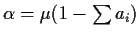 and then recognize that
![$\displaystyle \ell(\alpha,\phi,\sigma) = -\frac{1}{2\sigma^2}
\sum_p^{T-1} \left[ X_t-\alpha - \sum_1^p a_iX_{t-i}\right]^2
-(T-p)\log(\sigma)
$](img89.gif)
![$\displaystyle \left[\begin{array}{c} X_p \\ \vdots \\ X_{T-1} \end{array} \right]
$](img90.gif)
![$\displaystyle \left[\begin{array}{ccc}
X_{p-1} & \cdots & X_0
\\
\vdots &
\vdots & \vdots
\\
X_{T-2} & \cdots & X_{T-p-1}
\end{array}\right]
$](img91.gif)
 and
and  we would get an estimate for
by
we would get an estimate for
by
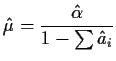
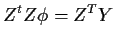
Notice that if we put
![$\displaystyle Z=\left[\begin{array}{ccc}
X_{p-1} -\bar{X}& \cdots & X_0 -\bar{X...
...&
\vdots
\\
X_{T-2} -\bar{X}& \cdots & X_{T-p-1} -\bar{X}
\end{array}\right]
$](img95.gif)
![$\displaystyle Z^tZ \approx T \left[\begin{array}{cccc}
\hat{C}(0) & \hat{C}(1) ...
...ots & \cdots
\\
\cdots & \cdots & \hat{C}(1) & \hat{C}(0)
\end{array}\right]
$](img96.gif)
![$\displaystyle Y=\left[\begin{array}{c} X_p -\bar{X} \\ \vdots \\ X_{T-1} -\bar{X}
\end{array} \right]
$](img97.gif)
![$\displaystyle Z^tY \approx T \left[\begin{array}{c} \hat{C}(1) \\ \vdots \\ \hat{C}(p)
\end{array}\right]
$](img98.gif)
To compute a full mle of
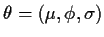 you generally begin by finding preliminary estimates
 say by one of the conditional likelihood
methods above and then iterate via Newton-Raphson or
some other scheme for numerical maximization of the
log-likelihood.
say by one of the conditional likelihood
methods above and then iterate via Newton-Raphson or
some other scheme for numerical maximization of the
log-likelihood.
 models
Here we consider the model with known mean (generally this
will mean we estimate
and subtract the mean
from all the observations):

In general has a
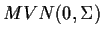 distribution and, letting
 denote the vector of
  s we find
![$\displaystyle \ell(\psi,\sigma) = -\frac{1}{2}\left[\log(\det(\Sigma))
- X^T \Sigma^{-1} X\right]
$](img107.gif) denotes the column vector of all the data.
As an example consider
denotes the column vector of all the data.
As an example consider  so that
![$\displaystyle \Sigma = \left[\begin{array}{ccccc}
\sigma^2(1+b_1^2) & -b_1\sigm...
...
\\
0 & \cdots & \cdots & -b_1\sigma^2& \sigma^2(1+b_1^2)
\end{array}\right]
$](img109.gif)
 .
.
Notice that
 |
 |
|
 |
 |
|
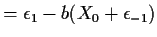 |
||
 |
 |
|
 |
||
 |
||
 |
 |
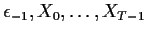 would give
 |
 |
|
 |
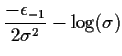
s the terms in this likelihood are squares
as usual (plus logarithms of ) leading to
 |
 |
|
![$\displaystyle - \sum_0^{T-1} \left[\frac{1}{2} (X_t - \psi X_{t-1} - \psi^2 X_{t-2} - \cdots -\psi^{t+1} \epsilon_{-1})^2+\log(\sigma)\right]$](img128.gif) |
somehow.
Method A: Put
 since 0 is
the most probable value and maximize
since 0 is
the most probable value and maximize
![$\displaystyle -T\log(\sigma) - \frac{1}{2\sigma^2} \sum_0^{T-1} \left[X_t - \psi X_{t-1}
- \psi^2 X_{t-2} - \cdots -\psi^{t}X_0\right]^2
$](img130.gif) the coefficients of
are close to 0 for most
the coefficients of
are close to 0 for most  and the remaining few terms are
negligible relatively to the total.
and the remaining few terms are
negligible relatively to the total.
Method B: Backcasting is the process of
guessing
on the basis of the data; we replace
in the log likelihood by

 and .
and .
We will use the EM algorithm to solve this problem.