After exponential quantities the circular functions, sine and cosine, should be considered because they arise when imaginary quantities are involved in the exponential. — Leonhard Euler, Swiss mathematician, physicist, astronomer, logician and engineer, 1707 – 1783
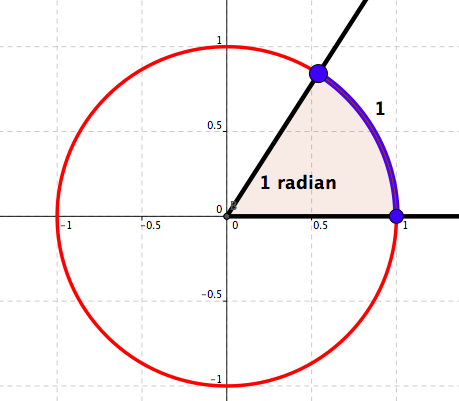
Reminder: We say that the angle that is associated with the arc of the length 1 measures 1 radian. See Figure 4.26.
\begin{equation*}
\begin{array}{lll}
\text{a real number } x \amp \to \amp \text{the unique corresponding point on the unit circle }X=(a,b)\\
\amp \to \amp x\mapsto a \text{ and } x\mapsto b\\
\amp \to \amp \text{ Call }a=\cos (x) \text{ and call }b=\sin (x)\\
\end{array}
\end{equation*}
Figure4.28.From \(x\) to \(\cos x\) and \(\sin x\text{.}\)
Definition: The cosine of \(x\text{,}\) denoted \(\cos x\text{,}\) is the first coordinate of the endpoint of the radius of the unit circle corresponding to \(x\text{.}\)
Definition: The sine of \(x\text{,}\) denoted \(\sin x\text{,}\) is the second coordinate of the endpoint of the radius of the unit circle corresponding to \(x\text{.}\)
By definition: \(\cos x\) is the first coordinate of the corresponding point on the unit circle and \(\cos x\) is the first coordinate of the corresponding point on the unit circle.
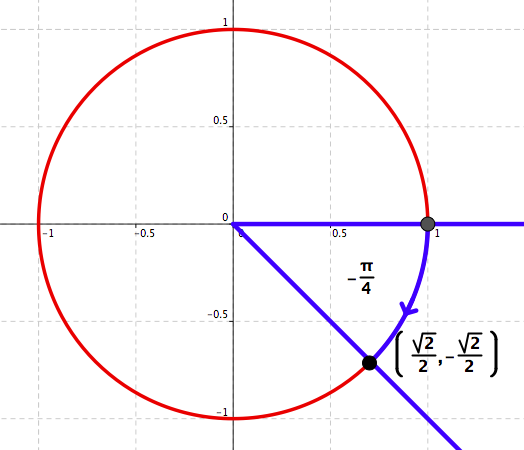
Figure4.33.Note that the points with the coordinates \((\cos x,\sin x)\) and \((\cos (-x),\sin (-x))\) are symmetric with respect to the \(x\)-axis. Thus \(\cos(-x)=\cos x\text{.}\)
Figure4.34.Note that the points with the coordinates \((\cos x,\sin x)\) and \((\cos (-x),\sin (-x))\) are symmetric with respect to the \(x\)-axis. Thus \(\sin(-x)=-\sin x\text{.}\)
Suppose that \(\alpha\) is an angle with the vertex at the origin. Also, suppose that the positive ray of the \(x\)–axis is the initial ray of the angle \(\alpha\text{.}\) See Figure 4.30 and Figure 4.31.
Figure4.36.If the terminal ray of the angle \(\alpha\) belongs to the \(2^{\text{nd}}\) or the \(3^{\text{rd}}\) quadrant then \(\cos \alpha\lt 0\text{.}\)
Figure4.37.If the terminal ray of the angle \(\alpha\) belongs to the \(1^{\text{st}}\) or the \(2^{\text{nd}}\) quadrant then \(\sin \alpha \gt 0\) .