| Research Interests
|
||||||||||||||||||
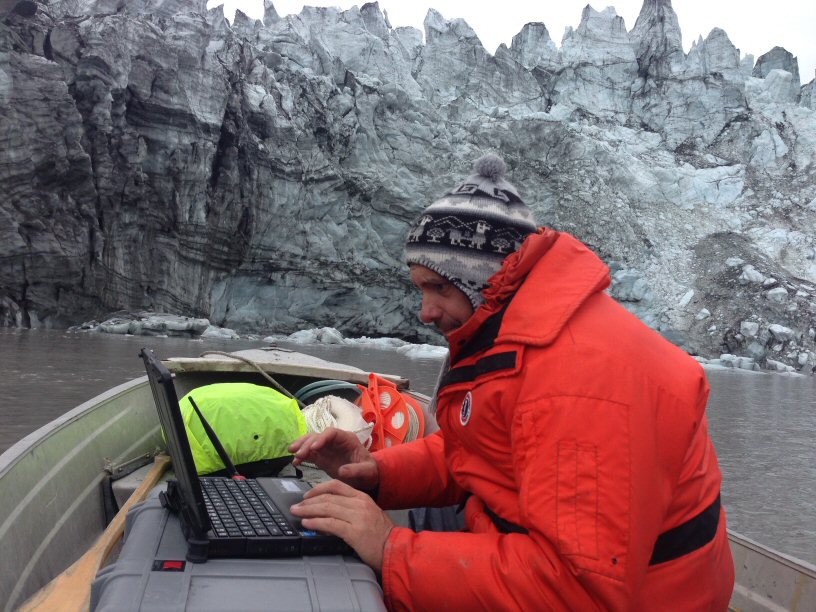 |
My primary interests are in the geomorphic and sedimentary processes that shape Earth's surface. I work at a range of temporal and spatial scales from detailed examinations of sediment dynamics occurring over fractions of a second in laboratory channels to monitoring annual river and watershed responses to human impacts. The theme of my research throughout my career has been erosion and sedimentation processes, particularly in river channels. I use a spectrum of research approaches, including field observation and experimentation, physical modeling in laboratories, development of theoretical models, and numerical simulation. I have recently been engaged in research on the topics listed below.
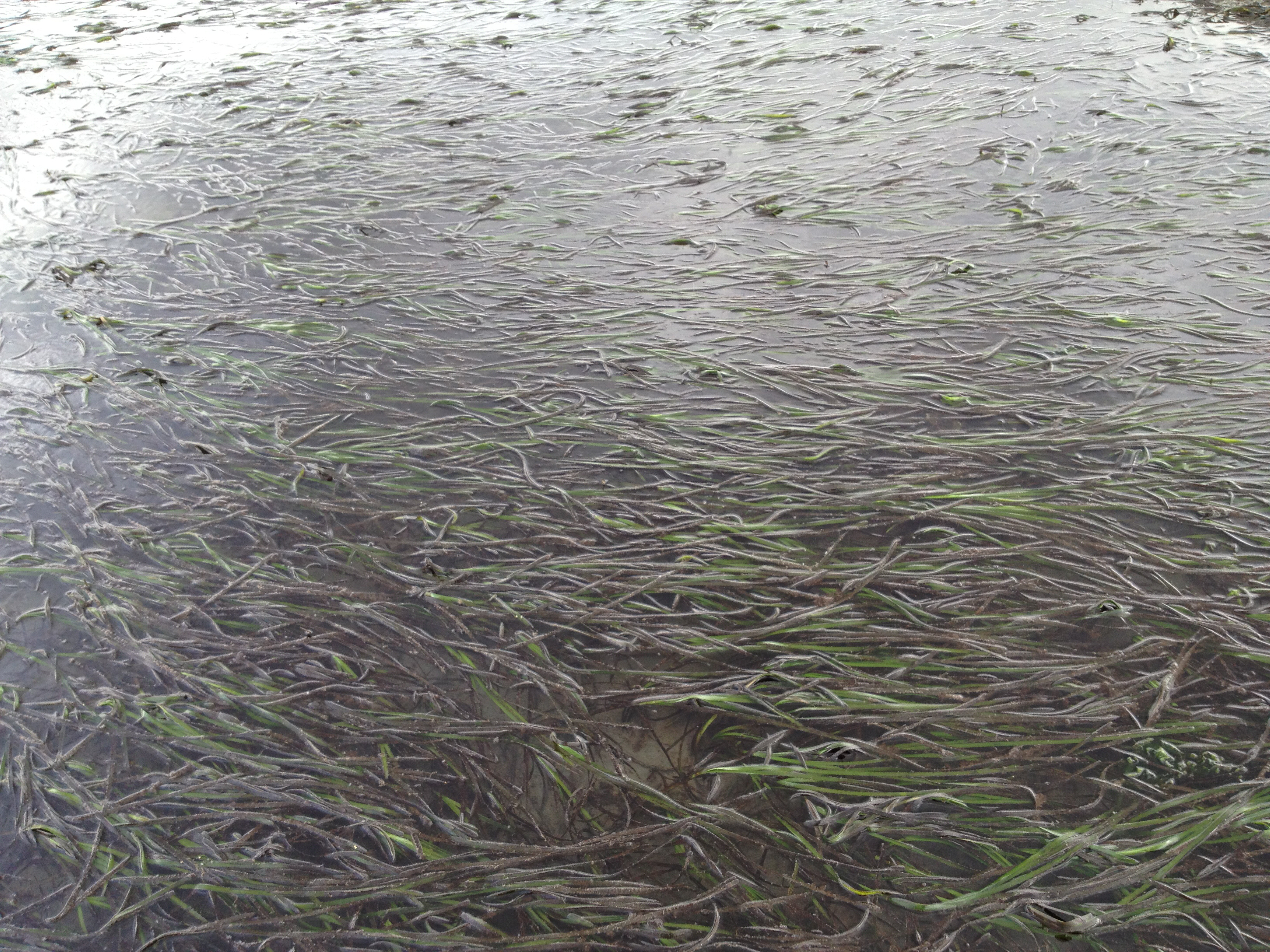
Dynamics of Bedrock Canyons Understanding the linkages amongst surface processes and solid earth dynamics represents one of the greatest challenges in Earth Science. Active incision in bedrock rivers sets the pace of landscape evolution. The relief of mountain ranges is ultimately controlled by the depth of bedrock incision by rivers. Furthermore, rivers actively cut deep valleys and canyons into bedrock, and transport that material to the sea, unburdening the Earth's surface and allowing isostatic uplift of majestic mountain peaks in tectonically active settings. Our ability to predict the behavior of alluvial river channels (rivers that flow through their own deposits) has steadily increased over the past century and, in the past few decades, models have been developed that capture many of the essential morphodynamic processes. However, our understanding of the morphodynamics of non-alluvial, bedrock-bound channels is not nearly as well developed. Improved understanding of large-scale, long-term landscape evolution requires a better understanding of fluid and sediment dynamics in bedrock rivers. Recent work by my research group has shown that bedrock canyons exhibit a complex flow structure that causes velocity inversions and radically alters the distribution of shear stress in bedrock canyons, which influences the patterns and magnitude of rock erosion [Venditti et al., Nature, 2014].We seek answers to the following research questions: 1) How are channel morphology and flow dynamics linked in bedrock constrained channels? 2) What causes velocity inversions in bedrock rivers? 3) Are non-uniform flow structures important for predicting the long term incision rate in bedrock rivers? We use a combination of targeted field campaigns in the Fraser Canyon, British Columbia, physical modelling in the River Dynamics Lab at Simon Fraser University to explore flow, sediment movement and erosion patterns and numerical modelling of outcomes from the field and lab to integrate results over geologic time scales. 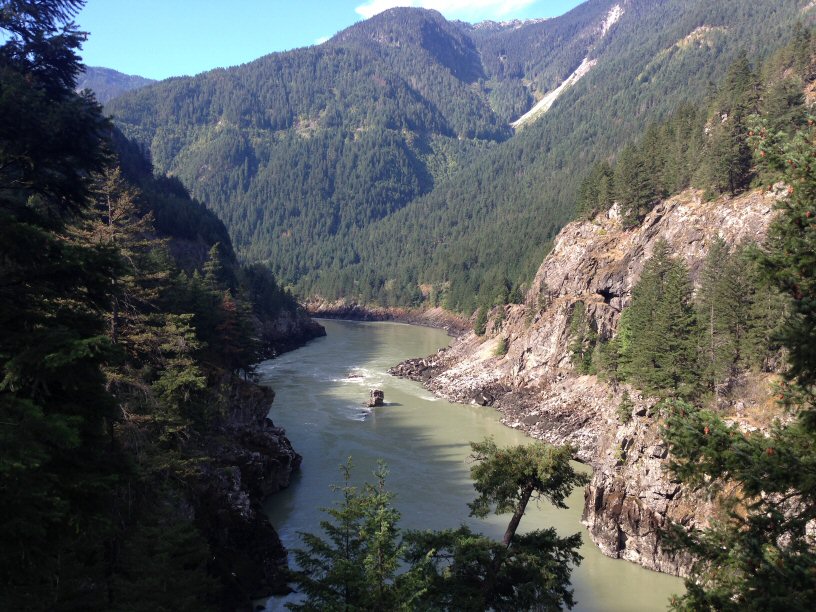 Exit of Black Canyon, British Columbia at Low Flow. Gravel Sand-Transitions River bed sediments fine in the downstream direction, in the absence of lateral sediment inputs. Rivers typically go through a unimodal gravel-bedded reach where the bed material fines in the downstream direction, then a bimodal sand-gravel reach and finally a unimodal sand-bedded reach as rivers approach base level. This transition from gravel to sand bedded condition is often observed to be abrupt. There is no other place in the fluvial system where such abrupt transitions between grain-sizes occurs. Our work has been focused on trying to answer the following questions: 1) What is the morphology of the GST in large river systems?, 2) Why do abrupt GSTs emerge? 3) What controls their locations? and 4) How does sediment move through GSTs? [ Venditti et al., 2010; Venditti and Church, 2014; Venditti et al., 2015; Lamb and Venditti, 2016]  Gravel-sand transition reach in the Fraser River near Mission, British Columbia. Click on image for a higer resolution version. Morphodynamics of Vegetated Sediment Beds Vegetation is ubiquitous in riverine and coastal environments, but the physics governing morphodynamic interactions modulated by vegetation are still poorly understood. There has been a lot of previous work on how various types of vegetation impact turbulent flow and hydraulic roughness in fluid flows. The effect of such modifications of the flow on sediment transport has not been widely investigated. We have been exploring two inter-related questions: 1) How much of the total applied shear stress is communicated to the sediment bed and available to mobilize and transport sediment? [Le Bouteiller and Venditti, in review at Water Resources Research] and 2) How do sediment beds morphodynamically adjust to the presence of vegetation? [LeBouteiller and Venditti, 2014; LeBouteiller and Venditti, 2015]
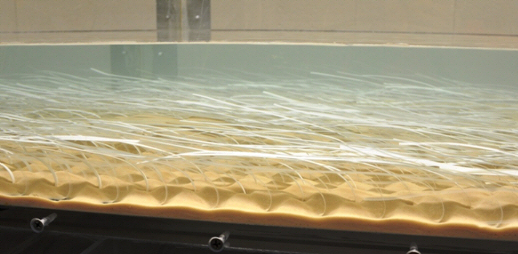
Impacts of Run-of-River Hydro Development The development of RoR hydro power is a controversial issue in British Columbia and many other jurisdictions because the cumulative effects of these relatively small hydro projects is currently unknown. We have been working with Wendy Palen's research group and Innergex, a major RoR developer and operator in Canada, to develop quantitative methods to assess project impacts in the pre-project development phase. We know that disruptions to sediment supply continuity caused by RoR hydropower development have the potential to cause downstream changes in bed surface sediment grain size which can influence the productivity of fish habitat. The most common approach to understanding the impacts of RoR hydropower is to study channel changes in the years following project development, but by then, any impacts are manifest and difficult to reverse. We have been using 1D morphodynamic model to test the hypothesis that the greatest risk of geomorphic change occurs where predevelopment sediment supply is high and project design creates substantial sediment storage volume. Our results support the hypothesis and provide quantitative metrics for the conditions that are likely to have major ecological impacts [Fuller et al., 2016]. 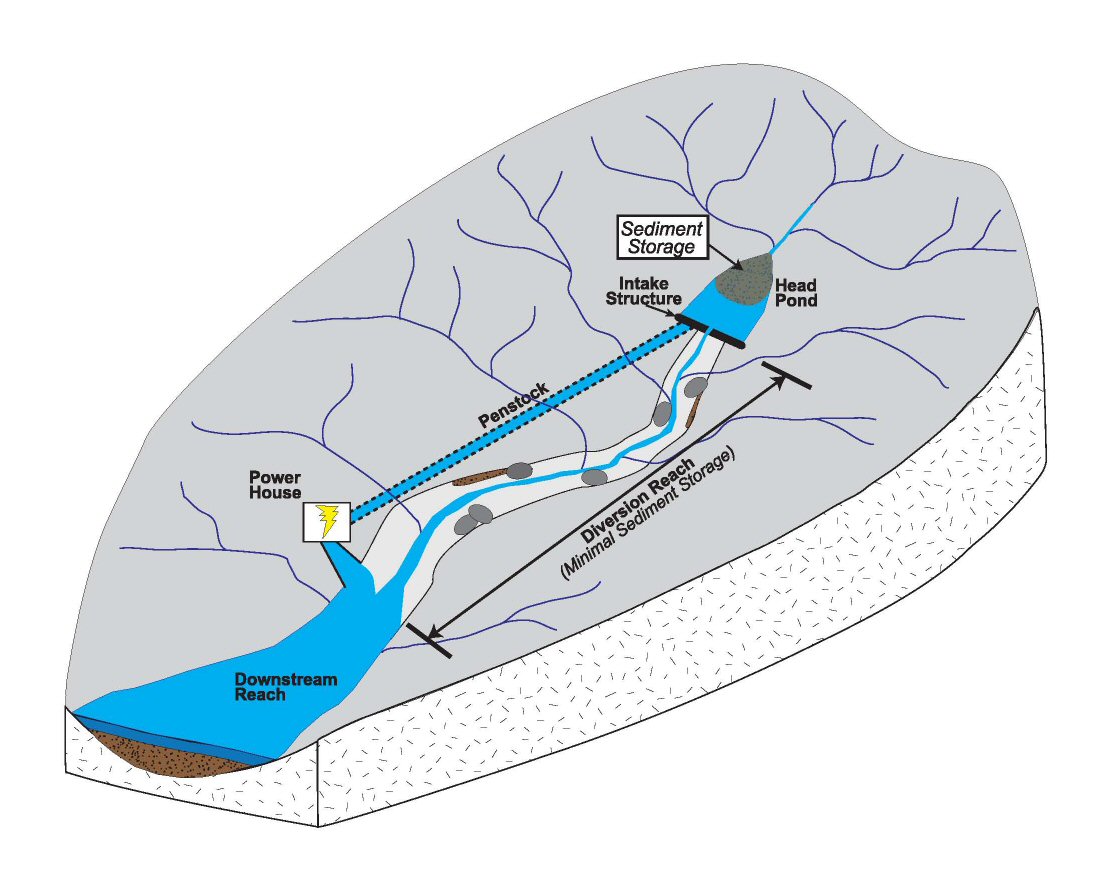 Typical Run-of-River Hydro project in British Columbia at Low Flow. Bedform Dynamics in Sand-bedded Rivers In sand-bedded alluvial channels, the bottom boundary consists of a labile bed comprising bedforms of many different scales and geometries. Bedforms are deformations of a sand bed that are smaller than channel-scale bar forms and that have specific geometric properties. They are ubiquitous in channels with flows capable of moving sandy sediment. A wide variety of bedforms is known to develop at an assortment of scales in rivers and in a range of textural materials suggesting common formative processes. These features occur at discrete sites on riverbeds, although they commonly recur in periodic fashion and can be channel extensive. There are two broad classes of bedforms commonly observed in sand-bedded rivers: small scale ripples and larger-scale dunes. There is also a host of other bedforms that may occur (e.g., antidunes, upper-stage plane bed waves, and bedload sheets) under certain hydraulic or sediment-supply conditions that are rarer, but still occur in channels. Our work to date has focused on: 1) Comparisons between turbulent flow fields measured in laboratory and field situations [Venditti and Bauer, 2005]2) Bedform hierarchy [Venditti et al., 2005; Church and Venditti, 2005 AGU Abst] 3) The transition between 2D and 3D bedforms [Venditti et al., 2005; Venditti et al., 2005; ] 4) Bedform growth from initially flat-bed boundaries [Venditti et al., 2005; Venditti et al., 2006] 5) Bedform migration and sediment transport [Venditti et al., 2005; Lin M.Sc. Thesis, 2011 Lin and Venditti, 2013 Venditti et al. 2016, 2013] 6) Bedform dynamics in tidally influences rivers [Bradley Thesis, 2012; Bradley et al., 2012; Hendershot Thesis, 2012] 7) Low lee angle dune dynamics [Bradley et al., 2013; Hendershot Thesis, 2012] Hendershot et al., 2016]
Flow and Sediment Transport in Gravel-Bedded Streams 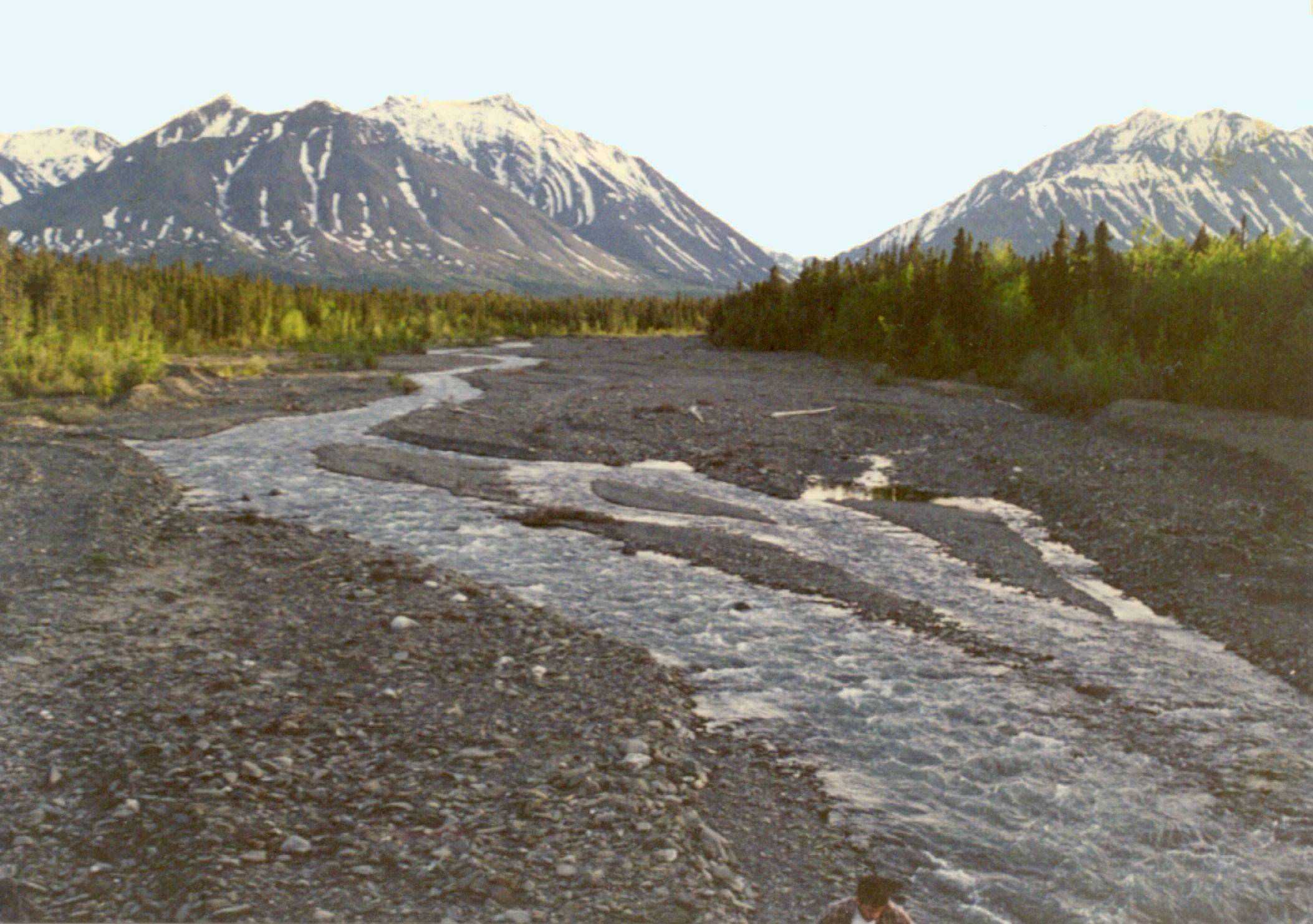 Quill Creek, Yukon Territory
Gravel-bedded streams dominate the mountainous environs of western North America and understanding process and mechanisms in these streams are critical to developing appropriate management strategies in these areas that are undergoing urban or industrial development. Our work to date has focused on: 1) Linkages between sediment supply, development and dynamics of bed surface patchiness and channel topography [Dietrich et al., 2006; Venditti et al., 2008; Nelson et al., 2009; Venditti et al., 2010; Nelson et al., 2010; Venditti et al., 2012] 2) The dynamics of sediment pulses in gravel-bedded rivers [Cui et al., 2008; Sklar et al., 2009; Venditti et al., 2010 Humphries et al., 2012] 3) Sediment entrainment in steep streams [Lamb et al., 2008]
Turbulence and Coherent Flow Structures in Rivers The interaction between flow structure, mobile sediment and bed surface morphology is of central importance in understanding river dynamics. Coherent flow structures drive sediment transport processes in rivers and are capable of sculpting morphological features of rivers at larger scales. We are interested in understanding the dynamics, kinematics and of topology of the coherent flow structures that that are responsible for grain-scale motion, larger scale structures that control bedform dynamics and the channel scale flow structure that governs the morphology of alluvial rivers. To date, much of our work has focused on: 1) The linkage between turbulent flow coherent flow structures and suspended sediment transport over dunes [Venditti and Bennett, 2000 Bradley Thesis, 2012; Bradley et al., 2012;] 2) Turbulent flow over 2D and 3D bedforms [Venditti, 2007] 3) Identification of coherent flow structures in open channels [Keylock et al., 2014 Venditti et al., 2013] In August 2011, we hosted the second Coherent Flow Structures Conference and produced an edited book loosely based on the conference. Coherent Flow Structures at Earth's Surface presents a series of major, invited papers and a selection of the some of the most novel, innovative papers presented at the conference. You can access individual chapters via Wiley's online library | |||||||||||||||||
|
|
||||||||||||||||||
.gif)
.gif)
.gif)