


Reading for Today's Lecture: Chapters 1, 2 and 3 of Ross.
Example 3: Survival of family names. Traditionally: family name follows sons. Given man at end of 20th century. Probability descendant (male) with same last name alive at end of 21st century? or end of 30th century?
Simplified model: count generations not years. Compute probability, of survival of name for n generations.
Technically easier to compute qn, probability of extinction by generation n.
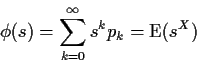
Useful rvs:


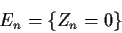
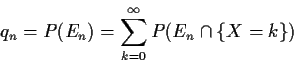
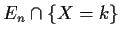 .
Let
.
Let


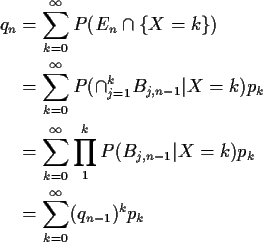
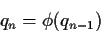
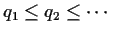 so that the limit of
the qn, say
so that the limit of
the qn, say  ,
must exist and (because
,
must exist and (because  is
continuous)
solve
is
continuous)
solve

Geometric Distribution: Assume

 is probability of success.)
Then
![\begin{align*}\phi(s) & = \sum_0^\infty s^k (1-\theta)^k \theta
\\
& = \theta \...
...fty \left[s(1-\theta)\right]^k
\\
& = \frac{\theta}{1-s(1-\theta)}
\end{align*}](img19.gif)
Set
 to get
![\begin{displaymath}s[1-s(1-\theta)]=\theta
\end{displaymath}](img21.gif)


 the only root which is a probability is 1 and
 .
If
.
If
 then in fact
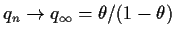 .
.
Binomial( ): If
): If

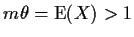
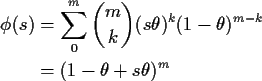 has two roots. One is 1. The other is
less than 1 if and only if
has two roots. One is 1. The other is
less than 1 if and only if
 .
.
Poisson( ): Now

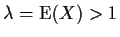
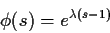 has two roots. One is 1. The other
is less than 1 if and only if
has two roots. One is 1. The other
is less than 1 if and only if
 .
.
Important Points: