


Reading for Today's Lecture: Chapter 4 sections 1-3.
Goals of Today's Lecture:
Today's notes
We have reviewed the following definitions:
 set
of possible outcomes,
set
of possible outcomes,  .
.
 .
.
 and
and
 .
.
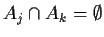
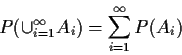
 pairwise disjoint
(
pairwise disjoint
(
 )
)






 is previous with x replaced by X after getting
formula.
is previous with x replaced by X after getting
formula.
Tactics:
 is a partition
then
is a partition
then

Tactics for expected values:

![\begin{displaymath}{\rm E}\left[{\rm E}(Y\vert X)\right] = {\rm E}(Y)
\end{displaymath}](img22.gif)
The last names example has the following structure: if, at generation n there are m individuals then the number of sons in the next generation has the distribution of the sum of m independent copies of the random variable X which is the number of sons I have. This distribution does not depend on n, only on the value m of Zn. We call Zn a Markov Chain.
Ingredients of a Markov Chain:
 of random variables whose values
are all in S.
of random variables whose values
are all in S.
 with entries Pi,j for
  .
The matrix
is required to be stochastic which means
.
The matrix
is required to be stochastic which means

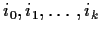
The stochastic process
is called a
Markov chain if

 and all k.
The matrix
is called a transition matrix.
Example: If X in the last names example has
a Poisson distribution then given Zn=k,
Zn+1 is like the sum of k independent Poisson
random variables which has a Poisson(
distribution then given Zn=k,
Zn+1 is like the sum of k independent Poisson
random variables which has a Poisson( )
distribution.
So
)
distribution.
So
![\begin{displaymath}{\bf P}= \left[\begin{array}{llll}
1 & 0 & 0 & \cdots
\\
e^{...
...ts
\\
\vdots &
\vdots &
\vdots &
\ddots
\end{array}\right]
\end{displaymath}](img31.gif)
Example: Weather: each day is dry (D) or wet (W).
Xn is weather on day n.
Suppose dry days tend to be followed by dry days, say 3 times in 5 and wet days by wet 4 times in 5.
Markov assumption: yesterday's weather irrelevant to prediction of tomorrow's given today's.
Transition Matrix:
![\begin{displaymath}{\bf P}= \left[\begin{array}{cc} \frac{3}{5} & \frac{2}{5}
\\
\frac{1}{5} & \frac{4}{5}
\end{array} \right]
\end{displaymath}](img32.gif)
Now suppose it is wet today. P(wet in 2 days) ?
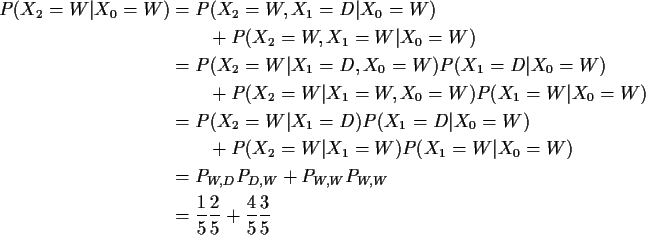
Notice that all the entries in the last line are items in .
Look at the matrix product
 :
:
![\begin{displaymath}\left[\begin{array}{ll} \frac{3}{5} & \frac{2}{5}
\\
\frac{1...
... \frac{2}{5}
\\
\frac{1}{5} & \frac{4}{5}
\end{array} \right]
\end{displaymath}](img35.gif) .
.