


Reading for Today's Lecture: Chapter 4 sections 1-3.
Goals of Today's Lecture:
Look at the matrix product
 :
:
![\begin{displaymath}\left[\begin{array}{ll} \frac{3}{5} & \frac{2}{5}
\\
\frac{1...
... \frac{2}{5}
\\
\frac{1}{5} & \frac{4}{5}
\end{array} \right]
\end{displaymath}](img3.gif) .
.
General case. Define
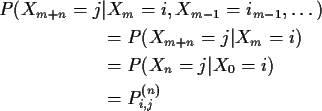
Proof of these assertions by induction on m,n.
Example for n=2. Two bits to do:
First suppose U,V,X,Y are discrete variables.
Assume

for any x,y,u,v. Then I claim
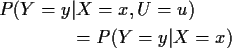
In words, if knowing both U and V doesn't change the
conditional probability then knowing U alone doesn't
change the conditional probability.
Proof of claim:


Second step: consider
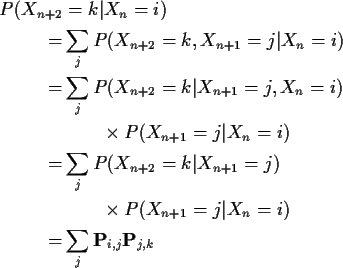
This shows that

 means the matrix product
.
Notice both
that the quantity does not depend on n and that we can
compute it by taking a power of
means the matrix product
.
Notice both
that the quantity does not depend on n and that we can
compute it by taking a power of  .
.
More general version

 we get the Chapman-Kolmogorov
equations:
we get the Chapman-Kolmogorov
equations:

Summary: A Markov Chain has stationary n step transition probabilities which are the nth power of the 1 step transition probabilities.
Here is Maple output for the 1,2,4,8 and 16 step transition matrices for our rainfall example:
> p:= matrix(2,2,[[3/5,2/5],[1/5,4/5]]);
                      [3/5    2/5]
                 p := [          ]
                      [1/5    4/5]
> p2:=evalm(p*p):
> p4:=evalm(p2*p2):
> p8:=evalm(p4*p4):
> p16:=evalm(p8*p8):
This computes the powers (evalm understands
matrix algebra).
Fact:
![\begin{displaymath}\lim_{n\to\infty} {\bf P}^n = \left[
\begin{array}{cc} \frac{...
...{3}
\\
\\
\frac{1}{3} & \frac{2}{3}
\end{array}\right] \, .
\end{displaymath}](img16.gif)
> evalf(evalm(p));
            [.6000000000    .4000000000]
            [                          ]
            [.2000000000    .8000000000]
> evalf(evalm(p2));
            [.4400000000    .5600000000]
            [                          ]
            [.2800000000    .7200000000]
> evalf(evalm(p4));
            [.3504000000    .6496000000]
            [                          ]
            [.3248000000    .6752000000]
> evalf(evalm(p8));
            [.3337702400    .6662297600]
            [                          ]
            [.3331148800    .6668851200]
> evalf(evalm(p16));
            [.3333336197    .6666663803]
            [                          ]
            [.3333331902    .6666668098]
Where did 1/3 and 2/3 come from?
Suppose we toss a coin
 and start the
chain with Dry if we get heads and Wet if we get
tails.
and start the
chain with Dry if we get heads and Wet if we get
tails.
Then


 by matrix .
A special :
if we put
 and
and
 then
then
![\begin{displaymath}\left[ \frac{1}{3} \quad \frac{2}{3} \right]
\left[\begin{ar...
...y} \right] = \left[ \frac{1}{3} \quad \frac{2}{3} \right] \, .
\end{displaymath}](img23.gif)
A probability vector
is called an initial distribution for
the chain if

A Markov Chain is stationary if
An initial distribution is called stationary if the chain is
stationary. We find that
is a stationary initial distribution
if

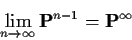
Suppose  converges to some matrix
 .
Notice that
.
Notice that
![\begin{align*}{\bf P}^\infty & = \lim {\bf P}^n
\\
& = \left[\lim {\bf P}^{n-1}\right] {\bf P}
\\
& = {\bf P}^\infty {\bf P}\, .
\end{align*}](img29.gif)
This proves that each row
of
satisfies

Def'n: A row vector x is a left eigenvector of A with
eigenvalue  if
if

So each row of
is a left eigenvector of
with eigenvalue 1.