


Example 3: Mean values
 = total number of sons in generation
  .
.
 for convenience.
Compute
 .
.
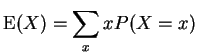
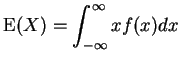
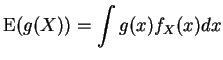
Recall definition of expected value:
If  is discrete then
If is absolutely continuous then
Theorem: If  , has density
  then
then
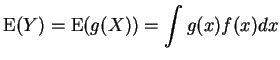
Key properties of  :
:
1: If  then
then
 . Equals iff
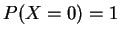 .
.
2:
 .
.
3: If
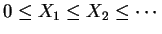 then
then

4:
 .
.
Conditional Expectations
If ,  , two discrete random variables then

Extension to absolutely continuous case:
Joint pmf of and is defined as
 is
is

 is
is

 have joint density
  then has density
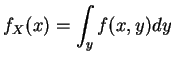
Example:

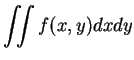 |
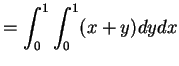 |
|
 |
||
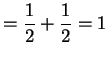 |
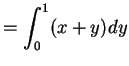
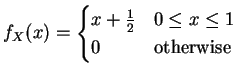
The marginal density of is, for
 .
.
 |
 |
|
 |
||
 |
For  not in
 ![$ [0,1]$](img39.gif) the integral is 0 so
the integral is 0 so
Conditional Densities
If and have joint density
 then
we define the conditional density of given
then
we define the conditional density of given  by
analogy with our interpretation of densities. We take limits:
by
analogy with our interpretation of densities. We take limits:

 and let
 and tend to 0 the conditional density is the limit
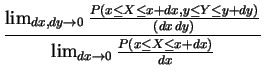
Going back to our interpretation of joint densities and ordinary densities we see that our definition is just
 and of random variables we
refer to
and of random variables we
refer to  as the joint density and to
  as
the marginal density of .
as
the marginal density of .
Example: For of previous example conditional density
of given defined only for
:
 a Poisson
 random variable. Observe then toss
a coin times. is number of heads.
random variable. Observe then toss
a coin times. is number of heads. 
 |
 |
|
 |
||
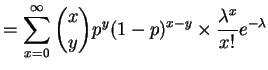 |
WARNING: in sum
 is required and ,
  integers
so sum really runs from to
integers
so sum really runs from to 
|
![$\displaystyle = \frac{(p\lambda)^ye^{-\lambda}}{y!} \sum_{x=y}^\infty \frac{\left[(1-p)\lambda\right]^{x-y}}{(x-y)!}$](img60.gif) |
|
![$\displaystyle = \frac{(p\lambda)^ye^{-\lambda}}{y!}\sum_0^\infty \frac{\left[(1-p)\lambda\right]^{k}}{k!}$](img61.gif) |
||
 |
||
 |
 ) distribution.
Conditional Expectations
If and are continuous random variables with joint density
we define:

Key properties of conditional expectation
1: If  then
then
 . Equals iff
 .
.
2:
 .
.
3: If and are independent then

4:
 .
.
Example:
 :
,
:
,
 |
 |
|
 |
Computing expectations by conditioning:
Notation:
 is the function of you get by
working out
is the function of you get by
working out
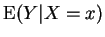 , getting a formula in and replacing
by . This makes
a random variable.
, getting a formula in and replacing
by . This makes
a random variable.
Properties:
1:
 .
.
2: If and are independent then
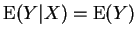
3:
 .
.
4:
![$ {\rm E}\left[{\rm E}(Y\vert X)\right] = {\rm E}(Y) $](img81.gif) (compute average
holding fixed first, then average over ).
(compute average
holding fixed first, then average over ).
In example:


 |
![$\displaystyle = {\rm E}\left[{\rm E}(Z_n\vert X)\right]$](img85.gif) |
|
![$\displaystyle = {\rm E}\left[ X{\rm E}(Z_{n-1})\right]$](img86.gif) |
||
 |
||
 |
||
 |
||
 |
||
 |
||
 |
For  expect exponential decay. For
  exponential
growth (if not extinction).
exponential
growth (if not extinction).
We have reviewed the following definitions:
 set
of possible outcomes,
set
of possible outcomes,  .
.
 .
.
 function defined for events, values in
satisfying:
function defined for events, values in
satisfying:
 and
and
 .
.
 pairwise disjoint
(
pairwise disjoint
(
 )
)

discrete:



continuous:
; probabilities are double integrals


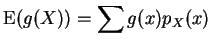


 is previous with replaced by after getting
formula.
is previous with replaced by after getting
formula.
Tactics:
 ,
,  for which
  is known.
 is a partition
then
is a partition
then

Tactics for expected values:

![$\displaystyle {\rm E}\left[{\rm E}(Y\vert X)\right] = {\rm E}(Y)
$](img121.gif)