


Finding stationary initial distributions. Consider the  for the weather example. The equation

 |
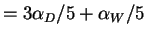 |
|
 |
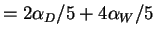 |

 is to be a
probability vector then
is to be a
probability vector then
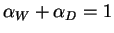
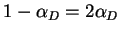

![$\displaystyle {\bf P}= \left[\begin{array}{cccc}
0 & 1/3 & 0 & 2/3
\\
1/3&0 & 2/3 & 0
\\
0 & 2/3 & 0 & 1/3
\\
2/3 & 0 & 1/3 & 0
\end{array}\right]
$](img12.gif)
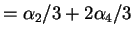
 and get
 |
 |
|
 |
 |
|
 |
 |
|
 |
 |
|
 |
 |


p:=matrix([[0,1/3,0,2/3],[1/3,0,2/3,0],
          [0,2/3,0,1/3],[2/3,0,1/3,0]]);

               [ 0     1/3     0     2/3]
               [                        ]
               [1/3     0     2/3     0 ]
          p := [                        ]
               [ 0     2/3     0     1/3]
               [                        ]
               [2/3     0     1/3     0 ]
> p2:=evalm(p*p);
             [5/9     0     4/9     0 ]
             [                        ]
             [ 0     5/9     0     4/9]
        p2:= [                        ]
             [4/9     0     5/9     0 ]
             [                        ]
             [ 0     4/9     0     5/9]
> p4:=evalm(p2*p2):
> p8:=evalm(p4*p4):
> p16:=evalm(p8*p8):
> p17:=evalm(p8*p8*p):
> evalf(evalm(p16));
    [.5000000116 , 0 , .4999999884 , 0]
    [                                 ]
    [0 , .5000000116 , 0 , .4999999884]
    [                                 ]
    [.4999999884 , 0 , .5000000116 , 0]
    [                                 ]
    [0 , .4999999884 , 0 , .5000000116]
> evalf(evalm(p17));
    [0 , .4999999961 , 0 , .5000000039]
    [                                 ]
    [.4999999961 , 0 , .5000000039 , 0]
    [                                 ]
    [0 , .5000000039 , 0 , .4999999961]
    [                                 ]
    [.5000000039 , 0 , .4999999961 , 0]
> evalf(evalm((p16+p17)/2));
  [.2500, .2500, .2500, .2500]
  [                          ]
  [.2500, .2500, .2500, .2500]
  [                          ]
  [.2500, .2500, .2500, .2500]
  [                          ]
  [.2500, .2500, .2500, .2500]
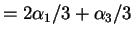
 doesn't converges but
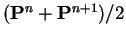 does.
Next example:
does.
Next example:
![$\displaystyle p = \left[\begin{array}{cccc}
\frac{2}{5} & \frac{3}{5}
& 0 &0
\\...
...ac{2}{5} & \frac{3}{5}
\\
0 &0 &
\frac{1}{5} & \frac{4}{5}\end{array}\right]
$](img28.gif) :
:
|
 |
|
|
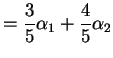 |
|
|
 |
|
|
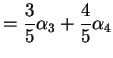 |
|
|
|
|
 |
|
 |
 |
|
|
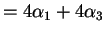 |
Pick  in
in ![$ [0,1/4]$](img38.gif) ;
put
;
put
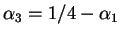 .
.
 .
So solution is not unique.
.
So solution is not unique.
> p:=matrix([[2/5,3/5,0,0],[1/5,4/5,0,0],
            [0,0,2/5,3/5],[0,0,1/5,4/5]]);

               [2/5    3/5     0      0 ]
               [                        ]
               [1/5    4/5     0      0 ]
          p := [                        ]
               [ 0      0     2/5    3/5]
               [                        ]
               [ 0      0     1/5    4/5]
> p2:=evalm(p*p):
> p4:=evalm(p2*p2):
> p8:=evalm(p4*p4):
> evalf(evalm(p8*p8));
        [.2500000000 , .7500000000 , 0 , 0]
        [                                 ]
        [.2500000000 , .7500000000 , 0 , 0]
        [                                 ]
        [0 , 0 , .2500000000 , .7500000000]
        [                                 ]
        [0 , 0 , .2500000000 , .7500000000]
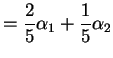
Notice that rows converge but to two different vectors:

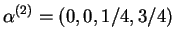 revisited?
Check that
revisited?
Check that


 (
(
 ) then
> p:=matrix([[2/5,3/5,0],[1/5,4/5,0],
             [1/2,0,1/2]]);

                  [2/5    3/5     0 ]
                  [                 ]
             p := [1/5    4/5     0 ]
                  [                 ]
                  [1/2     0     1/2]
> p2:=evalm(p*p):
> p4:=evalm(p2*p2):
> p8:=evalm(p4*p4):
> evalf(evalm(p8*p8));
  [.2500000000 .7500000000        0       ]
  [                                       ]
  [.2500000000 .7500000000        0       ]
  [                                       ]
  [.2500152588 .7499694824 .00001525878906]
all rows converge to some . In
this case this is a stationary initial distribution.
the locations of zeros flip flop. does
not converge. Observation: average
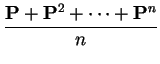
some rows converge to one and some to
another. In this case the solution of
is not
unique.
Basic distinguishing features: pattern of 0s in matrix .
State  leads to state
  if
if
 for some
  .
It is convenient to agree that
.
It is convenient to agree that
 the identity matrix;
thus leads to .
the identity matrix;
thus leads to .
Note leads to and leads to  implies leads to
(Chapman-Kolmogorov).
implies leads to
(Chapman-Kolmogorov).
States and communicate if leads to and leads
to .
The relation of communication is an equivalence relation; it
is reflexive, symmetric and transitive: if
and communicate and and communicate then and
communicate.
Example ( signs indicate non-zero entries):
![$\displaystyle {\bf P}= \left[\begin{array}{ccccc}
0& 1 & 0 & 0 &0
\\
0 & 0 & ...
...+ & + & 0 & 0
\\
+ & 0 & 0 & + & 0
\\
0 & + & 0 & + & +
\end{array}\right]
$](img55.gif)
For this example:
 ,
,
 ,
,
 so
so  are all in the same communicating class.
 but not vice versa.
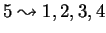 but not vice versa.
So the communicating classes are
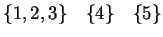
A Markov Chain is irreducible if there is only one communicating class.
Notation:

State is recurrent if  , otherwise
transient.
, otherwise
transient.
If then Markov property (chain starts over when
it gets back to ) means prob return infinitely many times
(given started in or given ever get to ) is 1.
Consider chain started from transient .
Let  be number of visits
to state (including visit at time 0). To return
be number of visits
to state (including visit at time 0). To return  times must return once
then starting over return
times must return once
then starting over return  times, then never return.
So:
times, then never return.
So:

 .
.
has a Geometric distribution and
 .
.
Another calculation:
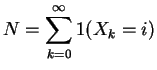
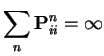
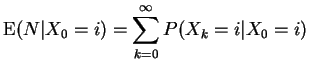 then this is
 is transient if and only if

For last example:  and
and  are transient. Claim:
states 1, 2 and 3 are recurrent.
are transient. Claim:
states 1, 2 and 3 are recurrent.
Proof: argument above shows each transient state is visited only finitely many times. So: there is a recurrent state. (Note use of finite number of states.) It must be one of 1, 2 and 3. Proposition: If one state in a communicating class is recurrent then all states in the communicating class are recurrent.
Proof: Let be the known recurrent state so
 and communicate. Find integers and such that


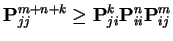 get
get  so
so

Proposition also means that if 1 state in a class is transient so are all.
State has period  if is greatest common
divisor of
if is greatest common
divisor of
 and are in the same class then and have same period.
If
and are in the same class then and have same period.
If  then state is called aperiodic; if
  then
is periodic.
then
is periodic.
![$\displaystyle {\bf P}= \left[\begin{array}{ccccc}
0& 1 & 0 & 0 &0
\\
0 & 0 & ...
...0 & 0 & 0 & 0
\\
0 & 0 & 0 & 0 & 1
\\
0 & 0 & 0 & 1 & 0
\end{array}\right]
$](img87.gif)
 is a class of period 3 states
and
is a class of period 3 states
and  a class of period 2 states.
![$\displaystyle {\bf P}= \left[\begin{array}{ccc}
0& 1/2 & 1/2
\\
1 & 0 & 0
\\
1 & 0 & 0
\end{array}\right]
$](img90.gif)
A chain is aperiodic if all its states are aperiodic.