


Example: consider a sequence of independent coin tosses with probability  of Heads on a single toss. Let
  be number of heads minus number of tails
after
be number of heads minus number of tails
after  tosses. Put
  .
.
is a Markov Chain. State space is
 , the integers and
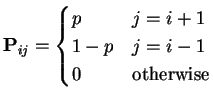
This chain has one communicating class (for  ) and
all states have period 2. According to the strong law of large
numbers
) and
all states have period 2. According to the strong law of large
numbers  converges to
  . If
. If  this guarantees
that for all large enough
this guarantees
that for all large enough
 , that is, the number
of returns to 0 is not infinite. The state 0 is then transient
and so all states must be transient.
, that is, the number
of returns to 0 is not infinite. The state 0 is then transient
and so all states must be transient.
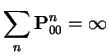
For  the situation is different. It is a fact that
 # H = # T at time $n$
 even this is the probability of exactly
  heads
in tosses.
heads
in tosses.
Local Central Limit Theorem (normal approximation to
 ) (or Stirling's approximation) shows
 Binomial
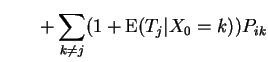
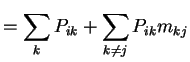
Start irreducible recurrent chain in state  .
Let
.
Let  be first
  such that
  .
Define
.
Define

 |
 |
|
 |
||
 |
||
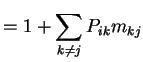 |
Example
![$\displaystyle {\bf P}=
\left[\begin{array}{cc} \frac{3}{5} & \frac{2}{5}
\\
\\
\frac{1}{5} & \frac{4}{5}
\end{array} \right]
$](img30.gif)
 |
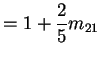 |
|
 |
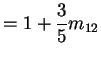 |
|
 |
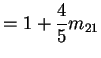 |
|
 |
 |
|
 |
|
|
 |
|
 |
|
|
 |
Notice stationary initial distribution is
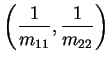
 :
:
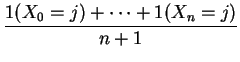 ; take expected value.
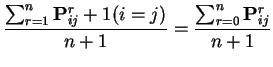
 converge to
  then fraction converges to
 ; i.e. limiting fraction of time in state is .
Heuristic: start chain in . Expect to return to every
 time units. So are in state about once every
time units; i.e. limiting fraction of time in state
is
time units. So are in state about once every
time units; i.e. limiting fraction of time in state
is  .
.
Conclusion: for an irreducible recurrent finite state space Markov chain

Previous conclusion is still right if there is a stationary initial distribution.
Example:
 Heads
Heads Tails after tosses
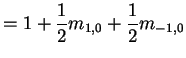
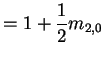
of fair coin. Equations are
Tails after tosses
of fair coin. Equations are
 |
 |
|
 |
 |
Some observations:
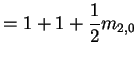
You have to go through 1 to get to 0 from 2 so

Symmetry (switching H and T):

The transition probabilities are homogeneous:

Conclusion:
|
 |
|
 |
||
 |
Summary of the situation:
Every state is recurrent.
All the expected hitting times  are infinite.
All entries
 converge to 0.
Jargon: The states in this chain are null recurrent.
Page 229, question 21: runner goes from front or back
door, prob 1/2 each. Returns front or back, prob 1/2 each.
Has  pairs of shoes, wears pair if any at departure door,
leaves at return door. No shoes? Barefoot. Long run fraction
of time barefoot?
pairs of shoes, wears pair if any at departure door,
leaves at return door. No shoes? Barefoot. Long run fraction
of time barefoot?
Solution: Let be number of shoes at front door on day .
Then is a Markov Chain.
Transition probabilities:
pairs at front door on day .  is if
goes out back door (prob is 1/2) or out front door and back
in front door (prob is 1/4). Otherwise is
is if
goes out back door (prob is 1/2) or out front door and back
in front door (prob is 1/4). Otherwise is  .
.
 pairs at front door on day . is
  if out back, in front (prob is 1/4). is
  if out
front, in back. Otherwise is .
if out
front, in back. Otherwise is .
0 pairs at front door on day . is 0 if
out front door (prob 1/2) or out back door and in back door
(prob 1/4) otherwise is  .
.
Transition matrix  :
:
![$\displaystyle \left[\begin{array}{cccccc}
\frac{3}{4} & \frac{1}{4} & 0 & 0 &\c...
... \vdots
\\
0 & 0 & 0 & \cdots & \frac{1}{4} & \frac{3}{4}
\end{array}\right]
$](img75.gif)
Doubly stochastic: row sums and column sums are 1.
So
 for all is stationary initial distribution.
Solution to problem: 1 day in  no shoes at front door. Half of
those go barefoot. Also 1 day in all shoes at front door; go
barefoot half of these days. Overall go barefoot
no shoes at front door. Half of
those go barefoot. Also 1 day in all shoes at front door; go
barefoot half of these days. Overall go barefoot  of the time.
Insurance company's reserves fluctuate: sometimes up, sometimes down.
Ruin is event they hit 0 (company goes bankrupt). General problem.
For given model of fluctuation compute probability of ruin either
eventually or in next time units.
Simplest model: gambling on Red at Casino. Bet $1 at a time. Win
$1 with probability , lose $1 with probability  . Start with
dollars. Quit playing
when down to $0 or up to
. Start with
dollars. Quit playing
when down to $0 or up to  . Compute
 reach $N$ before $0$
= fortune after plays.  .
.
Transition matrix:
![$\displaystyle {\bf P}=
\left[\begin{array}{cccccc}
1 & 0 & 0 & 0 &\cdots & 0
\...
... & \ddots & \ddots & \vdots
\\
0 & 0 & 0 & \cdots & 0 & 1
\end{array}\right]
$](img84.gif)
 |
 |
|
 |
 |
|
 |
 |
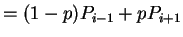
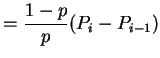
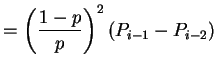
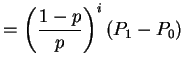
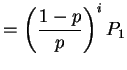
Middle equation is

 |
 |
|
 |
||
 |
||
 |
||
 |
 to
to  to get
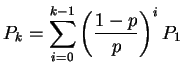
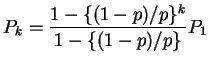
For  we get
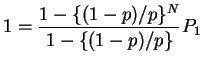
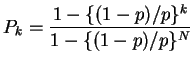
Notice that if our formulas for the sum of the geometric series
are wrong. But for we get


![$\displaystyle {\bf P}= \left[\begin{array}{cccc}
\frac{1}{2} & \frac{1}{2} & 0 ...
...\\
\frac{1}{4} & \frac{1}{4} & \frac{3}{8} & \frac{1}{8}
\end{array}\right]
$](img107.gif)
 be the expected
total number of visits to state for chain started in .
be the expected
total number of visits to state for chain started in .
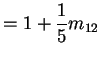
For  or
or  and
and  or 4:
or 4:

For  or
or 

For
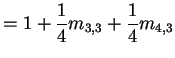
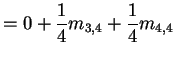
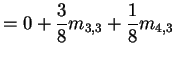
 first step analysis:
 |
 |
|
 |
 |
|
 |
 |
|
 |
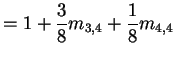 |
In matrix form
![$\displaystyle \left[\begin{array}{cc} m_{3,3} &m_{3,4} \\ \\ m_{4,3} &m_{4,4}\end{array}\right]$](img125.gif) |
![$\displaystyle = \left[\begin{array}{cc} 1 & 0 \\ \\ 0 & 1 \end{array}\right] +$](img126.gif) |
|
![$\displaystyle \qquad \left[\begin{array}{cc} \frac{1}{4} & \frac{1}{4} \\ \\ \f...
...eft[\begin{array}{cc} m_{3,3} &m_{3,4} \\ \\ m_{4,3} &m_{4,4}\end{array}\right]$](img127.gif) |
Translate to matrix notation:

 is the identity,
 is the matrix of means and
  the
part of the transition matrix corresponding to transient states.
the
part of the transition matrix corresponding to transient states.
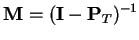
Solution is
![$\displaystyle {\bf I} - {\bf P}_T =
\left[\begin{array}{rr} \frac{3}{4} & -\frac{1}{4} \\ \\
-\frac{3}{8} & \frac{7}{8}
\end{array}\right]
$](img133.gif)
![$\displaystyle {\bf M} = \left[\begin{array}{rr} \frac{14}{9} & \frac{4}{9} \\ \\
\frac{2}{3} & \frac{4}{3}
\end{array}\right]
$](img134.gif)