


Particles arriving over time at a particle detector. Several ways to describe most common model.
Approach 1: numbers of particles arriving in an interval has Poisson distribution, mean proportional to length of interval, numbers in several non-overlapping intervals independent.
For  , denote number of arrivals in
 ![$ (s,t]$](img2.gif) by
by  . Model is
has a Poisson
 distribution.
 the variables
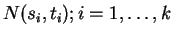 are independent.
Approach 2:
Let
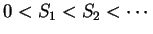 be the times at which the particles
arrive.
be the times at which the particles
arrive.
Let
 with
with  by convention.
Then
 are independent Exponential random variables with mean
  .
.
Note
 is called survival function of
  .
.
Approaches are equivalent. Both are deductions of a model based on local behaviour of process.
Approach 3: Assume:
![$ [0,t]$](img14.gif) the probability of 1 point in the
interval
the probability of 1 point in the
interval ![$ (t,t+h]$](img15.gif) is of the form
is of the form

the probability of 2 or more points in
interval is of the form

All 3 approaches are equivalent. I show: 3 implies 1, 1 implies 2
and 2 implies 3. First explain  ,
,  .
.
Notation: given functions  and
and  we write


[Aside: if there is a constant  such that


 and s.t. for all

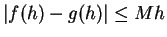
 is tiny compared to
  while
while
 is (very) roughly the same size as .]
Model 3 implies 1:
Fix  , define
  to be conditional probability of 0 points in
![$ (t,t+s]$](img35.gif) given value of process on .
given value of process on .
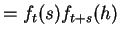
Derive differential equation for
. Given process on and 0 points in probability of no
points in ![$ (t,t+s+h]$](img36.gif) is
is
 the probability of no points in is
. Using
the probability of no points in is
. Using
 gives
gives
 |
 |
|
 |
to get

 and find


Notice: survival function of exponential rv..
General case. Notation:
 .
.
 is a non-decreasing function of . Let

 by conditioning on
 and
and  .
.
Given probability that
 is conditional
probability of
is conditional
probability of  points in .
So, for  :
:

 we have

 we have

 is increasing so only consider
  .
.
 |
 |
|
 |
and let t get

 the term
  is dropped and

 we get

 to get

 to see

With  we get

 we have
  and
and
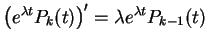
 has Poisson
 distribution.
Similar ideas permit proof of
 has independent Poisson increments.
If is a Poisson Process we define
to be the times between 0 and the first point, the first point and
the second and so on.
Fact:
are iid exponential rvs with
mean .
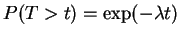
We already did  rigorously. The event
  is exactly the
event
is exactly the
event  . So
. So
I do case of  . Let
. Let  be two positive numbers and
 ,
,
 . Consider event

This is almost the same as the intersection of the four events:
![$\displaystyle N(0,t_1]$](img92.gif) |
 |
|
![$\displaystyle N(t_1,t_1+\delta_1]$](img94.gif) |
 |
|
![$\displaystyle N(t_1+\delta_1,t_1+\delta_1+t_2]$](img96.gif) |
|
|
![$\displaystyle N(s_2+\delta_1,s_2+\delta_1+\delta_2]$](img97.gif) |
|

 and let
  and
and  go to 0
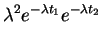
to get joint density of is
go to 0
to get joint density of is
More rigor:
 .
.
 .
.
First step: Compute

![$ (s_{i-1},s_i]$](img106.gif) for
for
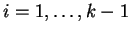 (
( ) and at least one point in
![$ (s_{k-1},s_k]$](img109.gif) which has probability
which has probability

Second step: write this in terms of joint cdf of
.
I do  :
:

 .
.
Differentiate twice, that is, take



That completes the first part.
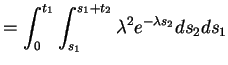
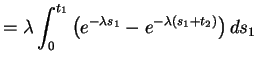
Now compute the joint cdf of by

 |
 |
|
 |
||
 |
||
 |

Summary so far:
Have shown:
Instantaneous rates model implies independent Poisson increments model implies independent exponential interarrivals.
Next: show independent exponential interarrivals implies the instantaneous rates model.
Suppose
 iid exponential rvs with means . Define
 by
by  if and only if

Let  be the event
 . We
are to show
. We
are to show
![$\displaystyle P(N(t,t+h] = 1\vert N(t)=k,A) = \lambda h + o(h)
$](img131.gif)
![$\displaystyle P(N(t,t+h] \ge 2\vert N(t)=k,A) = o(h)
$](img132.gif)
If  is a possible trajectory consistent with
  then
then  has jumps at points

![$ (0,t]$](img137.gif) .
.
So given
with  we are essentially being given

 given by
 irrelevant (independence).
![$\displaystyle P(N(t,t+h] = 1\vert$](img142.gif) |
 |
|
 |
||
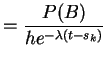 |
 to get the limit
![$\displaystyle P
(N(t,t+h] = 1\vert N(t)=k,A) /h \to \lambda
$](img147.gif)
The computation of
![$\displaystyle \lim_{h\to 0} P(N(t,t+h] \ge 2\vert N(t)=k,A) /h
$](img148.gif)
Convolution: If  and
and  independent rvs with
densities and respectively and
independent rvs with
densities and respectively and  then
then

 we get
 and .
and .
If
 iid Exponential
 then
then
 has a Gamma
 distribution. Density
of
distribution. Density
of  is
is

 .
.
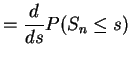
Proof:
 |
![$\displaystyle = P(N(0,s] < n)$](img163.gif) |
|
 |
Then
 |
 |
|
 |
||
 |
||
 |
||
 |
||
|

Extreme Values: If
 are independent exponential rvs
with means
are independent exponential rvs
with means
 then
then
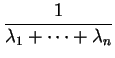
 has an exponential distribution with
mean
has an exponential distribution with
mean
Proof:
 |
 |
|
 |
||
 |
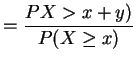
Memoryless Property: conditional distribution of
 given
given  is
exponential if has an exponential distribution.
is
exponential if has an exponential distribution.
Proof:
 |
 |
|
 |
||
 |
||
 |
||
 |
The hazard rate, or instantaneous failure rate for a positive
random variable  with density and cdf
  is
is

 this is

Weibull random variables have density

 . The corresponding survival function is
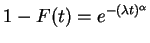

 , decreasing for
  . For
. For  this is the exponential distribution.
Since
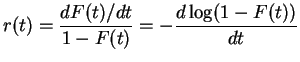

 determines and .