


Consider a population of single celled organisms in a stable environment.
Fix short time interval, length  .
.
Each organism has some probability of dividing to produce two organisms and some other probability of dying.
We might suppose:
 plus
plus  .
.
 plus .
is .
Tacit assumptions:
Constants of proportionality do not depend on time: ``stable environment''.
Constants do not depend on organism: organisms are all similar and live in similar environments.
 : total population at time
  .
.
 : history of
process up to time .
: history of
process up to time .
Condition on event  .
.
Probability of two or more divisions
(more than one division by a single organism or two or more organisms dividing)
is .
Probability of both a division and a death
or of two or more deaths is .
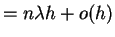
So probability of exactly 1 division by any one of the  organisms is
 .
.
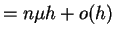
Similarly probability of 1 death is
 .
.
We deduce:
 |
 |
|
 |
||
|
 |
|
 |
||
|
 |
|
 |
||
|
 |
|
 |
These equations lead to:
 |
 |
|
 |
||
 |
This is the Markov Property.
Definition:A process
 taking values in
 , a finite or countable state space is a Markov Chain
if
, a finite or countable state space is a Markov Chain
if
|
|
|
|
||
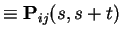 |
Definition:A Markov chain  has stationary transitions if

From now on: our chains have stationary transitions.
 time,
time,  , until process leaves
has exponential distribution, rate
denoted
, until process leaves
has exponential distribution, rate
denoted  .
.
 is Markov chain - transition matrix has
 . sometimes called skeleton.
to  :
:


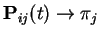
 satisfy:


 has entries

 if
if 
 for the instantaneous
``birth'' rate:
for the instantaneous
``birth'' rate:

 for the instantaneous
``death'' rate:
for the instantaneous
``death'' rate:


 then process is a pure birth process.
If all
then process is a pure birth process.
If all
 a pure death process.

 is
is


 .
.
Suppose  a Markov Chain with stationary transitions.
Then
a Markov Chain with stationary transitions.
Then
 |
 |
|
 |
||
 |
||
 |
||
 |
||
|
||
 |
||
|
This shows
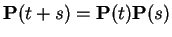
Now consider the chain starting from and let be
the first for which
 . Then is
a stopping time.
. Then is
a stopping time.
[Technically:
 .]
Then
.]
Then
 |
 |
|
 |
||
 |
Conclusion: given  , has memoryless property
so has an exponential distribution. Let be the
rate parameter.
, has memoryless property
so has an exponential distribution. Let be the
rate parameter.
Let
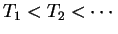 be the stopping times at which
transitions occur. Then
be the stopping times at which
transitions occur. Then
 . The sequence
  is a Markov chain by the
Markov property. That
reflects the fact
that
is a Markov chain by the
Markov property. That
reflects the fact
that
 by design.
As before we say
 if
if
 for some .
It is fairly clear that
for the
for some .
It is fairly clear that
for the  if and only
if
for the embedded chain .
if and only
if
for the embedded chain .
We say
 ( and communicate) if
and
( and communicate) if
and
 .
.
Now consider
 transitions so far so that
 . Then the event
  is, except
for possibilities of probability the event that
is, except
for possibilities of probability the event that
 and
and 

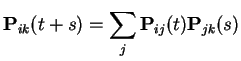
The Chapman-Kolmogorov equations are
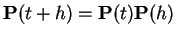
 from both sides, divide by and let
  .
Remember that
.
Remember that
 is the identity.
We find
is the identity.
We find


The Chapman-Kolmogorov equations can also be written
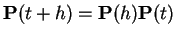 from both sides, dividing by and letting
gives
from both sides, dividing by and letting
gives

Look at these equations in component form:

 our calculations of instantaneous transition
rates gives
our calculations of instantaneous transition
rates gives

 we have

 either means
  which has probability
 or there have been two or more transitions in
![$ [0,h]$](img108.gif) , a possibility of probability .)
Thus
, a possibility of probability .)
Thus

Let  be the matrix with entries


is the infinitesimal generator of the chain.
Thus
 |
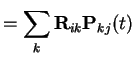 |
|
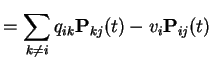 |
On the other hand
|
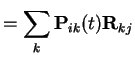 |
|
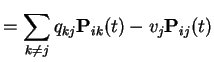 |
Remark: When the state space is infinite the forward equations may not be justified. In deriving them we interchanged a limit with an infinite sum; the interchange is always justified for the backward equations but not for forward.
Example:  . Then
![$\displaystyle {\bf P}= \left[\begin{array}{cc} 0 & 1 \\ 1 & 0 \end{array}\right]
$](img119.gif)
 and
and  . The matrix
is
. The matrix
is
![$\displaystyle {\bf R}= \left[\begin{array}{cc}-v_0 & v_0 \\ v_1 & -v_1 \end{array}\right]
$](img122.gif)
 |
 |
|
 |
 |
|
 |
 |
|
 |
 |
|
 |
|
|
 |
|
|
 |
|
|
 |
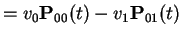
Add  first plus
  third backward equations to get


 to get
  . This gives


 and get


Alternative calculation:

![$\displaystyle {\bf M} = \left[\begin{array}{cc} 1 & v_0\\ \\ 1 & -v_1\end{array}\right]
$](img147.gif)
![$\displaystyle {\bf M}^{-1} = \left[\begin{array}{cc} \frac{v_1}{v_0+v_1} & \frac{v_0}{v_0+v_1}
\\ \\ \frac{1}{v_0+v_1} & \frac{-1}{v_0+v_1}\end{array}\right]
$](img148.gif)
![$\displaystyle {\bf\Lambda} = \left[\begin{array}{cc} 0 & 0\\ \\ 0 & -(v_0+v_1)\end{array}\right]
$](img149.gif)
Then
 |
 |
|
 |
||
 |
![$\displaystyle \sum_0^\infty{\bf\Lambda}^n\frac{t^n}{n!} = \left[\begin{array}{cc}1 & 0 \\ 0&
e^{-(v_0+v_1)t}\end{array}\right]
$](img154.gif)
 |
 |
|
![$\displaystyle = {\bf M} \left[\begin{array}{cc}1 & 0 \\ 0& e^{-(v_0+v_1)t}\end{array}\right]{\bf M}^{-1}$](img157.gif) |
||
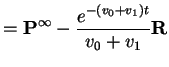 |
![$\displaystyle {\bf P}^\infty=\left[\begin{array}{cc} \frac{v_1}{v_0+v_1} & \fra...
..._0+v_1}
\\
\\
\frac{v_1}{v_0+v_1} & \frac{v_0}{v_0+v_1}
\end{array}\right]
$](img159.gif)
Notice: rows of
 are a stationary initial distribution. If rows are
then
are a stationary initial distribution. If rows are
then
![$\displaystyle {\bf P}^\infty = \left[\begin{array}{c}1 \\ 1 \end{array}\right] \pi \equiv {\bf 1}\pi
$](img161.gif)


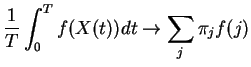
Fact:
 is long run fraction of time in
state 0.
is long run fraction of time in
state 0.
Fact:
Consider a population of individuals. Suppose
in next time interval  probability of population
increase of 1 (called a birth) is
probability of population
increase of 1 (called a birth) is
 and
probability of decrease of 1 (death) is
and
probability of decrease of 1 (death) is
 .
.
Jargon: is a birth and death process.
Special cases:
All ; called a pure birth process.
All
(0 is absorbing): pure death process.
 and
and
 is a linear
birth and death process.
is a linear
birth and death process.
 ,
,
 : Poisson Process.
 and
is a linear
birth and death process with immigration.
and
is a linear
birth and death process with immigration.
Ingredients of Queuing Problem:
1: Queue input process.
2: Number of servers
3: Queue discipline: first come first serve? last in first out? pre-emptive priorities?
4: Service time distribution.
Example:
Imagine customers arriving at a facility at times of a Poisson
Process  with rate
  . This is the input process,
denoted
. This is the input process,
denoted  (for Markov) in queuing literature.
Single server case:
Service distribution: exponential service times, rate  .
.
Queue discipline: first come first serve.
= number of customers in line at time .
is a Markov process called  queue:


Example:
 queue:
Customers arrive according to PP rate . Each
customer begins service immediately. is number
being served at time . is a birth and death process
with


We have seen that a stationary initial distribution is
a probability vector solving
 ; process is
in state a fraction
; process is
in state a fraction  of time and then makes transition at rate
 . RHS is total rate of arrival in state . For each state
 is fraction of time spent in state and
then
is fraction of time spent in state and
then  the instantaneous rate of transition from to .
So equation says:
Rate of departure from balances rate of arrival to . This is called
balance.
Application to birth and death processes:
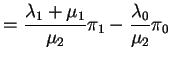
Equation is

 and
and

 |
 |
|
 |
 |
|
 |

Apply
 to get

If


 is constant. Put to discover that
the constant is .
is constant. Put to discover that
the constant is .