


Two elementary definitions of expected values:
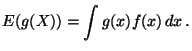
Defn: If  has density
  then
then
Defn: If has discrete density then

FACT: If  for a smooth
 |
 |
|
 |
||
 |
 .
.
In general, there are random variables which are neither absolutely continuous nor discrete. See STAT 801 for general definition of E.
Defn: We call integrable if

Facts:  is a linear, monotone, positive operator:
 provided and
  are
integrable.
are
integrable.
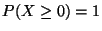 implies
 .
.
 and , integrable implies
 .
.
Major technical theorems:
Monotone Convergence: If
 and
and
 (which has to exist) then
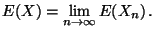
Dominated Convergence: If
 and
and  rv such that
  (technical
details of this convergence later in the course) and
a random variable such that
(technical
details of this convergence later in the course) and
a random variable such that  with
with
 then
then

 the same rv .
Theorem: With this definition of if has density
 (even in
  say) and then
 has pmf then

Firts conclusion works, e.g., even if has a density but doesn't.
Defn: The
 moment (about the origin) of a real
rv is
moment (about the origin) of a real
rv is
 (provided it exists).
We generally use
(provided it exists).
We generally use
 for
for  .
.
Defn: The
central moment is
![$\displaystyle \mu_r = E[(X-\mu)^r] \, .
$](img38.gif)
 the variance.
Defn: For an valued random vector

 entry is
  (provided all entries exist).
Defn: The (
 ) variance covariance matrix of is
![$\displaystyle Var(X) = E\left[ (X-\mu)(X-\mu)^t \right]
$](img44.gif)
 has a finite second moment.
Moments and probabilities of rare events are closely connected as will be seen in a number of important probability theorems.
Example: Markov's inequality
 |
![$\displaystyle = E[1(\vert X-\mu\vert \ge t)]$](img47.gif) |
|
![$\displaystyle \le E\left[\frac{\vert X-\mu\vert^r}{t^r}1(\vert X-\mu\vert \ge t)\right]$](img48.gif) |
||
![$\displaystyle \le \frac{E[\vert X-\mu\vert^r]}{t^r}$](img49.gif) |
Special Case: Chebyshev's inequality

Example moments: If  is standard normal then
 |
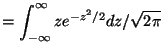 |
|
 |
||
 |
 |
 |
|
 |
 |
|
 |

 . Remembering that
  and
and


If now
 , that is,
 ,
then
,
then
 and
and
![$\displaystyle \mu_r(X) = E[(X-\mu)^r] = \sigma^r E(Z^r) \, .
$](img69.gif)
 for
the distribution of
for
the distribution of
 is justified;
  is indeed
the variance.
is indeed
the variance.
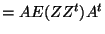
Similarly for
 we have
  with
with
 and
and

 |
 |
|
 |
||
 |
||
 |
 and
and

Theorem: If
 are independent and each is
integrable then
are independent and each is
integrable then
 is integrable and
