


Def'n: The moment generating function of a real valued  is
is
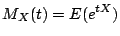
 for which the expected value is finite.
Def'n: The moment generating function of  is
is
![$\displaystyle M_X(u) = E[e^{u^tX}]
$](img5.gif)
 for which the expected value is finite.
Formal connection to moments:
 |
![$\displaystyle = \sum_{k=0}^\infty E[(tX)^k]/k!$](img8.gif) |
|
 |
 and read off the moments of from the coefficients of
 .
.
Example: : has density

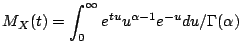
 to get
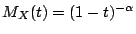
 get exponential distribution.
Have power series expansion
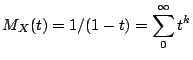
 . Coeff of is

Theorem: If  is finite for all
![$ t \in [-\epsilon,\epsilon]$](img21.gif) for some
for some
 then
then
is finite.
is  (in fact is analytic).
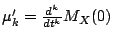 .
.
Note: means has continuous derivatives of all orders. Analytic
means has convergent power series expansion in neighbourhood of each
 .
.
Theorem: Suppose and  have mgfs and
  which are
finite for all
. If
which are
finite for all
. If
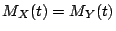 for
all
then and have the same
distribution.
for
all
then and have the same
distribution.
The proof, and many other facts about mgfs, rely on techniques of complex variables.
If
 are independent and
 then
the moment generating function of is the product of those
of the individual
then
the moment generating function of is the product of those
of the individual  :
:
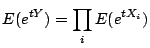
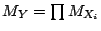 .
.
Note: also true for multivariate .
Problem: power series expansion of not
nice function of expansions of individual  .
.
Related fact: first 3 moments
(meaning  ,
,  and
and  ) of are sums of those
of the :
) of are sums of those
of the :
 |
 |
|
 |
 |
|
![$\displaystyle E[(Y-E(Y))^3] =$](img42.gif) |
![$\displaystyle \sum E[(X_i-E(X_i))^3]$](img43.gif) |
![$\displaystyle E[(Y-E(Y))^4] =
\sum \{E[(X_i-E(X_i))^4] -3E^2[(X_i-E(X_i))^2]\}
+ 3 \left\{\sum E[(X_i-E(X_i))^2]\right\}^2\, .
$](img44.gif)
It is possible, however, to replace the moments by other objects called cumulants which do add up properly.
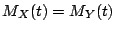
Theorem: If and are two random variables such that
 (for some
) then
and have the same distribution.
(for some
) then
and have the same distribution.
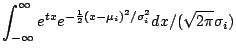
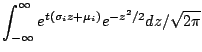
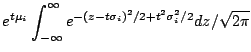
Example: If
are independent and has a
 distribution
then
distribution
then
 |
 |
|
 |
 |
|
|
 |
|
|
 |
then has mgf

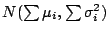 . This proves
has this normal distribution.
. This proves
has this normal distribution.
Example: Suppose that
 are independent
 rvs. Then we have defined
 to have a
  distribution. It is easy to check (see earlier in course)
 has density
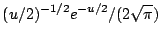
 is
is

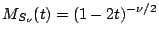
 rv. This shows that the
 distribution has
the Gamma density which is
distribution has
the Gamma density which is

Example: The Cauchy density is

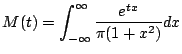
 except for
  where we get 1.
This mgf is exactly the mgf of every distribution
so it is not much use for distinguishing such distributions.
The problem is that these distributions do not have infinitely
many finite moments.
where we get 1.
This mgf is exactly the mgf of every distribution
so it is not much use for distinguishing such distributions.
The problem is that these distributions do not have infinitely
many finite moments.
This observation has led to the development of a substitute for the mgf which is defined for every distribution, namely, the characteristic function:
