


For general composite hypotheses optimality theory is not usually successful in producing an optimal test. instead we look for heuristics to guide our choices. The simplest approach is to consider the likelihood ratio

 and
and
 which are reasonable estimates of
  assuming respectively
the alternative or null hypothesis is true. The simplest method is to
make each
assuming respectively
the alternative or null hypothesis is true. The simplest method is to
make each  a maximum likelihood estimate, but maximized only
over
a maximum likelihood estimate, but maximized only
over  .
.
Example 1:  :
test
:
test  against
  . (Remember UMP
test.) Log likelihood is
. (Remember UMP
test.) Log likelihood is

 then global maximum in
  at
at  .
If
.
If
 global maximum in at 0.
Thus
global maximum in at 0.
Thus  which maximizes
  subject
to is if
and 0 if
.
Similarly,
subject
to is if
and 0 if
.
Similarly,  is if
and 0 if
. Hence
is if
and 0 if
. Hence

 so rejection
region will be of the form
so rejection
region will be of the form
 . To get level
  reject if
 .
Notice simpler statistic is log likelihood ratio
.
Notice simpler statistic is log likelihood ratio

Example 2: In the problem suppose we
make the null  . Then the value of is simply 0 while
the maximum of the log-likelihood over the alternative
. Then the value of is simply 0 while
the maximum of the log-likelihood over the alternative
 occurs at . This gives

 distribution. This test leads to the
rejection region
distribution. This test leads to the
rejection region
 which is the
usual UMPU test.
which is the
usual UMPU test.
Example 3: For the
 problem testing
against
we must find two estimates of
problem testing
against
we must find two estimates of
 . The maximum of the likelihood over the alternative
occurs at the global mle
. The maximum of the likelihood over the alternative
occurs at the global mle
 . We find

Maximize  over null hypothesis.
Recall
over null hypothesis.
Recall
 so find
 by maximizing


 statistic. Likelihood ratio test
rejects for large values of
statistic. Likelihood ratio test
rejects for large values of  -- the
usual test.
-- the
usual test.
Notice that if  is large we have
![$\displaystyle \lambda \approx n[1+t^2/(n-1) +O(n^{-2})] \approx t^2 \, .
$](img46.gif) statistic is approximately standard normal
if is large we see that
statistic is approximately standard normal
if is large we see that
![$\displaystyle \lambda = 2[\ell(\hat\theta_1) - \ell(\hat\theta_0)]
$](img47.gif) distribution.
distribution.
This is a general phenomenon when the null hypothesis being tested is of the form  . Here is the general
theory. Suppose that the vector of
. Here is the general
theory. Suppose that the vector of  parameters can
be partitioned into
parameters can
be partitioned into
 with
with  a vector
of
a vector
of  parameters and
  a vector of
  parameters.
To test
parameters.
To test
 we find two mles of . First the
global mle
we find two mles of . First the
global mle
 maximizes
the likelihood over
maximizes
the likelihood over
 (because typically the probability that
  is exactly
 is 0).
Now we maximize the likelihood over the null hypothesis, that is
we find
 to maximize

![$\displaystyle 2[\ell(\hat\theta)-\ell(\hat\theta_0)]
$](img62.gif)
Now suppose that the true value of is
 (so that the null hypothesis is true). The score function is a
vector of length and can be partitioned as
(so that the null hypothesis is true). The score function is a
vector of length and can be partitioned as
 .
The Fisher information matrix can be partitioned as
.
The Fisher information matrix can be partitioned as
![$\displaystyle \left[\begin{array}{cc}
I_{\phi\phi} & I_{\phi\gamma}
\\
I_{\gamma\phi} & I_{\gamma\gamma}
\end{array}\right] \, .
$](img65.gif)
According to our large sample theory for the mle we have


 and
and
 around
  you
get
you
get

 is the second derivative matrix of . Remember that
 and you get
![$\displaystyle 2[\ell(\hat\theta) - \ell(\theta_0)] \approx U^t I^{-1}U \, .
$](img74.gif)
 gives
gives
![$\displaystyle 2[\ell(\hat\theta_0) -\ell(\theta_0)] \approx U_\gamma^t I_{\gamma\gamma}^{-1}
U_\gamma \, .
$](img76.gif)

 . It is now possible to use the general
theory of the distribution of
. It is now possible to use the general
theory of the distribution of  where
where  is
is
 to
demonstrate that
to
demonstrate that
Theorem: The log-likelihood ratio statistic
![$\displaystyle \lambda = 2[\ell(\hat\theta) - \ell(\hat\theta_0)]
$](img82.gif)
 distribution.
Aside:
Theorem: Suppose
 with
with  non-singular and
is a symmetric matrix. If
non-singular and
is a symmetric matrix. If
 then has a
 distribution with df
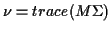 .
.
Proof: We have  where
where
 and
and
 is standard multivariate normal. So
 .
Let
.
Let  .
Since
condition in the theorem is
.
Since
condition in the theorem is
 is non-singular so is
  . Multiply by
  on left and
 on right; get
  .
.
 is symmetric so
 where
where  is diagonal matrix containing the
eigenvalues of and
is diagonal matrix containing the
eigenvalues of and  is orthogonal matrix whose columns
are the corresponding orthonormal eigenvectors. So
rewrite
is orthogonal matrix whose columns
are the corresponding orthonormal eigenvectors. So
rewrite

 is
is
 ; i.e.
  is
standard multivariate normal. Now
is
standard multivariate normal. Now

We have established that the general distribution of any
quadratic form is a linear combination of  variables.
Now go back to the condition . If
variables.
Now go back to the condition . If  is an eigenvalue
of and
is an eigenvalue
of and  is a corresponding eigenvector then
 but also
 . Thus
 .
It follows that either
.
It follows that either  or
or  . This means
that the weights in the linear combination are all 1 or 0 and that
has a distribution with degrees of freedom,
. This means
that the weights in the linear combination are all 1 or 0 and that
has a distribution with degrees of freedom,  ,
equal to the number of
,
equal to the number of  which are equal to 1. This is
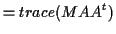
the same as the sum of the so
which are equal to 1. This is
the same as the sum of the so

 |
 |
|
 |
||
 |
||
 |
||
 |
||
 |
In the application is  the Fisher information and
 where
where
![$\displaystyle J= \left[\begin{array}{cc}
0 & 0 \\ 0 & I_{\gamma\gamma}^{-1}
\end{array}\right]
$](img128.gif)
 becomes
![$\displaystyle \left[\begin{array}{cc}
I & 0 \\ 0 & 0
\end{array}\right]
$](img130.gif)
 is a
is a  identity matrix. It follows that
 and that
 .
.