


Hypothesis testing: a statistical problem where you must choose,
on the basis of data  , between two alternatives. We formalize this
as the problem of choosing between two hypotheses:
, between two alternatives. We formalize this
as the problem of choosing between two hypotheses:
 or
or
 where
where
 and
and  are a partition of the model
 . That is
 and
and
 .
.
A rule for making the required choice can be described in two ways:
 we choose if we observe
 which is equal to 1 for
those
which is equal to 1 for
those  for which we choose and 0 for those for
which we choose .
for which we choose and 0 for those for
which we choose .
For technical reasons which will come up soon I prefer to use the
second description. However, each  corresponds to a
unique rejection region
corresponds to a
unique rejection region
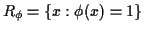 .
.
Neyman Pearson approach treats two hypotheses asymmetrically.
Hypothesis  referred to as the null hypothesis
(traditionally the hypothesis that some treatment has no effect).
referred to as the null hypothesis
(traditionally the hypothesis that some treatment has no effect).
Definition: The power function of a test
(or the corresponding critical region  ) is
) is

Interested in optimality theory, that is,
the problem of finding the best . A good will
evidently have
 small for
 and large for
 . There is generally a
trade off which can be made in many ways, however.
. There is generally a
trade off which can be made in many ways, however.
Finding a best test is easiest when the hypotheses are very precise.
Definition: A hypothesis  is simple
if
is simple
if  contains only a single value
  .
.
The simple versus simple testing problem arises when we test
 against
 so that
  has only two points in it. This problem is of importance as
a technical tool, not because it is a realistic situation.
has only two points in it. This problem is of importance as
a technical tool, not because it is a realistic situation.
Suppose that the model specifies that if
then
the density of is  and if
then
the density of is
and if
then
the density of is  . How should we choose ?
To answer the question we begin by studying the problem of
minimizing the total error probability.
. How should we choose ?
To answer the question we begin by studying the problem of
minimizing the total error probability.
Type I error: the error made when
but we choose  , that is,
 .
.
Type II error: when
but we choose
 .
.
The level of a simple versus simple test is
 We make a Type I error

Other error probability denoted  is
is

Minimize
 , the total error
probability given by
, the total error
probability given by
 |
 |
 |
|
|
![$\displaystyle \int[ \phi(x) f_0(x) +(1-\phi(x))f_1(x)] dx$](img41.gif) |
Problem: choose, for each , either the value
0 or the value 1, in such a way as to minimize the integral.
But for each the quantity
 and .
To make
it small we take
and .
To make
it small we take
 if
if
 and
and
 if
if
 .
It makes no
difference what we do for those for which
.
It makes no
difference what we do for those for which
 .
Notice: divide both sides
of inequalities to get condition in terms
of likelihood ratio
.
Notice: divide both sides
of inequalities to get condition in terms
of likelihood ratio
 .
.
Theorem: For each fixed  the
quantity
the
quantity
 is minimized by any
which has
is minimized by any
which has
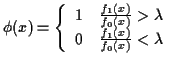
 of a Type I error to be no more than
some prespecified level
of a Type I error to be no more than
some prespecified level  . (This value
is typically
. (This value
is typically  these days, chiefly for historical reasons.)
The Neyman and Pearson approach is then to minimize
subject to the constraint
 .
Usually this is really equivalent to the constraint
.
Usually this is really equivalent to the constraint
 (because if you use
 you could make
  larger and keep
but
make smaller. For discrete models, however, this
may not be possible.
Example: Suppose is Binomial
larger and keep
but
make smaller. For discrete models, however, this
may not be possible.
Example: Suppose is Binomial and
either
and
either  or
or  .
.
If is any critical region
(so is a subset of
 ) then
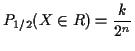
 . If we want
 with say
 for example we have to recognize that the possible
values of are
for example we have to recognize that the possible
values of are
 and
so on.
and
so on.
Possible rejection regions for
:
| Region | |
|
 |
0 | 1 |
 |
0.03125 |  |
 |
0.03125 |  |
So  minimizes subject to
 .
.
Raise slightly to 0.0625: possible
rejection regions are  ,
,  , and
, and
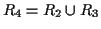 .
.
The first three have the same
and as before while  has
has
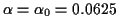 an
an
 . Thus is optimal!
Problem: if all trials are failures ``optimal'' chooses
 rather than
  . But makes 5 failures
much more likely does .
. But makes 5 failures
much more likely does .
Problem: discreteness. Here's how we get
around the problem. First we expand the set of possible values of
to include numbers between 0 and 1. Values of between
0 and 1 represent the chance that we choose given that we observe
; the idea is that we actually toss a (biased) coin to decide!
This tactic will show us the kinds of rejection regions which are
sensible. In practice we then restrict our attention to levels
for which the best is always either 0 or 1. In the
binomial example we will insist that the value of
be either 0 or
 or
or
 or ...
Smaller example: 4 possible values of and
or ...
Smaller example: 4 possible values of and  possible
rejection regions. Here is a table of the levels for each possible rejection region :
possible
rejection regions. Here is a table of the levels for each possible rejection region :
|
|
 |
0 |
| {3}, {0} | 1/8 |
| {0,3} | 2/8 |
| {1}, {2} | 3/8 |
| {0,1}, {0,2}, {1,3}, {2,3} | 4/8 |
| {0,1,3}, {0,2,3} | 5/8 |
| {1,2} | 6/8 |
| {0,1,3}, {0,2,3} | 7/8 |
| {0,1,2,3} | 1 |
Best level  test has rejection region
 ,
,
![$ \beta = 1-[(3/4)^3+(1/4)^3] = 36/64$](img89.gif) .
Best level
test using randomization rejects when
.
Best level
test using randomization rejects when
 and, when
  tosses a coin with
  ,
then rejects if you get H.
Level is
,
then rejects if you get H.
Level is
 ; probability of
Type II error is
; probability of
Type II error is
![$ \beta =1-[(3/4)^3 +(1/3)(3)(3/4)^2(1/4)] = 28/64$](img94.gif) .
.
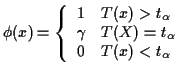
Definition: A hypothesis test is a function
whose values are always in ![$ [0,1]$](img95.gif) . If we observe
. If we observe  then we
choose with conditional probability
then we
choose with conditional probability  .
In this case we have
.
In this case we have
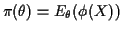
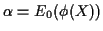
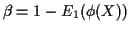
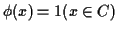
Note that a test using a rejection region  is equivalent to
The Neyman Pearson Lemma: In testing  against
  the probability
of a type II error is minimized, subject to
by the test function:
the probability
of a type II error is minimized, subject to
by the test function:
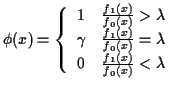 is the largest constant such that
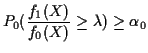
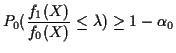
 is any number chosen so that
 |
|
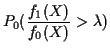 |
|
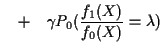 |
|||
|
 |
is unique if
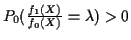 .
.
Example: Binomial with  and
and  :
ratio
:
ratio  is
is
 this ratio is one of 1, 3, 9, 27, 81, 243 divided
by 32.
this ratio is one of 1, 3, 9, 27, 81, 243 divided
by 32.
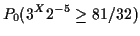
Suppose we have
 . must be one
of the possible values of . If we try
. must be one
of the possible values of . If we try
 then
then
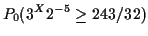 |
|
 |
|
|
 |
 |
|
 |
|
|
 |
 .
.
Since

 and find
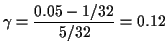
NOTE: No-one ever uses this procedure. Instead the value of
used in discrete problems is chosen to be a possible value of the rejection
probability when  (or
(or  ). When the sample size is large
you can come very close to any desired with a non-randomized test.
). When the sample size is large
you can come very close to any desired with a non-randomized test.
If
 then we can either take to be 243/32
and or
and . However, our
definition of in the theorem makes
and
.
then we can either take to be 243/32
and or
and . However, our
definition of in the theorem makes
and
.
When the theorem is used for continuous distributions it can be the case
that the cdf of
 has a flat spot where it is equal to
 . This is the point of the word ``largest'' in the theorem.
Example: If
 are iid
  and
we have
and
we have  and
and  then
then

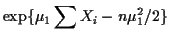 so that
 has
a continuous distribution. Rewrite probability as
has
a continuous distribution. Rewrite probability as
![\begin{multline*}
P_0(\sum X_i > [\log(\lambda) +n\mu_1^2/2]/\mu_1)
\\
=
\\
1-\Phi\left(\frac{\log(\lambda) +n\mu_1^2/2}{n^{1/2}\mu_1}\right)
\end{multline*}](img142.gif)
 be upper critical
point of
be upper critical
point of  ; then
![$\displaystyle z_{\alpha_0} = [\log(\lambda) +n\mu_1^2/2]/[n^{1/2}\mu_1]\, .
$](img145.gif) in terms of
in terms of
 ,
,  and
and  .
.
The rejection region looks complicated: reject if a complicated
statistic is larger than which has a complicated formula.
But in calculating we re-expressed the rejection
region in terms of
 . [WARNING: in the algebra above I used .]
This is why the Neyman Pearson lemma is a lemma!
Definition: In the general problem of testing
against the level of a test function
is
. [WARNING: in the algebra above I used .]
This is why the Neyman Pearson lemma is a lemma!
Definition: In the general problem of testing
against the level of a test function
is
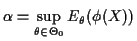
 is a Uniformly Most Powerful level
test if
has level
is a Uniformly Most Powerful level
test if
has level

has level
then
for every
we have

Proof of Neyman Pearson lemma: Given a test with level strictly less than we can define
the test
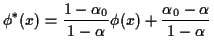 and smaller than that of . Hence we may
assume without loss that
and minimize subject to
. However, the argument which follows doesn't actually
need this.
and smaller than that of . Hence we may
assume without loss that
and minimize subject to
. However, the argument which follows doesn't actually
need this.
Suppose you want to minimize  subject to
  .
Consider first the function
.
Consider first the function
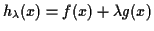
 minimizes
  then for any other
![$\displaystyle f(x_\lambda) \le f(x) +\lambda[ g(x) - g(x_\lambda)]
$](img160.gif) such that
the solution has
such that
the solution has
 . Then for
any we have
. Then for
any we have
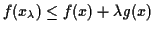 satisfying the constraint
we have
satisfying the constraint
we have
 the
quantity minimizes subject to .
the
quantity minimizes subject to .
Notice that to find you set the usual partial
derivatives equal to 0; then to find the special you
add in the condition
.
For each
 we have seen that
 minimizes
 where
where
 .
.
As increases the level of
decreases from 1
when  to 0 when
 . There is thus a
value
. There is thus a
value  where for
 the level is less than
while for
the level is less than
while for
 the level is at least .
Temporarily let
the level is at least .
Temporarily let
 . If
. If
 define
 . If
. If
 define
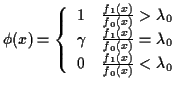
 .
You can check that
.
You can check that
![$ \gamma\in[0,1]$](img179.gif) .
.
Now has level and according to the theorem above
minimizes
 . Suppose is some other
test with level
. Suppose is some other
test with level
 . Then


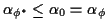

Example application of NP: Binomial to test  versus
 for a
for a  the NP test is of the form
 so that

 so that

 and not on so
that this test is UMP for against
and not on so
that this test is UMP for against  . Since this
test has level even for the larger null hypothesis
it is also UMP for
. Since this
test has level even for the larger null hypothesis
it is also UMP for  against .
Application of the NP lemma: In the model
consider
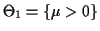 and
and
 or
or
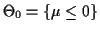 . The UMP level test of
 against
 is
is

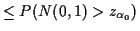
Proof: For either choice of
this test has level because
for  we have
 |
 |
|
 |
||
 |
||
 |
||
 |
. The central point is that the critical
point is determined by the behaviour on the edge of the null hypothesis.)
Now if is any other level test then we have

 . According to the NP lemma

 rejects if
 . But we just checked that this
test had a rejection region of the form
. But we just checked that this
test had a rejection region of the form
 . The NP lemma produces
the same test for every chosen as an alternative. So we have
shown that
. The NP lemma produces
the same test for every chosen as an alternative. So we have
shown that
 for any .
This phenomenon is somewhat general. What happened was this. For
any
 the likelihood ratio
  is an increasing
function of
is an increasing
function of  . The rejection region of the NP test is thus
always a region of the form
. The rejection region of the NP test is thus
always a region of the form
 . The value of the constant
is determined by the requirement that the test have level
and this depends on
. The value of the constant
is determined by the requirement that the test have level
and this depends on  not on .
Definition: The family
 has monotone likelihood ratio with respect to a statistic
  if for each
 the likelihood ratio
 is a monotone increasing function of .
Theorem: For a monotone likelihood ratio family the
Uniformly Most Powerful level test of
 (or of
) against the alternative
(or of
) against the alternative
 is
is
 .
.
Typical family where this works: one parameter exponential family. Usually there is no UMP test.
Example: test  against two sided alternative
 . There is no UMP level
test.
. There is no UMP level
test.
If there were its power at would have to be
as high as that of the one sided level test and so its rejection
region would have to be the same as that test, rejecting for large
positive values of
 . But it also has to have power as
good as the one sided test for the alternative
. But it also has to have power as
good as the one sided test for the alternative
 and
so would have to reject for large negative values of
.
This would make its level too large.
and
so would have to reject for large negative values of
.
This would make its level too large.
Favourite test: usual 2 sided test rejects for large values
of
 .
Test maximizes power subject to two constraints: first,
level ; second power is minimized at .
Second condition means
power on alternative is larger than on the null.
.
Test maximizes power subject to two constraints: first,
level ; second power is minimized at .
Second condition means
power on alternative is larger than on the null.