


Why bother doing the Newton Raphson steps?
Why not just use the method of moments estimates?
Answer: method of moments estimates not usually as close to right answer as MLEs.
Rough principle: A good estimate
 of
of  is usually
close to
is usually
close to  if is the true value of . Closer
estimates, more often, are better estimates.
if is the true value of . Closer
estimates, more often, are better estimates.
This principle must be quantified if we are to ``prove'' that the mle is a good estimate. In the Neyman Pearson spirit we measure average closeness.
Definition: The Mean Squared Error (MSE) of an estimator
is the function
![$\displaystyle MSE(\theta) = E_\theta[(\hat\theta-\theta)^2]
$](img4.gif)
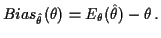
Standard identity:

Primitive example: I take a coin from my pocket and toss it
6 times. I get  . The MLE of the probability of heads is

 is the number of heads. In this case I get
 .
.
Alternative estimate:
 .
.
That is,
 ignores data; guess coin is fair.
The MSEs of these two estimators are
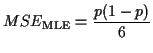
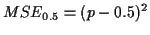
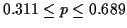
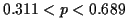 then 2nd MSE is smaller
than first.
then 2nd MSE is smaller
than first.
For this reason I would recommend use of
for sample sizes this small.
Same experiment with a thumbtack: tack can land point up (U) or tipped over (O).
If I get
 how should I estimate
  the probability of
  ?
?
Mathematics is identical to above but is
is better than  ?
?
Less reason to believe
 than
with a coin.
than
with a coin.