


We are investigating assumptions on a discrete time process which will permit us to make reasonable estimates of the parameters. We will look for assumptions which guarantee at least the existence
Definition: A stochastic process
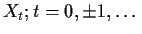 is
stationary if the joint distribution of
is
stationary if the joint distribution of
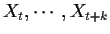 is the same
as the joint distribution of
is the same
as the joint distribution of
 for all
  and all
  .
(Often we call this strictly stationary.)
.
(Often we call this strictly stationary.)
Definition: A stochastic process
is
weakly (or second order) stationary if
 (that is the mean does not depend on ) and

 only (and does not depend on ).
Remark:
 finite variance, strictly stationary implies
weakly stationary. second order stationary and Gaussian implies strictly
stationary.
finite variance, strictly stationary implies
weakly stationary. second order stationary and Gaussian implies strictly
stationary.
Definition: is Gaussian if, for each
 the vector
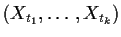 has a Multivariate Normal Distribution.
Examples of Stationary Processes:
1) Strong Sense White Noise: A process
 is strong sense
white noise if
is iid with mean 0 and finite variance
is strong sense
white noise if
is iid with mean 0 and finite variance  .
.
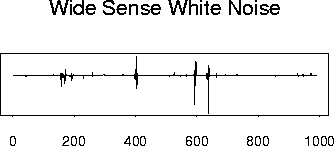
2) Weak Sense White Noise:
is second order stationary with

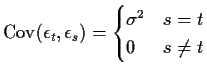
In this course we always use
as notation for white noise and
as the variance of this white noise. We use subscripts to indicate
variances of other things.
Example Graphics:
 data
data


2) Moving Averages: if
is white noise then
 is stationary. (If you use second order white noise you get second
order stationary. If the white noise is iid you get strict stationarity.)
is stationary. (If you use second order white noise you get second
order stationary. If the white noise is iid you get strict stationarity.)
Example proof:
![$ {\rm E}(X_t) = \left[ {\rm E}(\epsilon_t) +{\rm E}(\epsilon_{t-1})\right] /2
= 0$](img19.gif) which is constant as required. Moreover:
which is constant as required. Moreover:
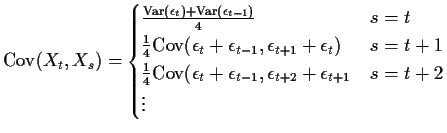
Most of these covariances are 0. For instance

 s are uncorrelated by assumption. The only non-zero covariances
occur for
s are uncorrelated by assumption. The only non-zero covariances
occur for  and
and  . Since
 we get

 so that the process is stationary.
The proof that is strictly stationary when the s are iid is
in your homework; it is quite different.
Example Graphics:
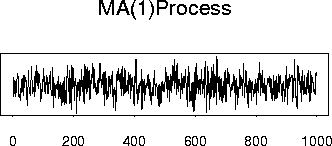

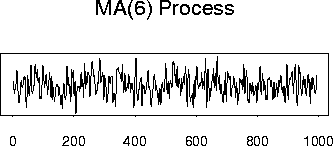
The trajectory of can be made quite smooth (compared to that of
white noise) by averaging over many s.
3) Autoregressive Processes:
An AR(1) process is a process satisfying the equations:
is wide noise. If  is second order stationary with
 , say, then take expected values of (1)
to get
, say, then take expected values of (1)
to get
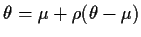

 (which will actually guarantee that is not stationary)
or
(which will actually guarantee that is not stationary)
or
 . Now we calculate variances:
 |
 |
|
 |
is
uncorrelated with
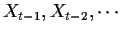 .
In the strictly stationary case we are imagining that somehow
.
In the strictly stationary case we are imagining that somehow  is built up out of past values of
 which are independent of
.
In the weakly stationary case we are imagining that
is actually a linear function of these past values.
In either case this makes
which are independent of
.
In the weakly stationary case we are imagining that
is actually a linear function of these past values.
In either case this makes
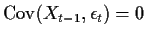 .
If is stationary so that
.
If is stationary so that
 then
we find
then
we find


 . There is no
stationary process satisfying (1)
for
. There is no
stationary process satisfying (1)
for
 .
.
Now for
 how is determined from
the
? (We want to solve the equations
(1) to get an explicit formula for .)
The case
how is determined from
the
? (We want to solve the equations
(1) to get an explicit formula for .)
The case  is notationally simpler. We get
 |
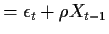 |
|
 |
||
 |
||
 |
it seems reasonable to suppose that
 and
for a stationary series this is true in the appropriate mathematical sense.
This leads to taking the limit as
and
for a stationary series this is true in the appropriate mathematical sense.
This leads to taking the limit as
 to get

Claim: It is a theorem that if is a weakly stationary
series then
 converges (technically
it converges in mean square) and is a second order stationary solution to the
equation (1). If is a strictly stationary process then
under some weak assumptions about how heavy the tails of are
converges almost surely and is a
strongly stationary solution of (1).
converges (technically
it converges in mean square) and is a second order stationary solution to the
equation (1). If is a strictly stationary process then
under some weak assumptions about how heavy the tails of are
converges almost surely and is a
strongly stationary solution of (1).
In fact if
 are constants such that
 and
is weakly stationary (respectively strongly stationary with finite variance)
then
and
is weakly stationary (respectively strongly stationary with finite variance)
then
 a linear filter of .
Example Graphics:
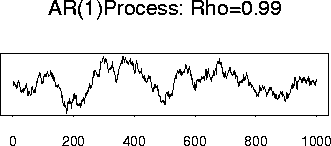
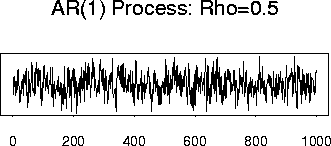
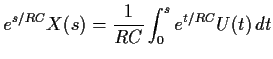
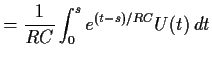
Motivation of the jargon ``filter'' comes from physics. Consider an electric circuit
with a resistance  in series with a capacitance
  . We apply an ``input'' voltage
 across the two elements and measure the voltage drop across the capacitor. We will call
this voltage drop the ``output'' voltage and denote the output
voltage by . The relevant physical rules are these:
across the two elements and measure the voltage drop across the capacitor. We will call
this voltage drop the ``output'' voltage and denote the output
voltage by . The relevant physical rules are these:
 plus the
voltage drop across the resistor plus
plus the
voltage drop across the resistor plus  . (The negative sign is a convention; the
input voltage is not a ``drop''.)
. (The negative sign is a convention; the
input voltage is not a ``drop''.)
 where
where  is the
current flowing in the circuit.
is the
current flowing in the circuit.
is
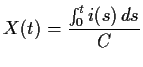
These rules give
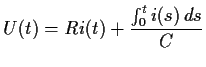 to get


 to see that

 , is obtained by integrating from 0 to
  to
get
to
get
 |
 |
|
 |
 filter
 .
.
