


Cauchy problem: for vector
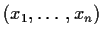 we define
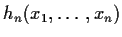 to be that root of

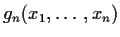 (here gn is the Borel
function used in defining the median above). If
is exactly midway between
two roots which are tied for closest we define hnto be the root smaller than gn.
(here gn is the Borel
function used in defining the median above). If
is exactly midway between
two roots which are tied for closest we define hnto be the root smaller than gn.
It is possible to prove that this defines a Borel function from
 to
to  .
Now define
.
Now define

 are iid Cauchy(0) then
To prove this fix
 we prove that
 where
where
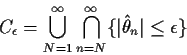
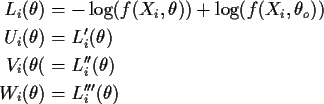
Notation:
 on the data.
 to denote
differentiation wrt
to denote
differentiation wrt  .
.
etc:
 inside
 with
with
 .
To define this new event
note that
if
.
To define this new event
note that
if
 has a unique root over
![$[-3\epsilon,3\epsilon]$](img22.gif) and
and
![$[-\epsilon,\epsilon]$](img23.gif) and
and
 closest to
 is
actually the root in points 1 and 2 and so
is
actually the root in points 1 and 2 and so

Define
 to be the event that there is
an N such that for all
to be the event that there is
an N such that for all  and all
 we have

 to be the event that there is
an N such that for all
to be the event that there is
an N such that for all


 to be the event that there is
an N such that for all
to be the event that there is
an N such that for all

Already shown:
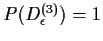 .
.
Next show
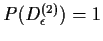 .
Note that
.
Note that
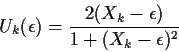
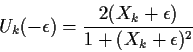
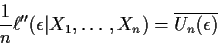
 is the event that there is
an N such that for all
is the event that there is
an N such that for all

 ,
,
 averages of
iid variates. Apply SLLN and show
averages of
iid variates. Apply SLLN and show
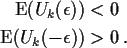
In fact
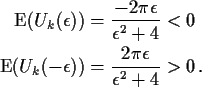
Defect: argument not easy to generalize; uses exact computation of moment.
More general tactic: use Jensen's inequality.
If
is smaller at  and at
  than it is
at 0 then there must be a critical point in
,
that is, a root of
.
than it is
at 0 then there must be a critical point in
,
that is, a root of
.
Define

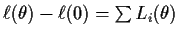 .
.
 is the event
  such
that
such
that


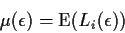
 where
where
 is the event


 .
.
If so then

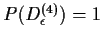 .
.
To prove the claim we apply Jensen's inequality:
 is a function which is convex on an interval
(a,b) with
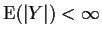
P(a<Y<b)=1Assume
is a function which is convex on an interval
(a,b) with
P(a<Y<b)=1Assume
 .
Then
.
Then
 is strictly convex then the inequality is strict unless
 .
.
Jargon:
is convex if for each x,y and

 strictly convex if the inequality is strict.
If
is twice differentiable and
 then
is convex; a strict inequality shows
is strictly
convex.
then
is convex; a strict inequality shows
is strictly
convex.
Apply Jensen's inequality with
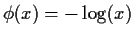 to
Y=g(X)/f(X) where X has density f and g is some other
density. Then
to
Y=g(X)/f(X) where X has density f and g is some other
density. Then


Technically: interval (a,b) is
 .
The assumption
.
The assumption
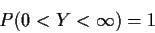

The other technical detail is that g(x) might be 0 some places where
f(x) is not 0. This might mean
P(Y=0) > 0. On the event Y=0we will agree to take
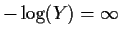 and conclude
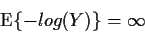
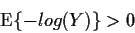
![\begin{displaymath}{\rm E}[\log\{g(X)\} - \log\{f(X)\}] < 0 \, .
\end{displaymath}](img79.gif)
Applied to our Cauchy problem we have shown
 for all
 .
Hence
.
.
Hence
.
Finally we consider
.
Up to now we have been
able to make do with an arbitrary .
In this case, however,
the result holds only for small
.
First consider

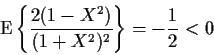
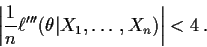
 may be shown to be bounded by
 .)
As a result
.)
As a result

Pick
so that
 .
If B is the event
.
If B is the event
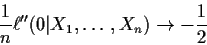
 is in B then there is an N such that for we have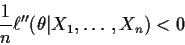
 .
.
This proves that for all

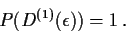
We have now shown that for

 in this event we have that there is an N such that
.
This establishes the result.
in this event we have that there is an N such that
.
This establishes the result.
Consider parametric family
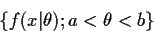
 be true value of
Let
 be the event:
such that
has a local maximum on the interval
be the event:
such that
has a local maximum on the interval
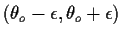
![$[\theta_o-\epsilon,\theta_o+\epsilon]$](img100.gif) .
.
We have proved quite generally that
 |
(2) |
Add assumption
 |
(A) |
 be the event that
there is an N such that for all
there is
a critical point of
in
be the event that
there is an N such that for all
there is
a critical point of
in
 which is a local maximum of
we have proved
which is a local maximum of
we have proved
 |
(3) |
The event
 then has probability 1. On
this event there is a sequence of roots of the likelihood equations
which is consistent.
then has probability 1. On
this event there is a sequence of roots of the likelihood equations
which is consistent.
Remaining problem: prove, under
general conditions, that there is probably only one root near .
Consider event that
is monotone on
.
Previous proof based on showing
that next derivative was negative at
and did not
change much over a small enough interval.
Behaviour at
is essentially the behaviour of


Begin with
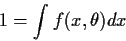 gives
gives
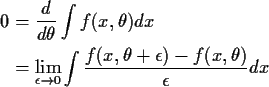
In order to take the limit inside the integral sign we must prove that for
any sequence


Normally: apply dominated convergence theorem.
If f is continuously differentiable wrt
then
difference quotient is exactly

 depends on both n and x.
One tactic: compute


Assuming dominated convergence theorem applies:
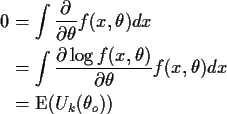
Differentiating again and again passing limits through integrals
gives


Next we consider
 there
is a
there
is a
 (which is random but between
and
)
such that this difference is
(which is random but between
and
)
such that this difference is
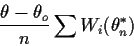
Define
 the Mi are integrable
then SLLN shows
the Mi are integrable
then SLLN shows
 small enough.
Pick
so small that
bound strictly smaller than

 is event
st
we have
is monotone decreasing on
.
is event
st
we have
is monotone decreasing on
.
