Stochastic process: family
 of rvs
I the index set. Often
of rvs
I the index set. Often
 ,
e.g.
,
e.g.
 ,
[0,1]
,
[0,1] or
or  .
.
Continuous time: I is an interval
Discrete time:
 .
.
Generally all Xn take values in state space S. In following S is a finite or countable set; each Xn is discrete.
Usually S is ,
or
 for some finite m.
Markov Chain: stochastic process
 .
taking values in a finite or countable set S such that for
every n and every event of the form
.
taking values in a finite or countable set S such that for
every n and every event of the form

 is the
(possibly infinite) array with elements
is the
(possibly infinite) array with elements
 .
.
is the (one step) transition matrix of the Markov
Chain.
If P(A) > 0 we define
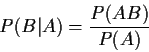
WARNING: in (1) we require the condition
to hold only when
Evidently the entries in
are non-negative and

 .
Any such matrix is called stochastic.
.
Any such matrix is called stochastic.
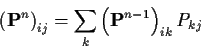
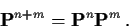
We define powers of
by
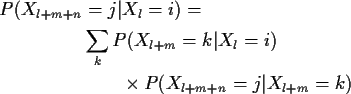
Condition on Xl+n-1 to compute
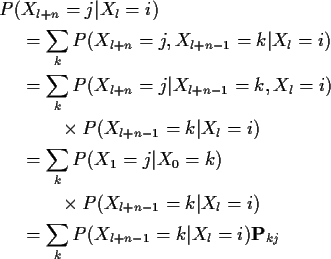

Notice: sum over k2 computes k1,j entry in
matrix
 .
.

We may now prove by induction on n that

Remark: It is important to notice that these probabilities
depend on m and n but not on l. We say the chain
has stationary transition probabilities. A more general
definition of Markov chain than (1)
is

Notice RHS now permitted to
depend on n.
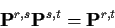
Define
 :
matrix with i,jth entry
:
matrix with i,jth entry
Remark: The calculations above involve sums in which all terms are positive. They therefore apply even if the state space S is countably infinite.
Extensions of the Markov Property
Function
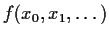 defined on
  =
all infinite sequences of points in S.
=
all infinite sequences of points in S.
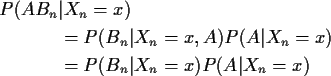
Let Bn be the event


Proof of (2):
Special case:


Events defined from
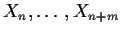 :
sum over appropriate vectors
:
sum over appropriate vectors
 .
.
General case: montone class techniques.
If an entry
 is 0 it is not possible to go from state ito state j in one step. It may be possible to make the transition
in some larger number of steps, however. We say i leads to j(or j is accessible from i) if there is an integer
is 0 it is not possible to go from state ito state j in one step. It may be possible to make the transition
in some larger number of steps, however. We say i leads to j(or j is accessible from i) if there is an integer  such that

 .
By defining
.
By defining  to be the identity matrix
  we
arrive at
if there is an
for which
we
arrive at
if there is an
for which
 .
.
We say states i and j communicate if
and
 .
We write
.
We write
 if i and j communicate.
Communication is an equivalence relation, that is, a reflexive, symmetric
and transitive relation on the states of S. More precisely:
if i and j communicate.
Communication is an equivalence relation, that is, a reflexive, symmetric
and transitive relation on the states of S. More precisely:
Reflexive: for all i we have
.
Symmetric: if
then
 .
.
Transitive: if
and
 then
then
 .
.
Proof:
Reflexive: follows from our inclusion of n=0 in the definition of leads to.
Symmetry is obvious.
Transitivity: suffices to check
that
and
 imply that
 .
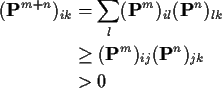
But
if
.
But
if
 and
and
 then
then
Any equivalence relation on a set partitions the set into equivalence classes; two elements are in the same equivalence class if and only if they are equivalent.
Communication partitions S into equivalence classes called communicating classes.
Example:
![\begin{displaymath}{\bf P}= \left[\begin{array}{cccccccc}
\frac{1}{4} & \frac{1}...
... & 0 & 0 &0 &0 & \frac{1}{2} & \frac{1}{2}
\end{array}\right]
\end{displaymath}](img52.gif)
Find communicating classes: start with say state 1, see where it leads.
 ,
,
 and
and
 in row 1.
 .
So: (transitivity)
1, 2, 3 and 4 all in the same communicating class.
.
So: (transitivity)
1, 2, 3 and 4 all in the same communicating class.
Suppose
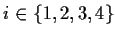 and
and
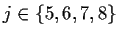 .
Then
.
Then
 is sum of products of
 .
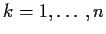
Cannot be positive unless there is a sequence
.
Cannot be positive unless there is a sequence
 with
with
 for
for
 .
.
Consider first
k for which
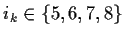 Then
Then
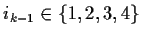 and
so
and
so
 .
.
So:
 is a communicating class.
 ,
,
 ,
,
 and
and
 .
.
 so
so  must be
communicating class.
must be
communicating class.
 and
and  are communicating classes.
Note: states 5 and 6 have special property. Each time you are in either state you run a risk of going to one of the states 1, 2, 3 or 4. Eventually you will make such a transition and then never return to state 5 or 6.
States 5 and 6 are transient.
To make this precise
define hitting times:


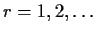
Let Nk be number of times chain is ever in state k.
Claims:
 .
.

Proof using strong Markov property:
Stopping time for
the Markov chain is a random variable T taking values in
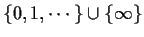 such that for each finite k
there is a function fk such that
such that for each finite k
there is a function fk such that

Standard shorthand notation: by