


STAT 870 Lecture 11
> p:= matrix(2,2,[[3/5,2/5],[1/5,4/5]]);
                      [3/5    2/5]
                 p := [          ]
                      [1/5    4/5]
> p2:=evalm(p*p):
> p4:=evalm(p2*p2):
> p8:=evalm(p4*p4):
> p16:=evalm(p8*p8):
This computes the powers (evalm understands
matrix algebra).
Fact:
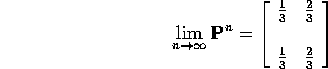
> evalf(evalm(p));
            [.6000000000    .4000000000]
            [                          ]
            [.2000000000    .8000000000]
> evalf(evalm(p2));
            [.4400000000    .5600000000]
            [                          ]
            [.2800000000    .7200000000]
> evalf(evalm(p4));
            [.3504000000    .6496000000]
            [                          ]
            [.3248000000    .6752000000]
> evalf(evalm(p8));
            [.3337702400    .6662297600]
            [                          ]
            [.3331148800    .6668851200]
> evalf(evalm(p16));
            [.3333336197    .6666663803]
            [                          ]
            [.3333331902    .6666668098]
Where did 1/3 and 2/3 come from?
Suppose we toss a coin  and start the
chain with Dry if we get heads and Wet if we get
tails.
and start the
chain with Dry if we get heads and Wet if we get
tails.
Then

and
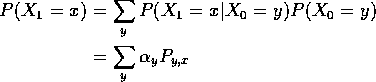
Notice last line is a matrix multiplication of
row vector  by matrix
  .
A special : if we put
.
A special : if we put  and
and  then
then

So: if 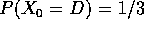 then
then 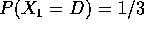 and analogously for W. This means that
  and
and  have the
same distribution.
have the
same distribution.
A probability vector is called the initial distribution for
the chain if

A Markov Chain is stationary if

for all i
Finding stationary initial distributions. Consider
above. The equation

is really
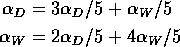
The first can be rearranged to

and so can the second. If is to be a
probability vector then

so we get

leading to

Some more examples:
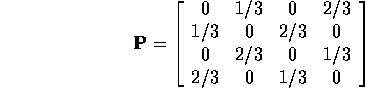
Set  and get
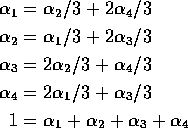
First plus third gives

so both sums 1/2. Continue algebra to get

p:=matrix([[0,1/3,0,2/3],[1/3,0,2/3,0],
          [0,2/3,0,1/3],[2/3,0,1/3,0]]);

               [ 0     1/3     0     2/3]
               [                        ]
               [1/3     0     2/3     0 ]
          p := [                        ]
               [ 0     2/3     0     1/3]
               [                        ]
               [2/3     0     1/3     0 ]
> p2:=evalm(p*p);
             [5/9     0     4/9     0 ]
             [                        ]
             [ 0     5/9     0     4/9]
        p2:= [                        ]
             [4/9     0     5/9     0 ]
             [                        ]
             [ 0     4/9     0     5/9]
> p4:=evalm(p2*p2):
> p8:=evalm(p4*p4):
> p16:=evalm(p8*p8):
> p17:=evalm(p8*p8*p):
> evalf(evalm(p16));
    [.5000000116 , 0 , .4999999884 , 0]
    [                                 ]
    [0 , .5000000116 , 0 , .4999999884]
    [                                 ]
    [.4999999884 , 0 , .5000000116 , 0]
    [                                 ]
    [0 , .4999999884 , 0 , .5000000116]
> evalf(evalm(p17));
    [0 , .4999999961 , 0 , .5000000039]
    [                                 ]
    [.4999999961 , 0 , .5000000039 , 0]
    [                                 ]
    [0 , .5000000039 , 0 , .4999999961]
    [                                 ]
    [.5000000039 , 0 , .4999999961 , 0]
> evalf(evalm((p16+p17)/2));
  [.2500, .2500, .2500, .2500]
  [                          ]
  [.2500, .2500, .2500, .2500]
  [                          ]
  [.2500, .2500, .2500, .2500]
  [                          ]
  [.2500, .2500, .2500, .2500]
 doesn't converges but
 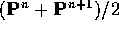 does.
Next example:
does.
Next example:
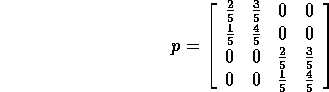
Solve :
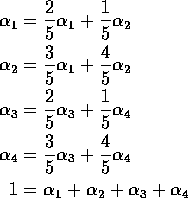
Second and fourth equations redundant. Get
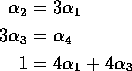
Pick  in [0,1/4];
put
in [0,1/4];
put  .
.

solves .
So solution is not unique.
> p:=matrix([[2/5,3/5,0,0],[1/5,4/5,0,0],
            [0,0,2/5,3/5],[0,0,1/5,4/5]]);

               [2/5    3/5     0      0 ]
               [                        ]
               [1/5    4/5     0      0 ]
          p := [                        ]
               [ 0      0     2/5    3/5]
               [                        ]
               [ 0      0     1/5    4/5]
> p2:=evalm(p*p):
> p4:=evalm(p2*p2):
> p8:=evalm(p4*p4):
> evalf(evalm(p8*p8));
        [.2500000000 , .7500000000 , 0 , 0]
        [                                 ]
        [.2500000000 , .7500000000 , 0 , 0]
        [                                 ]
        [0 , 0 , .2500000000 , .7500000000]
        [                                 ]
        [0 , 0 , .2500000000 , .7500000000]
Notice that rows converge but to two different vectors:

and

Solutions of revisited?
Check that

and

If  (
(  ) then
so again solution is not unique. Last example:
> p:=matrix([[2/5,3/5,0],[1/5,4/5,0],
             [1/2,0,1/2]]);

                  [2/5    3/5     0 ]
                  [                 ]
             p := [1/5    4/5     0 ]
                  [                 ]
                  [1/2     0     1/2]
> p2:=evalm(p*p):
> p4:=evalm(p2*p2):
> p8:=evalm(p4*p4):
> evalf(evalm(p8*p8));
  [.2500000000 .7500000000        0       ]
  [                                       ]
  [.2500000000 .7500000000        0       ]
  [                                       ]
  [.2500152588 .7499694824 .00001525878906]
Interpretation of examples
all rows converge to some . In
this case this is a stationary initial distribution. the locations of zeros flip flop. does
not converge. Observation: average

does converge.
some rows converge to one and some to
another. In this case the solution of is not
unique.
Basic distinguishing features: pattern of 0s in matrix .
The ergodic theorem
Consider a finite state space chain.
If x is a vector then the ith entry in  is
is

Rows of probability vectors, so a
weighted average of the entries in x.
If the weights are
strictly between 0 and 1 and the largest and smallest entries
in x are not the same then  is strictly
between the largest and smallest entries in x. In fact
is strictly
between the largest and smallest entries in x. In fact

and

Now multiply  by
by  .
.
ijth entry in  is a weighted average of the jth
column of .
is a weighted average of the jth
column of .
So, if all the entries in row i of
are positive and the jth column of is not constant, the
ith entry in the jth column of must be strictly
between the minimum and maximum entries of the jth column of
.
In fact, fix a j.
 maximum entry in column j of
 the minimum
entry.
the minimum
entry.
Suppose all entries of are positive.
Let  be the smallest entry in . Our argument above
shows that
be the smallest entry in . Our argument above
shows that

and

Putting these together gives

In summary the column maximum decreases, the column minimum increases
and the gap between the two decreases exponentially along
the sequence  .
.
This idea can be used to prove

Proof: First for k>r

For each i there is a k for which  and since
 we see
  .
The argument before the proposition shows that
.
The argument before the proposition shows that

exists for each m and  . This proves has a limit which
we call
. This proves has a limit which
we call  . Since
  also converges to we
find
also converges to we
find

Hence each row of is a solution of  . The argument
before the statement of the proposition shows all rows of are equal.
Let
. The argument
before the statement of the proposition shows all rows of are equal.
Let  be this common row.
Now if is any vector whose entries sum to 1
then  converges to

If is any solution of  we have by induction
 so
so  so
so  .
That is exactly one vector whose entries sum to 1 satisfies .
.
That is exactly one vector whose entries sum to 1 satisfies .

Note conditions:
There is an r for which all entries in are positive.
The chain has a finite state space.
Consider finite state space case:
need not have limit. Example:

Note  is the identity while
  .
Note, too, that
.
Note, too, that

Consider the equations  with
with  .
We get
.
We get

so that the solution to is again unique.
Definition: The period d of a state i is the greatest common divisor of


Definition: A state is aperiodic if its period is 1.
Proof: I do the case d=1. Fix i. Let

If  then
then  .
.
This (and aperiodic) implies (number theory argument) that there is an r such
that implies  .
.
Now find m and n so that

For k>r+m+n we see  so the gcd of the
set of k such that is 1.
so the gcd of the
set of k such that is 1.
The case of period d>1 can be dealt with by considering
 .
.
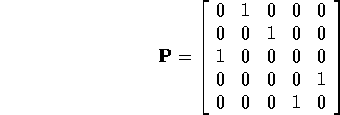
For this example  is a class of period 3 states
and
is a class of period 3 states
and  a class of period 2 states.
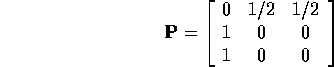
has a single communicating class of period 2.
A chain is aperiodic if all its states are aperiodic.