

 Postscript version of this file
Postscript version of this file
Meaning of unconditional expected values?
Markov property specifies only conditional probabilities; no way to deduce marginal distributions.
For every distribution  on S and transition matrix
  there is a
a stochastic process
there is a
a stochastic process
 with
with
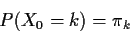 .
corresponding probability measure.
.
corresponding probability measure.
Notice Strong Markov Property proof used only conditional expectations.
Notation:
a probability on S.
 and
and  are expected values and probabilities for chain with initial
distribution .
are expected values and probabilities for chain with initial
distribution .
Summary of easily verified facts:
 For any sequence of states


For any event A:
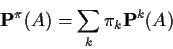
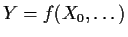
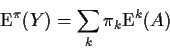
For any bounded rv
Now consider a transient state k, that is, a state for which

 is a stopping time.
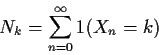
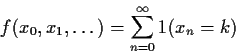
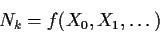
Let Nk be the number of visits to state k. That is
is a stopping time.
Let Nk be the number of visits to state k. That is


 we have
In short:

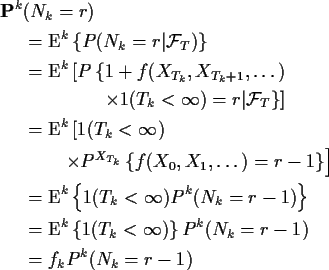
It is easily verified by induction, then, that
 so
so


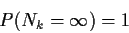
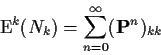
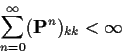
Proof: Suppose i is recurrent and
 .
There are integers
m and n such that
.
There are integers
m and n such that


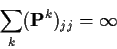
A finite state space chain has at least one recurrent state:
If all states we transient we would have for each k
 .
This would mean
.
This would mean
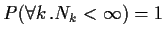 .
But for any
.
But for any  there must be at least one k for which
 (the total of a finite list of finite numbers is finite).
Infinite state space chain may have all states transient:
The chain Xn satisfying Xn+1=Xn+1 on the integers has all states transient.
More interesting example:
Toss a coin repeatedly.
Let
Xn be X0 plus the number of heads minus the number of tails
in the first n tosses.
Let p denote the probability of heads
on an individual trial.
Xn-X0 is a sum of n iid random variables Yiwhere P(Yi=1)=p and P(Yi=-1)=1-p.
SLLN shows Xn/n converges almost surely to 2p-1. If
 this is not 0.
In order for Xn/n to have a
positive limit we must have
 almost surely so
all states are visited only finitely many times. That is, all
states are transient. Similarly for p<1/2
almost surely so
all states are visited only finitely many times. That is, all
states are transient. Similarly for p<1/2
 almost surely and all states are transient.
Now look at p=1/2. The law of large numbers argument no long shows anything. I will show that all states are recurrent.
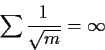
Proof: We show
 and show the sum is infinite.
If n is odd then
(pn)00 = 0 so we evaluate
and show the sum is infinite.
If n is odd then
(pn)00 = 0 so we evaluate

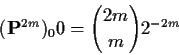
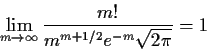
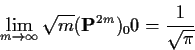
Compute expected times to return.
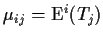
For  let Tx denote the hitting time for
x.
let Tx denote the hitting time for
x.
Suppose x recurrent in irreducible chain (only one communicating class).
Derive equations for expected values of different Tx.
Each Tx is a certain function fx applied to
 .
Setting
.
Setting
 we find





This gives

 and
applying the monotone convergence theorem.)
and
applying the monotone convergence theorem.)
Here is a simple example:
![\begin{displaymath}{\bf P}= \left[\begin{array}{ccc}
0 & \frac{1}{2} & \frac{1}{...
...ac{1}{2}
\\
\frac{1}{2} & \frac{1}{2} & 0
\end{array}\right]
\end{displaymath}](img57.gif)
The identity (1) becomes
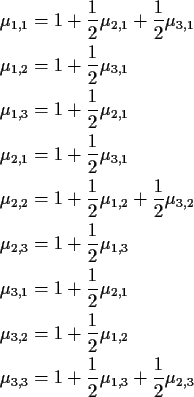
Seventh and fourth show
 .
Similar
calculations lead to
.
Similar
calculations lead to
 and, for
 .
.
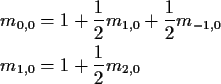
Example: The coin tossing Markov Chain with p=1/2 shows
that the situation can be different when S is infinite.
The equations above become:
and many more.
Some observations:
You have to go through 1 to get to 0 from 2 so
Symmetry (switching H and T):
The transition probabilities are homogeneous:
Conclusion:
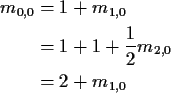
Notice that there are no finite solutions!
Summary of the situation:
Every state is recurrent.
All the expected hitting times mij are infinite.
All entries
 converge to 0.
Jargon: The states in this chain are null recurrent.
