


STAT 870 Lecture 12
Hitting Times
Start irreducible recurrent chain  in state i.
Let
in state i.
Let  be first n;SPMgt;0 such that
  .
Define
.
Define

First step analysis:
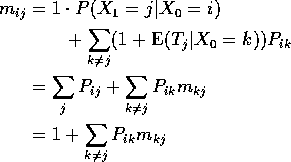
Example
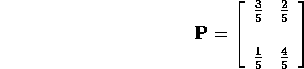
The equations are
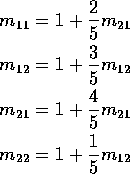
The second and third equations give immediately

Then plug in to the others to get

Notice stationary initial distribution is

Consider fraction of time spent in state j:

Imagine chain starts in chain i; take expected value.

If rows of  converge to
  then fraction converges to
 ; i.e. limiting fraction of time in state j is .
Heuristic: start chain in i. Expect to return to i every
 time units. So are in state i about once every
time units; i.e. limiting fraction of time in state i
is
time units. So are in state i about once every
time units; i.e. limiting fraction of time in state i
is  .
.
Conclusion: for an irreducible recurrent finite state space Markov chain

Real proof: Renewal theorem or variant.
Idea: 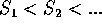 are times of visits to i. Segment i:

Segments are iid by Strong Markov.
Number of visits to i by time  is
exactly k.
is
exactly k.
Total elapsed time is  where
where  are
iid.
are
iid.
Fraction of time in state i by time is

by SLLN. So if fraction converges to  must have
Summary of Theoretical Results:
For an irreducible aperiodic positive recurrent Markov Chain:
 converges to a stochastic matrix
  . is the unique stationary initial distribution.
where  is the mean return time to state i from state i.
If the state space is finite an irreducible chain is positive recurrent.
Ergodic Theorem
Notice slight of hand: I showed

but claimed

almost surely which is also true. This is a step in the proof of the
ergodic theorem. For an irreducible positive recurrent Markov chain and
any f on S such that  :
:

almost surely. The limit works in other senses, too. You also get

E.g. fraction of transitions from i to j goes to

For an irreducible positive recurrent chain of period d:
 has d communicating classes each of which forms an irreducible aperiodic
positive recurrent chain.
has d communicating classes each of which forms an irreducible aperiodic
positive recurrent chain. has a limit . is the unique stationary initial distribution.
For an irreducible null recurrent chain:
converges to 0 (pointwise).
For an irreducible transient chain:
converges to 0 (pointwise).
For a chain with more than 1 communicating class:
 is a recurrent class the submatrix
  of
made by picking out rows i and columns j for which
of
made by picking out rows i and columns j for which  is a stochastic matrix. The corresponding entries in are just
 so you can apply the conclusions above. converge to 0.
Poisson Processes
Particles arriving over time at a particle detector. Several ways to describe most common model.
Approach 1: numbers of particles arriving in an interval has Poisson distribution, mean proportional to length of interval, numbers in several non-overlapping intervals independent.
For s;SPMlt;t, denote number of arrivals in (s,t] by N(s,t). Jargon: N(A) = number of points in A is a counting process. Model is
 distribution.
 the variables
 are independent.
Approach 2:
Let  be the times at which the particles
arrive.
be the times at which the particles
arrive.
Let 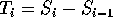 with
with  by convention. are called
interarrival times.
by convention. are called
interarrival times.
Then  are independent Exponential random variables with mean
  .
.
Note 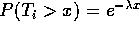 is called survival function of .
Approaches are equivalent. Both are deductions of a model based on local behaviour of process.
Approach 3: Assume:


Notation: given functions f and g we write

provided

[Aside: if there is a constant M such that

we say

Notation due to Landau. Another form is
means there is  and M s.t. for all

Idea: o(h) is tiny compared to h while O(h) is (very) roughly the same size as h.]
Generalizations:
 for some non-decreasing
non-negative function
for some non-decreasing
non-negative function  (called cumulative intensity). Result
called inhomogeneous Poisson process.
(called cumulative intensity). Result
called inhomogeneous Poisson process.