


STAT 870 Lecture 14
Properties of Poisson Processes
 and
and  are independent Poisson processes with
rates
are independent Poisson processes with
rates  and
and  , respectively, then
 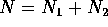 is a Poisson processes with rate
  .
.
 . Suppose each point
is marked with a label, say one of
. Suppose each point
is marked with a label, say one of  , independently of
all other occurrences. Suppose
, independently of
all other occurrences. Suppose  is the probability that a given point
receives label
is the probability that a given point
receives label  . Let
. Let  count the points with label i (so that
 ). Then
  are independent Poisson processes
with rates
are independent Poisson processes
with rates  .
.
 independent rvs, each
uniformly distributed on [0,T]. Suppose M is a Poisson
independent rvs, each
uniformly distributed on [0,T]. Suppose M is a Poisson  random variable independent of the U's. Let

Then N is a Poisson process on [0,T] with rate .
.
Let  be the times at which points arrive
Given N(T)=n,
be the times at which points arrive
Given N(T)=n,  have the same distribution
as the order statistics of a sample of size n from the
uniform distribution on [0,T].
have the same distribution
as the order statistics of a sample of size n from the
uniform distribution on [0,T].
 , have the same distribution
as the order statistics of a sample of size n from the
uniform distribution on [0,T].
, have the same distribution
as the order statistics of a sample of size n from the
uniform distribution on [0,T].
Indications of some proofs:
1)
independent Poisson processes rates  ,
,
 . Let
. Let  be the event of 2 or more points
in N in the time interval (t,t+h],
be the event of 2 or more points
in N in the time interval (t,t+h],  , the event of exactly
one point in N in the time interval (t,t+h].
, the event of exactly
one point in N in the time interval (t,t+h].
Let  and
and  be the corresponding events for .
Let  denote the history of the processes up to time t; we
condition on . Technically, is the
denote the history of the processes up to time t; we
condition on . Technically, is the  -field generated by

We are given:

and

Note that

Since

and
we have checked one of the two infinitesimal conditions for a Poisson process.
Next let  be the event of no points in
N in the time interval (t,t+h] and
be the event of no points in
N in the time interval (t,t+h] and  the same
for .
Then
the same
for .
Then
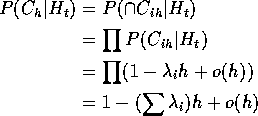
shows

Hence N is a Poisson process with rate  .
.
2) The infinitesimal approach used for 1 can do part of this.
See text for rest. Events defined as in 1):
The event that there is one point in in (t,t+h] is the event,
that there is exactly one point in any of the r processes together
with a subset of where there are two or more points in N in
(t,t+h] but exactly one is labeled i. Since 
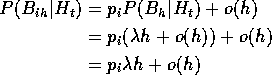
Similarly, is a subset of so
This shows each is Poisson with rate  . To
get independence requires more work; see the homework for an
easier algebraic method.
. To
get independence requires more work; see the homework for an
easier algebraic method.
3) Fix s;SPMlt;t. Let N(s,t) be the number of points in (s,t]. Given N=n the conditional distribution of N(s,t) is Binomial(n,p) with p=(s-t)/T. So

4): Fix  for
for  such that

Given N(T)=n we compute the probability of the event

Intersection of A,1 N(T)=n is (  ):
):

whose probability is

So

Divide by  and let all
  go to 0 to
get joint density of is
go to 0 to
get joint density of is

which is the density of order statistics from a Uniform[0,T] sample of size n.
5) Replace the event  with
with  . With
A as before we want
. With
A as before we want

Note that B is independent of  and that we have
already found the limit
and that we have
already found the limit

We are left to compute the limit of

The denominator is

Thus

This gives the conditional density of given
as in 4).
Inhomogeneous Poisson Processes
The idea of hazard rate can be used to extend the notion of Poisson
Process. Suppose  is a function of t. Suppose
N is a counting process such that
is a function of t. Suppose
N is a counting process such that

and

Then N has independent increments and N(t+s)-N(t) has a Poisson distribution with mean

If we put

then mean of N(t+s)-N(T) is
 .
.
Jargon: is the intensity or instantaneous intensity
and  the cumulative intensity.
Can use the model with any non-decreasing right continuous
function, possibly without a derivative. This allows ties.
Space Time Poisson Processes
Suppose at each time  of a Poisson Process, N, we have rv
 with the iid and independent of the Poisson process. Let M be the counting
process on
with the iid and independent of the Poisson process. Let M be the counting
process on  (where
  is the range space of the Ys)
defined by
is the range space of the Ys)
defined by

Then M is an inhomogeneous Poisson process with mean function  a measure extending

This means that each M(A) has a Poisson distribution with mean  and
if
and
if  are disjoint then
  are independent.
The proof in general is a monotone class argument. The first step is:
if
are independent.
The proof in general is a monotone class argument. The first step is:
if  are disjoint intervals and
  disjoint
subsets of then the rs rvs
disjoint
subsets of then the rs rvs  are independent
Poisson random variables. See the homework for proof of a special case.
are independent
Poisson random variables. See the homework for proof of a special case.