
Chapter Contents

Previous

Next
|
Chapter Contents |
Previous |
Next |
| Introduction to Clustering Procedures |
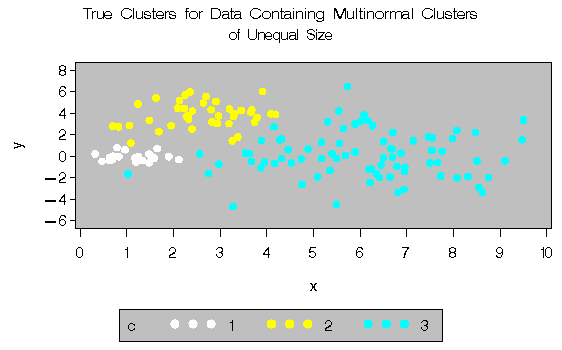
In this example, there are three multinormal clusters that differ in size and dispersion. PROC FASTCLUS and five of the hierarchical methods available in PROC CLUSTER are used. To help you compare methods, the true, generated clusters are plotted. The following SAS statements produce Figure 8.9:
   data unequal;
      keep x y c;
      mx=1; my=0; n=20; scale=.5; c=1; link generate;
      mx=6; my=0; n=80; scale=2.; c=3; link generate;
      mx=3; my=4; n=40; scale=1.; c=2; link generate;
      stop;
   generate:
      do i=1 to n;
         x=rannor(1)*scale+mx;
         y=rannor(1)*scale+my;
         output;
      end;
      return;
   run;

   title 'True Clusters for Data Containing Multinormal
          Clusters';
   title2 'of Unequal Size';
   proc gplot;
      plot y*x=c/frame cframe=ligr
           vaxis=axis1 haxis=axis2 legend=legend1;
   run;
|
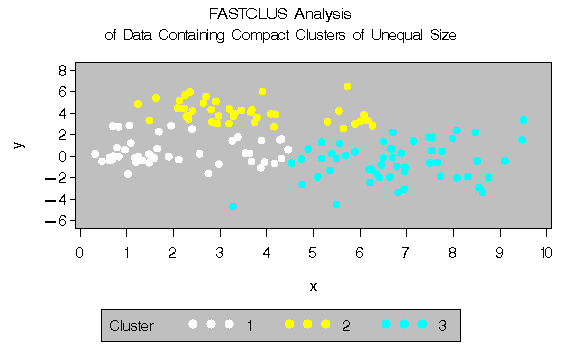
The following statements use the FASTCLUS procedure to find three clusters and the PLOTCLUS macro to plot the clusters. The statements produce Figure 8.10.
   proc fastclus data=unequal out=out maxc=3 noprint;
      var x y;
      title 'FASTCLUS Analysis';
      title2 'of Data Containing Compact Clusters of
              Unequal Size';
   run;

   %plotclus;
|
The following SAS statements produce Figure 8.11:
   proc cluster data=unequal outtree=tree
                method=ward noprint;
      var x y;
   run;

   proc tree noprint out=out n=3;
      copy x y;
      title 'Ward''s Minimum Variance Cluster Analysis';
      title2 'of Data Containing Compact Clusters of
              Unequal Size';
   run;

   %plotclus;

|
The following SAS statements produce Figure 8.12:
   proc cluster data=unequal outtree=tree method=average
                noprint;
      var x y;
   run;

   proc tree noprint out=out n=3 dock=5;
      copy x y;
      title 'Average Linkage Cluster Analysis';
      title2 'of Data Containing Compact Clusters of
              Unequal Size';
   run;

   %plotclus;

|
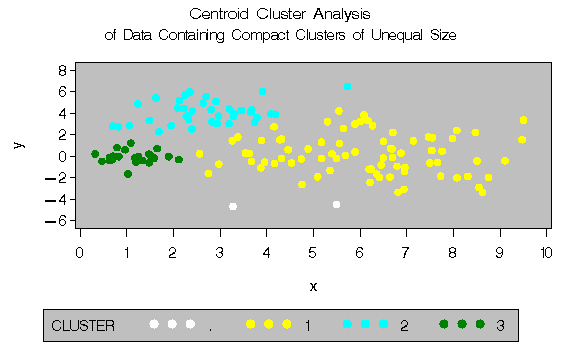
The following SAS statements produce Figure 8.13:
   proc cluster data=unequal outtree=tree
                method=centroid noprint;
      var x y;
   run;

   proc tree noprint out=out n=3 dock=5;
      copy x y;
      title 'Centroid Cluster Analysis';
      title2 'of Data Containing Compact Clusters of
              Unequal Size';
   run;

   %plotclus;
|
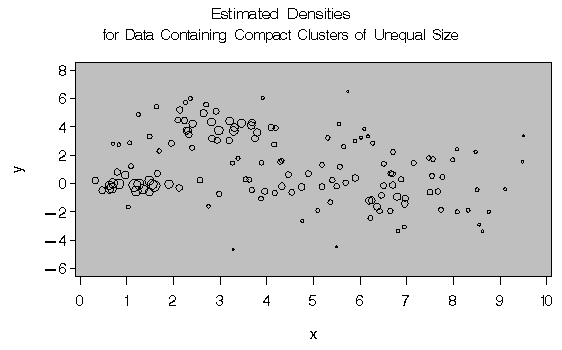
The following SAS statements produce Figure 8.14:
   proc cluster data=unequal outtree=tree method=twostage
                k=10 noprint;
      var x y;
   run;

   proc tree noprint out=out n=3;
      copy x y _dens_;
      title 'Two-Stage Density Linkage Cluster Analysis';
      title2 'of Data Containing Compact Clusters of
              Unequal Size';
   run;

   %plotclus;

   proc gplot;
      bubble y*x=_dens_/frame cframe=ligr
             vaxis=axis1 haxis=axis2 ;
      title 'Estimated Densities';
      title2 'for Data Containing Compact Clusters of
              Unequal Size';
   run;

|
|
The following SAS statements produce Figure 8.15:
   proc cluster data=unequal outtree=tree
                method=single noprint;
      var x y;
   run;

   proc tree data=tree noprint out=out n=3 dock=5;
      copy x y;
      title 'Single Linkage Cluster Analysis';
      title2 'of Data Containing Compact Clusters of
              Unequal Size';
   run;

   %plotclus;

|
In the PROC FASTCLUS analysis, the smallest cluster, in the bottom left of the plot, has stolen members from the other two clusters, and the upper-left cluster has also acquired some observations that rightfully belong to the larger, lower-right cluster. With Ward's method, the upper-left cluster is separated correctly, but the lower-left cluster has taken a large bite out of the lower-right cluster. For both of these methods, the clustering errors are in accord with the biases of the methods to produce clusters of equal size. In the average linkage analysis, both the upper- and lower-left clusters have encroached on the lower-right cluster, thereby making the variances more nearly equal than in the true clusters. The centroid method, which lacks the size and dispersion biases of the previous methods, obtains an essentially correct partition.
Two-stage density linkage does almost as well even though the compact shapes of these clusters favor the traditional methods. Single linkage also produces excellent results.
|
Chapter Contents |
Previous |
Next |
 Top |
Copyright © 1999 by SAS Institute Inc., Cary, NC, USA. All rights reserved.