Argument Structure
 The head of each proposition is a predicate or
an operator. The predicate corresponds to the basic lexical meaning
of the event. We will cover operators later. The predicate for
the above sentence is "DROP". We consider here DROP
and all forms in CAPs only to be abstract morphemes which correspond
to conceptual (information-semantic). Theta roles are not abstract
morphemes. A predicate is a bundle of abstract morphological features
The head of each proposition is a predicate or
an operator. The predicate corresponds to the basic lexical meaning
of the event. We will cover operators later. The predicate for
the above sentence is "DROP". We consider here DROP
and all forms in CAPs only to be abstract morphemes which correspond
to conceptual (information-semantic). Theta roles are not abstract
morphemes. A predicate is a bundle of abstract morphological features
(8) Property:
Predicate
A predicate is a bundle of abstract lexical features representing
an eventuality or an object.
Let us start with the predicate:
(9) DROP.
Every predicate referring to an eventuality (events and states)
must have at least one argument. Arguments are extensions of a
predicate, that are required a part of the meaning of the predicate.
An argument refers to either the participants of the event, or
it can refer to a proposition itself as we will see below. DROP
implies two arguments: the one who drops something (Bill) and
the object that is dropped (a cup). Arguments are enclosed in
angled brackets:
(10) <BILL> DROP
<CUP>
Note that CUP is the central predicate of the argument 'a cup.'
The names for these arguments is covered in week 2. The above
form based on a predicate and its arguments is called a phrase.
By convention, we prefer to place the predicate first, and
the arguments after the predicate:
(11) DROP <CUP> <BILL>
Furthermore, by convention, we prefer to place the internal
argument first, the external argument last (see argument.assignment).
 Arguments
We have noted that the abstract morphological form DROP takes
two arguments: <BILL> and <CUP>. Other predicates
take one argument:
(11) John slept.
There is no linear order in propositional structure. As mentioned
above we will put the predicate first, and the arguments after
it:
(11) SLEEP <JOHN>.
(12) DROP <CUP> <BILL>
Some predicates assignment more than two arguments:
(13) Sally set her books on the desk.
(14) PUT <HER BOOKS> <ON
DESK> <SALLY>
(15) Henry bought his car from Jane
for $250.
(16) BUY <HIS CAR> <FROM
JANE> <$250> <HENRY>
The arguments of most eventualities are objects.
 Consider sentence (1) again. If we extract
the lexical proposition from it, what remains is the tense of
the verb. Tense is an operator. We will
write operators in CAPS enclosed in square brackets:
Consider sentence (1) again. If we extract
the lexical proposition from it, what remains is the tense of
the verb. Tense is an operator. We will
write operators in CAPS enclosed in square brackets:
(17). [TENSE].
In English there are two tenses: present and past. We can represent
tense in binary features:
(18). [+Past], [-Past].
[+Past] refers to an event that precedes the speech event;
[-Past] refers to an events the does not precedes the speech.
Hence the [-Past] tense can be present or future. Click here to
go to tense. The forms in (18)
are called features. All operators contain a simple or complex
set of features. Predicates can be decomposed in semantic features
underlying lexical morphemes also. We will not attempt to do so
here.E-proposition (9) is an argument of [TENSE [+Past]]:
(19) [TENSE [+Past] <
E-proposition>
(20) < E-proposition> = <BILL>
DROP <CUP>
therefore:
(21) [TENSE [+Past] < DROP <CUP>
<BILL> > ]
(21) is technically part of a proposition. We will cover some
of the remaining operators that are required to make a complete
proposition later. (Go to aspect.)
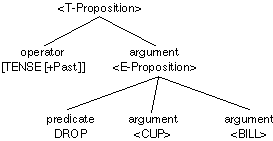
The incomplete proposition (21) and even more complex propositions
are difficult to read as they are drawn in a linear format. (21)
can be redrawn in a tree-structure format, common to linguists.
The incomplete proposition containing both [TENSE] and the E-proposition
is a T-Proposition :
(22)
In the weeks that follow we will discuss
the syntactic representation related to propositional structures.
We will commence with tense.