Feature Copying Down
(Lowering) Feature Copying Down
(Lowering)
Feature Copying Down
(Lowering) Feature Copying Down
(Lowering) Syntax
 Contents:
Raising | Government
| Lowering | Feature Copying
| Regular Verbs | Irregular
Verbs | 't' Past | 'd'
Past | Strong Verb | Lexical Entry of deal | Lexical
Entry of tell
Contents:
Raising | Government
| Lowering | Feature Copying
| Regular Verbs | Irregular
Verbs | 't' Past | 'd'
Past | Strong Verb | Lexical Entry of deal | Lexical
Entry of tell
 Let us start with
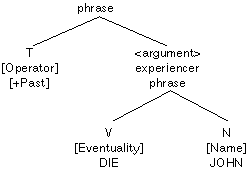
the D-structure for (1) given in Figure (2):
Let us start with
the D-structure for (1) given in Figure (2):
(1) John died.
Figure (2) represents the string (1):
(2)
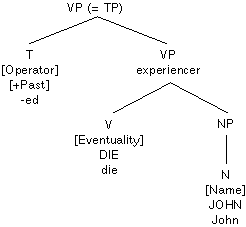
Each phrase is appropriately named N is expanded to [NP, N]. we choose to name each phrase according to its lexical projection rather than its operator-head (which we will place in parentheses). Now, lets spell out each category with its orthographical form (putting the question of its phonological form aside):
(3)
In linear form, (3) is represented as:
(4) -Ed die John.
(4) is obviously not a sentence of English, even though the morphemes appear to be English. "-ed" is a suffix which implies that it should be affixed to some form called a host. Somehow, the suffix must be attached to a host. The rules of English grammar that the host for tense affixes must be a verb. This is expressed in the lexical entry for [±Past]:
(5)
| Past Tense | |
| T | category |
| TENSE [+Past] | operator and feature |
| V\____ | hosting property |
| {ed, d, t} | orthographic form |
| /Èd, d, t/ | phonological form |
There are two choices of attaining this goal: the suffix can either copy the features of T to the main verb, or copy the features of the main verb to T. Note that either direction can apply yielding the same result: V will be the host for [+Past]. We assume that only one of these copying rules should apply. The question is which one?
The evidence is found in transitive verbs:
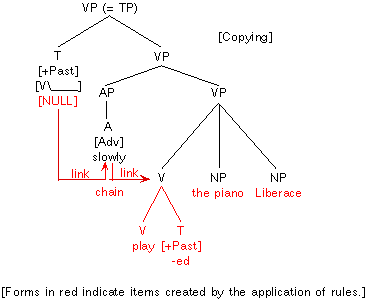
(6) Liberace slowly played the piano.
The logical structure in linear from is:
(7) [TENSE [+Past] < SLOWLY PLAY <theme: THE PIANO> <agent: LIBERACE> ].
The feature [+Past] is copied to V in the governing chain (a system of connected links) [T,A] + [A,V] = [T, A, V] :
(8)
Now, suppose the features of play
are copied to T (this process is called raising):
(9) played slowly [V --- ] the piano Liberace.
Either way, a gap remains in the verb's original position ([V --- ]. A gap is a node with no phonological content.
And once Liberace is copied to the subject position (go to Internal.Subject.Hypothesis and Raising) we get the following ungrammatical string:
(10) *Liberace played slowly the piano.
Thus, copying the verb to T yields the incorrect ordering of the adverb. Now, let's lower T or copy T to the verb. We get the following grammatical string:
(11) [T --- ] slowly played the piano Liberace
(12) Liberace [T --- ] slowly played the piano.
See (8).
In copying, the features of T are copied onto V. If V is regular, PLAY splits into a verb stem plus a suffix containing the feature [+Past]. PLAY is spelled out as play and [+Past] is spelled out as -ed. (the regular ending):
(13) play+ed.
As in the Case of nouns, a head, which includes all governors, governs a phrase and its head in its immediate c-command scope. In the above structure T governs V. We will focus on this particular relationship here. Government is defined:
(14) A governs B iff
a) A syntactically c-commands B
b) A is a head
c) There is no node C, such that A governs B, and B goversn C (the intervening governor restriction)
d) B is a complement of A and is the closet complement to A.
Note that in the case of phrasal verbs:
(15) Bill took out the garbage.,
Take out forms a verb which governs its complement the garbage. This means that c-command must be extended somewhat to include this case:
(16)
Let us now adopt the rule that copies the affix T to the verb.
(17) Tense affixes are copied to the verb.
This rule is motivated by the following principle:
A bound form is a form marked with the feature X\____], where X is a category. Such a form requires a host or the structure will crash.
Crash means that the sentence is rendered ungrammatical. (See definitions.)
Features are copied by means of a link. A link occurs within a government relationship. A featured may be copied from the head (the governor) to the tail of the link (the governee).
Let us first consider regular verbs.
First, the features of [Tense] are copied from T to the verb if
there no operators with positive feature which would take precedence
over copying from T. The verb now hosts the features of tense.
By a regular rule of English in the past tense, a default rule,
the word splits into a stem and an inflectional affix; here the
affix is T. The feature [+Past] is copied to the verb. Let us
start witht he following sentence:
(17)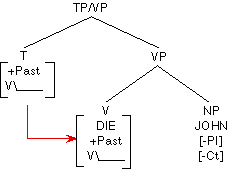
The feature of T, [±Past], is copied down to T. Once all the features have been copied, the default rule of English morphology applies. If the verb contains the features [+Past], [-Past, -Pers, -Pl] (third person singular agreement), [+Perf], [+Pass], or [+Prog], the verb splits into a verb stem plus an inflectional ending. The operator features pass to the ending; the other features pass to the verb stem:
(18)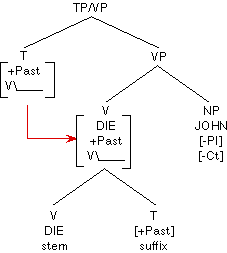
Note that irregular verbs such as SWIM belong to the class of verbs sometimes called strong verbs that does not split into a stem plus a suffix. It is spelled out as a single morpheme: swam: See strong verbs below (Strong Verbs). The failure of SWIM to split into two morphemes (swim+ed) supports the splitting analysis.
The structure given in (18) corresponds to what Chomsky calls S-Structure. S-structure is the resulting structure having applied all the rules of morphosyntax.
The structure next passes to the phonological component. This process is sometimes called spell-out. This process actually assigns the underlying phonological forms to each morpheme that are stored in the lexical entry. Formally, DIE should be spelled out as /daj/; [+Past] as /d/: /daj+d/. However, we will list the spell out forms in their orthographic form instead: died. This is to avoid the issues of what constitutes an underlying form. For the sake of exposition, we will print the orthographic forms in blue; forms in blue are not part of S-structure, but of surface structure:
(19)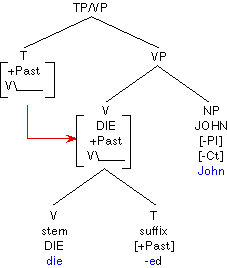
Note that (19) is not a grammatic structure. The NP John must raise to the subject position (see 322.Raising). Spell out does not technically take place until after raising.
The
default rule for verbs and adjectives is:
- X, [Y] --> X + [Y].
- where X = N or V, and Y = inflectional (grammatical ) feature that expands into a suffix.
Irregular verbs fall into two major classes: weak irregular verbs and strong irregular verbs. Weak irregular verbs end in the suffixes "-t" and "-d". The verbs are closely related to regular verbs: the two suffixes are variants of the regular ending "-ed". And all verb of this general class do not phonetically differentiate between the past tense and the non-progressive participle form. The non-progressive participle is often called either the past participle or the passive participle. Neither name is technically appropriate for this class. We consider first verbs which take the suffix "-t".
 The semi irregular
past tense suffix '-t'
The semi irregular
past tense suffix '-t'
Several verbs in English are formed with the suffix "-t"; e.g. dealt, knelt, felt, kept (see irregular.verbs) (lexicon):
(20) Mary dealt a wicked hand to the players.
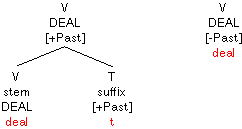
The feature is copied as above, and the verb splits into a stem and a suffix as above. However, [+Past] is not spelled out as the regular ending "-ed", but as "-t". To ensure that the ending is spelled out correctly, this information must be listed in the lexical entry for the verb:
| DEAL | morphemic form |
| V (main) (or) +V, -N, | syntactic Categorial class |
| [ACCOMPLISHMENT/ACHIEVEMENT] | inherent features |
| _____ NP PP | subcategorization |
| root/stem | morphological form |
| agent, theme, goal | theta role |
| human (agent), musical instrument (theme), human (goal) | selectional restriction |
| "distribute cards" | semantic synonym (meaning) |
| deal | orthographic form |
| /d l/+[+Past] | phonemic form of past & non-progressive participle allomorph |
| /dil/ | phonemic form of base allomorph |
The orthographic and phonemic sellout forms apply after all features are copied. The default rule (base allomorph) applied as after the irregular forms have applied:
(22)
Now consider the verb in:
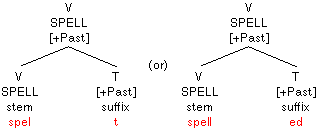
(23) John spelt the word.
Some verbs can be either regular
or irregular at the same time. Consider The two closely linked
lexical items for spell: SPELL-1 (spelt)
and SPELL-2. SPELL-2 has the information as SPELL-1, except
for the past tense: spelled. The lexical entry contains
information that it may take the '-t' ending or it may be expanded
by the default rules of the verbal system:
| SPELL | lexical form |
| V (main) (or) +V, -N, | syntactic Categorial class |
| [ACCOMPLISHMENT/ACHIEVEMENT] | inherent features |
| _____ NP | subcategorization |
| root/stem | morphological form |
| agent, theme | theta role |
| human (agent), musical instrument (theme) | selectional restriction |
| "write out letters" | semantic synonym (meaning) |
| spelt | orthographic form of past/nonprogressive form |
| spelled | default orthographic form |
| /spEl/+[+Past] | phonemic form of past & non-progressive participle allomorph |
| /spEl/ | phonemic form of base allomorph |
(25)
Note there is an orthographic rule of English the converts a doubled consonant into a single consonant before a consonantal ending (i.e., one the has an initial consonant).
Let us go into
a bit more detail. First, each predicate and operator must be
matched with the appropriate lexical item and grammatical item,
respectively. T-[+Past] is matched to T[+Past] in the grammatical
component of the lexicon. In the first pass, all the features
in the matched lexical entry or grammatical entry are copied to
the predicate or operator. The phonetic form is determined after
other syntactic process have been completed.
The
semi irregular past tense suffix '-d'
Several more verbs take '-d' unpredictably for the past marker: sell, sold; tell, told; make, made; do, did; say, said; pay, paid. These same ending are used for the non-progressive participle. There is but one exception to this: the non-progressive participle for do is do+ne, the ending used for strong verbs. This irregular form is encoded in the lexical entry for each verb; e.g.:
| TELL | morphemic form |
| V (main) (or) +V, -N, | syntactic Categorial class |
| [ACCOMPLISHMENT/ACHIEVEMENT] | inherent features |
| _____ NP PP | subcategorization |
| root/stem | morphological form |
| agent, theme, goal | theta role |
| human (agent), information (theme), human (goal) | selectional restriction |
| "orally communicate information" | semantic synonym (meaning) |
| /tol/+[+Past] | phonemic form of past & non-progressive participle allomorph |
| /t l/ | phonemic form of base allomorph (default) |
| tol | orthographic form of past & non-progressive participle allomorph |
| tell | default orthographic form |
(27)
The strong verb
presents an interesting problem. First consider the past tense
form of swim: swam.
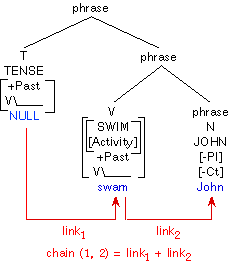
(28) John swam.
What is the morphological structure of swam? This question has provoked much debate and little consensus. Some linguists believe that the past tense is a null affix, and that this triggers somehow a change in the stem vowel:
(29) /swîm/+[+Past] --> /swæm+0/ (where '0' represents the null affix).
Other linguists believe that the past tense is marked by a replacement vowel; here /æ/:
(30) /swîm/+[+Past] --> /sw + æ + m/ (where /sw....m/ would be a discontinuous morpheme.
Other proposals abound, non of them convincing. We take the view that swam is a single morpheme. This morpheme contains (or refers to) SWIM plus [+Past]. That is, swam is more complex than swim which contains (or refers to) SWIM only. The advantage of this analysis can be seen in the following derivation.
The A-structure of (27) plus copying downward is:
(31)
The default rule of splitting the verb into a stem and a suffix cannot proceed without checking the lexical entry of the swim. It has the information that SWIM+'+Past] must be spelled out as swam. This rule must be applied:
(32)
By a more common convention, the each phrase is abbreviated to P, and the abbreviation of the head of the phrase is prefixed to P:
(33)
If we are right, the morpheme swam contains both SWIM and [+Past]. The only node that exclusively contains both these forms is the upper V. VP contains both of them as well, but it also contains NP. The lexical entry for SWAM does not include any complement.
Note that it is not common practice to include features in tree diagrams. There is nothing wrong in doing so. We include certain features mainly when we want to illustrate or emphasize a point.
To complete the derivation of the above example, raising must apply (see raising).

Contents:
Raising | Government
| Lowering | Feature Copying
| Regular Verbs | Irregular
Verbs | 't' Past | 'd'
Past | Strong Verb | Lexical Entry of deal | Lexical
Entry of tell
To go to
- raising click here
- argument assignment click here
- ambiguity click here
- internal subject hypothesis click here
To
return to
- 222 course outline click here
- 322 course outline click here
- 481 course outline click here