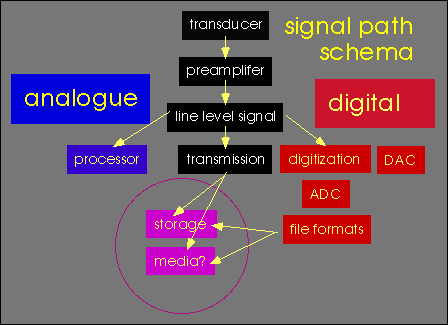
The transducer is a device which changes one form of energy into another. In sound applications this is usually a microphone but it may also be a phonograph record stylus, a magnetic coil guitar pick up or a loudspeaker. Speakers perform the opposite task of a microphone: they convert electrical energy into acoustic energy.
The signal from the microphone is a fragile analogue of the original sound pressure wave. It is called a microphone or mic signal. In order to remain faithful (i.e. maintain a high degree of fidelity) to the original, the mic signal is amplified by a microphone preamplifier or mic preamp. The output of the mic preamp is called a line level. This is a robust signal which can be transmitted, and modified more easily than a mic level. The analogue signals which travel from one audio device to another, such as from a mixer to a cassette deck, are often line level.
Representation
of a sound
wave as amplitude
over time: sine
(sinusoidal) wave or "pure tone"
Important
features are its period,
its wavelength,
its frequency
and its waveshape or waveform.
Most sustained sounds are may be thought of as a complex collection
of sine waves. If the sound has a perceivable pitch
it is called the fundamentaland
is the lowest frequency compnent. The other waves whcih comprise the sound
are called partials. If the sound is a conventional pitched musical
instrument then the partials are a subset of partials
called harmonics.
The relative amplitude of the individual harmonics determines the tone
of the sustained portion of the musical note. Harmonics are also
known as overtones. Partials which are not harmonic are referred
to as inharmonic. We number the harmonics starting with the fundamental
as one. The harmonics are cardinal number multiples of the fundamental
frequency (n x f , where
n =
1,
2, 3, ...) Thus if the fundamental is 2,000
Hz the 2nd harmonic is 4,000, the third is 6,000, etc. With the range
of human hearing limited to 20,000 Hz (realistically 14-17,000 Hz) we can
why most of the energy in music is in the lower half of that range.
This also explains why high frequency response in a reproduction system
is critical for high fidelity. Those upper harmonics or partials
provide "brightness" and definition and the sound will be dull and muted
if they are attenuated.

See
Signal
Path
See
Signal
path Overview
See
Processing
Options
See
Analogue
Representation, Analogue
Recording
See
Analogue
Sound Overview
See
Principles
of Digital Audio