


Reading for Today's Lecture: Sections 1, 2 and 3 of Chapter 2. Sections 1 and 2 of Chapter 4.
Goals of Today's Lecture:
Last time: We defined:
 .
.
Method 1: Two steps:
For Y=g(X) with X and Y each real valued
![\begin{displaymath}P(Y \le y) = P(g(X) \le y) = P(X \in g^{-1}((-\infty,y]))
\end{displaymath}](img3.gif)

Example: :
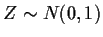 ,
i.e.
,
i.e.


![\begin{displaymath}f_Y(y) = \left\{ \begin{array}{ll}
0 & y < 0
\\
\frac{d}{dy...
...\right] & y > 0
\\
\mbox{undefined} & y=0
\end{array}\right.
\end{displaymath}](img9.gif)


We will find indicator notation useful:


Notice: I never evaluated FY before differentiating it. In fact
FY and FZ are integrals I can't do but I can differentiate then anyway.
You should remember the fundamental theorem of calculus:

Method 2: Change of variables.
Now assume g is one to one.
I will do the case where g is increasing
and I will be assuming that g is differentiable.
The density has the following interpretation (mathematically
what follows is just the expression of the fact that
the density is the derivative of the cdf):


 .
Since the interval is narrow the function fY is
nearly constant over this interval and we get
.
Since the interval is narrow the function fY is
nearly constant over this interval and we get


 in the limit


Remark: If g had been decreasing the
derivative  would have been negative but in
the argument above the interval
would have been negative but in
the argument above the interval
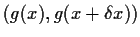 would have to have been written in the other order.
This would have meant that our formula had
would have to have been written in the other order.
This would have meant that our formula had
 .
In both cases this amounts to the formula
.
In both cases this amounts to the formula

 is called the Jacobian of the
transformation g.
is called the Jacobian of the
transformation g.
Example:
 or (see Chapter 3 for definitions of a number of ``standard''
distributions)
or (see Chapter 3 for definitions of a number of ``standard''
distributions)

Let  so that
 .
Setting
.
Setting  and solving
gives
and solving
gives  so that
g-1(y) = ey. Then
so that
g-1(y) = ey. Then
 and
and
 .
Hence
.
Hence


 and
and
 then the density
can be written as
then the density
can be written as

 and scale parameter
  .
(Note: there are several distributions going
under the name Extreme Value. If we had used
.
(Note: there are several distributions going
under the name Extreme Value. If we had used  we would have
found
we would have
found

Now we turn to multivariate problems. The simplest version has
 and Y=X1 (or in general any Xj).
 then
then
 (with q < p) has a density fY given by

We call
 the marginal density of
 and use the
expression joint density for fX but
is exactly the
usual density of
and use the
expression joint density for fX but
is exactly the
usual density of
 .
The adjective ``marginal'' is just there to
distinguish the object from the joint density of X.
.
The adjective ``marginal'' is just there to
distinguish the object from the joint density of X.
Example The function


 density.
The general multivariate problem has

Case 1: If q>p then Y will not have a density for ``smooth'' g. Y will have a singular or discrete distribution. This sort of problem is rarely of real interest. (However, variables of interest often have a singular distribution - this is almost always true of the set of residuals in a regression problem.)
Case 2 If q=p then we will be able to use a change of variables formula which generalizes the one derived above for the case p=q=1. (See below.)
Case 3: If q < p we will try a two step process.
In the first step we pad out Y
by adding on p-q more variables (carefully chosen)
and calling them
 .
Formally we find functions
.
Formally we find functions
 and define

 satisfies the conditions for applying
the change of variables formula from the previous case.
Then we apply that case to compute fZ. Finally we marginalize
the density of Z to find that of Y:
satisfies the conditions for applying
the change of variables formula from the previous case.
Then we apply that case to compute fZ. Finally we marginalize
the density of Z to find that of Y:
