


Reading for Today's Lecture: Chapter 2
Goals of Today's Lecture:
Last time: We defined:
We stated theorem saying independence is ``equivalent'' to factorization of either joint density or joint cdf.
We began to define conditional densities.
Reading for Today's Lecture: Chapter 4 sections 1, 2 and 3. Chapter 1 section 3.6.
Today's notes
We will define the conditional density of Y given X=x to be


 we have

 and let
tend to 0.
The denominator converges to fX(x) while the numerator converges to
and let
tend to 0.
The denominator converges to fX(x) while the numerator converges to


Now we turn to multivariate problems. The simplest version has
 and Y=X1 (or in general any Xj).
 then
then
 (with q < p) has a density fY given by

We call
 the marginal density of
 and use the
expression joint density for fX but
is exactly the
usual density of
and use the
expression joint density for fX but
is exactly the
usual density of
 .
The adjective ``marginal'' is just there to
distinguish the object from the joint density of X.
.
The adjective ``marginal'' is just there to
distinguish the object from the joint density of X.
Example The function


The marginal density of x1 is


 density.
The general multivariate problem has

Case 1: If q>p then Y will not have a density for ``smooth'' g. Y will have a singular or discrete distribution. This sort of problem is rarely of real interest. (However, variables of interest often have a singular distribution - this is almost always true of the set of residuals in a regression problem.)
Case 2 If q=p then we will be able to use a change of variables formula which generalizes the one derived above for the case p=q=1. (See below.)
Case 3: If q < p we will try a two step process.
In the first step we pad out Y
by adding on p-q more variables (carefully chosen)
and calling them
 .
Formally we find functions
.
Formally we find functions
 and define

 satisfies the conditions for applying
the change of variables formula from the previous case.
Then we apply that case to compute fZ. Finally we marginalize
the density of Z to find that of Y:
satisfies the conditions for applying
the change of variables formula from the previous case.
Then we apply that case to compute fZ. Finally we marginalize
the density of Z to find that of Y:

Suppose
 with
with  having density fX.
Assume the g is a one to one (``injective") map, that is,
g(x1) = g(x2) if and only if x1 = x2.
Then we find fY as follows:
having density fX.
Assume the g is a one to one (``injective") map, that is,
g(x1) = g(x2) if and only if x1 = x2.
Then we find fY as follows:
Step 1: Solve for x in terms of y: x=g-1(y).
Step 2: Remember the following basic equation
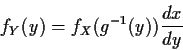
 when p>1. The interpretation is simply


![\begin{displaymath}\left\vert\frac{dy}{dx}\right\vert =
\left\vert \mbox{det} \...
...rac{\partial y_p}{\partial x_p}
\end{array} \right]\right\vert
\end{displaymath}](img33.gif)
Example: The density

 and Y2 is the angle (between 0 and
  )
in the
plane from the positive x axis to the ray from the origin to the point (X1,X2).
In other words, Y is X in polar co-ordinates.
)
in the
plane from the positive x axis to the ray from the origin to the point (X1,X2).
In other words, Y is X in polar co-ordinates.
The first step is to solve for x in terms of y which gives


Next problem: what are the marginal densities of Y1 and Y2?
Note that fY can be factored into
fY(y1,y2) = h1(y1)h2(y2) where


It is then easy to see that


 density.
You should be able to check that W=Y12/2 has a standard exponential
distribution. You should also know that by definition U=Y12 has a
density.
You should be able to check that W=Y12/2 has a standard exponential
distribution. You should also know that by definition U=Y12 has a
 distribution on 2 degrees of freedom and be able to find the
 density.
Note: This is an example of the general theorem I wrote down: when a joint density factors into a product you will always see the phenomenon above -- the factor involving the variable not be integrated out will come out of the integral and so the marginal density will be a multiple of the factor in question. This happens when and only when the two parts of random vector are independent.