


Reading for Today's Lecture: Section 5 of Chapter 4. Chapter 6 section 4.
Goals of Today's Lecture:
Last time
We derived the change of variables formula:
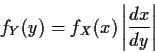
We showed that if (X,Y) has a density
fX,Y(x,y) then
X has (marginal) density

Today's notes
Def'n:
 iff
iff

Def'n:
 iff
iff
 (a column vector for later use) with the
Zi independent and each
(a column vector for later use) with the
Zi independent and each
 .
.
In this case according to our theorem

where the superscript t denotes matrix transpose.
Def'n:  has a multivariate normal distribution if it
has the same distribution as
has a multivariate normal distribution if it
has the same distribution as  for some
 ,
some
,
some
 matrix of constants A and
 .
.
If the matrix A is singular then X will not have a density. If A is
invertible then we can derive the multivariate normal density
by the change of variables formula:


 and notice that


 density. Notice that the density is
the same for all A such that
density. Notice that the density is
the same for all A such that
 .
This justifies the notation
.
.
This justifies the notation
.
For which vectors  and matrices
  is this a density?
Any
will work but if
is this a density?
Any
will work but if  then
then

where y=At x. The inequality is strict except for y=0 which
is equivalent to x=0. Thus
is a positive definite symmetric
matrix. Conversely, if
is a positive definite symmetric matrix
then there is a square invertible matrix A such that
so that
there is a
distribution. (The matrix A can be found
via the Cholesky decomposition, for example.)
More generally we say that X has a multivariate normal distribution
if it has the same distribution as
where now we remove the
restriction that A be non-singular. When A is singular X will not
have a density because there will exist an a such that
 ,
that is, so that X is confined to a hyperplane. It is still
true, however, that the distribution of X depends only on the matrix
in the sense that if
AAt = BBt then
and
,
that is, so that X is confined to a hyperplane. It is still
true, however, that the distribution of X depends only on the matrix
in the sense that if
AAt = BBt then
and
 have the same distribution.
Properties of the MVN distribution
1: All margins are multivariate normal: if
![\begin{displaymath}X = \left[\begin{array}{c} X_1\\ X_2\end{array} \right]
\end{displaymath}](img30.gif)
![\begin{displaymath}\mu = \left[\begin{array}{c} \mu_1\\ \mu_2\end{array} \right]
\end{displaymath}](img31.gif)
![\begin{displaymath}\Sigma = \left[\begin{array}{cc} \Sigma_{11} & \Sigma_{12}
\\
\Sigma_{21} & \Sigma_{22} \end{array} \right]
\end{displaymath}](img32.gif)
 implies that
 .
.
2: All conditionals are normal: the conditional distribution of X1given X2=x2 is

3:
 .
That is, an affine
transformation of a Multivariate Normal is normal.
.
That is, an affine
transformation of a Multivariate Normal is normal.
 are independent
 random
variables.
(That is each satisfies my definition above in 1 dimension.) Then
random
variables.
(That is each satisfies my definition above in 1 dimension.) Then
 and the sample variance s2 are
independent.
and the sample variance s2 are
independent.


Proof: Let
 .
Then
.
Then
 are
independent N(0,1) so
is multivariate
standard normal. Note that
are
independent N(0,1) so
is multivariate
standard normal. Note that
 and
and
 Thus
Thus


 .
.
Thus we need only give a proof in the special case  and
and  .
.